Iran Sanctions Failing as Mahan Air Grows Its Boeing 777 Fleet
 By The Aviation Hub
7 min read
By The Aviation Hub
7 min read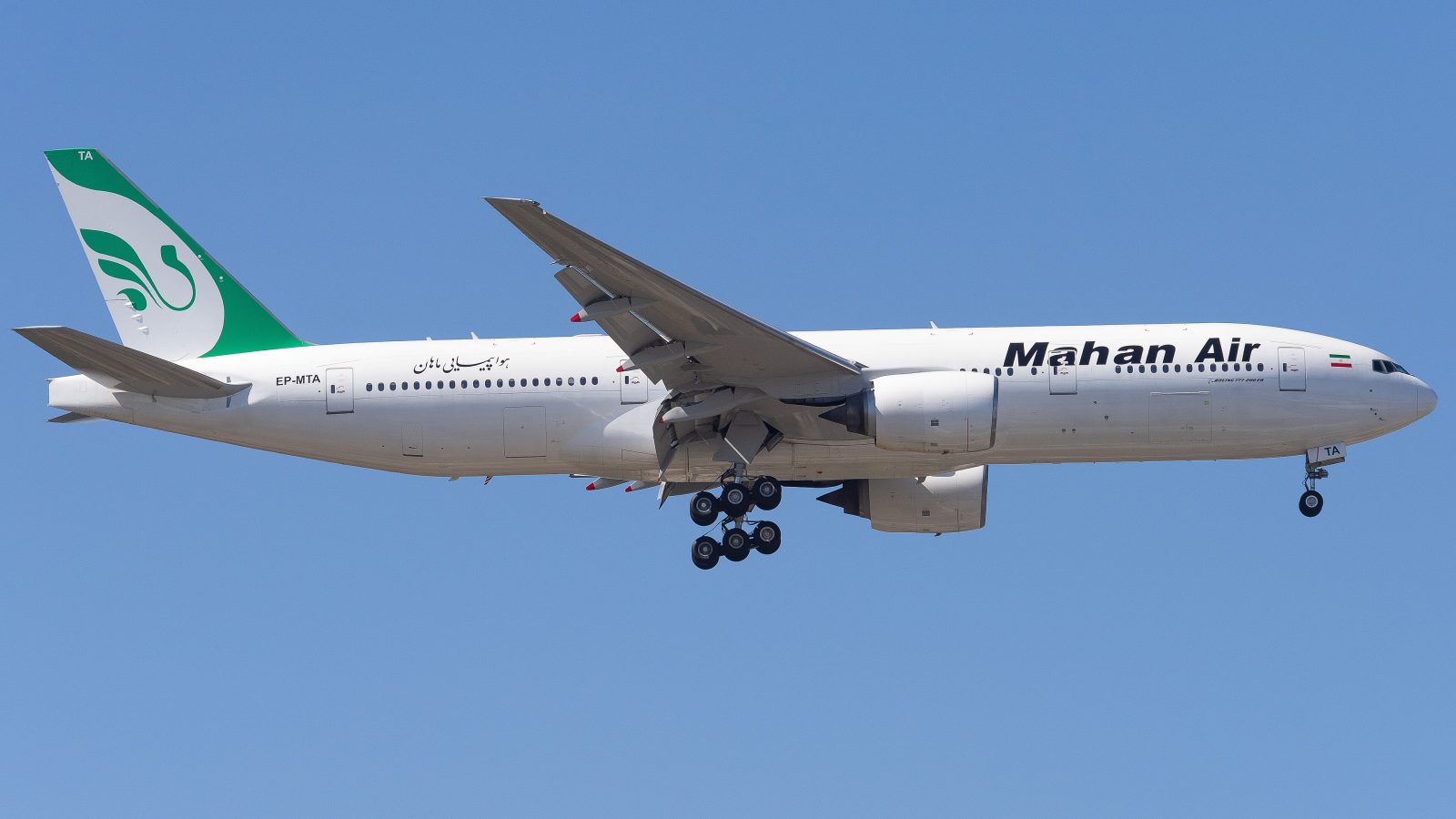
While the world has been watching the conflict in Iran, one of the country’s most heavily sanctioned airlines has been doing something that should not be possible.
Mahan Air has been adding Boeing 777s to its fleet throughout 2026, and more are on the way.
Three Boeing 777-200ERs have already joined the airline this year.
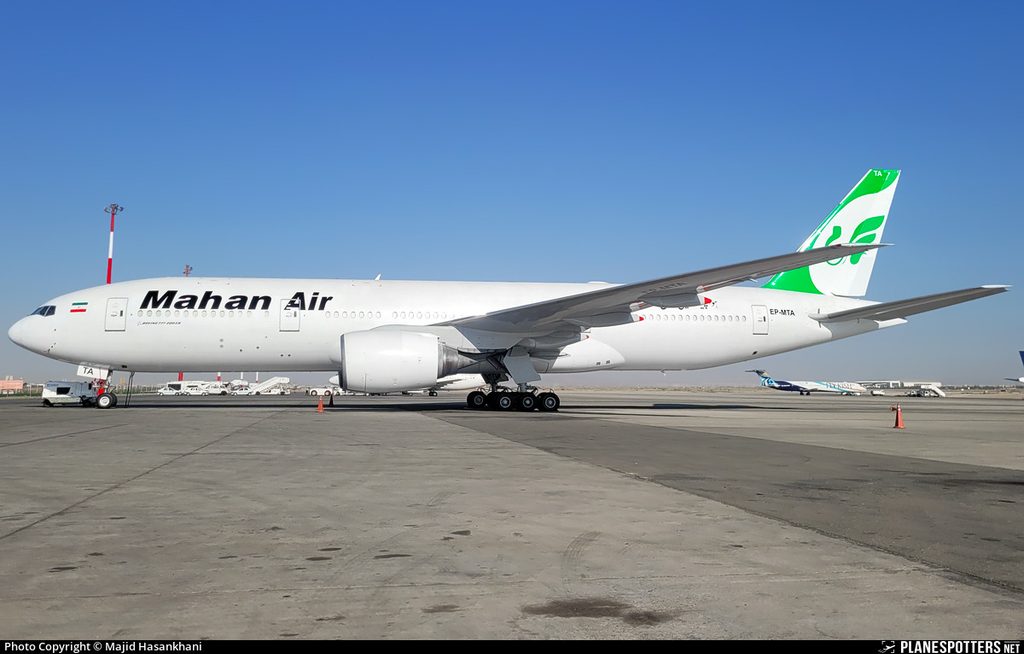
EP-MTE arrived in January, EP-MTB followed in February and EP-MTA joined in July.
Two more airframes are waiting in the wings.
These are American built widebodies, flying for an airline that Washington has sanctioned since 2011, arriving in Iran during a year of war.
It is difficult to reach any conclusion other than this one. From an aerospace perspective, sanctions on Iran are not working.
Three Boeing 777s Delivered to Mahan Air in 2026
All three aircraft are 777-212ERs, a customer code that points straight back to Singapore Airlines.
They were later flown by NokScoot, the Thai low cost carrier, before the pandemic grounded them.
EP-MTE (MSN 33369) was the first to appear.
It began flying for Mahan Air in February and was already operating services to Guangzhou by April.
EP-MTB (MSN 28527) followed. It was registered in February and began test flights on 13 April, according to ch-aviation.
EP-MTA completed the trio in July.
With the two confirmed serial numbers above and a third airframe still awaiting conversion, it is one of the last aircraft from the original batch of five.
The tally should in fact be higher.
A fourth sister, EP-MTC, joined Mahan Air in December 2025. It lasted barely three months.
The aircraft was destroyed at Mashhad during an Israeli airstrike on the airport after its final flight on 29 March 2026.
That hull loss did not slow the programme.
Mahan Air simply carried on bringing the rest of the fleet into service.
How the Aircraft Reached Iran
The route these aircraft took to Iran reads more like a thriller than an aircraft transaction.
After NokScoot stopped flying, Singapore Airlines placed the jets in long term storage at Alice Springs in Australia.
In late 2023, Ion Aviation LLC, a company based in Florida, acquired them and moved them onto the US register.
The aircraft were then ferried to Lanzhou in China, where they sat between late 2023 and March 2024 before being exported to Hong Kong.
In 2025 they surfaced at Jakarta, then moved on to Siem Reap in Cambodia.
The final step came via Madagascar.
A company calling itself UDAAN Aviation registered all five aircraft there on 17 January 2025, presenting itself as an airline start up.
The jets took the Malagasy registrations 5R-RIS, 5R-ISA, 5R-HER, 5R-IJA and 5R-RIJ.
On 15 July 2025, they landed in Iran at Chabahar, Zahedan and Mashhad.
Madagascar’s regulator later said the ferry flights relied on registration certificates that had been fraudulently altered.
The whole operation took more than eighteen months and crossed four continents. At no stage did anyone stop it.
The Next Wave: EP-MTD and a Former Saudia 777
The next aircraft due is EP-MTD.
It is still carrying the Malagasy registration 5R-RIS (MSN 32334) and has been sitting in Iran since July 2025.
It is the final aircraft from the UDAAN batch awaiting conversion, and its arrival would complete the set.
The second aircraft is more significant, because it comes from an entirely different source.
It is a Boeing 777-200ER currently listed under Sky Phoenix, a Turkish company, and it is one of several retired Saudia 777s that have been moving towards Iran this year.
That pipeline began in the United Arab Emirates.
ECT Aviation Support, based in Sharjah, held former Saudia aircraft in storage before they were placed on temporary Gambian C5 registrations.
One, C5-ECI (formerly HZ-AKI), departed Muscat on 27 June 2026 and lost its transponder signal en route to Iran.
Others were photographed parked in Iran in early July.
On 8 September, the US Treasury confirmed that three Boeing 777s destined for Mahan Air had been routed through the UAE and Oman during the summer.
It named ECT Aviation Support, Sky Phoenix and Aerobravo Airplane Management and Operation as the intermediaries.
This matters.
The UDAAN case was not an isolated scheme.
Iran now has at least two separate supply chains for widebody aircraft, running through different countries and different front companies.
Why Sanctions on Iran Aviation Are Not Working
The first problem is timing.
Every major enforcement action this year has come after the aircraft were already on the ground in Iran.
On 22 April, the US Office of Foreign Assets Control designated EP-MTB and EP-MTE themselves.
By then, both aircraft had been in Iran for nine months and one was already carrying passengers to China.
On 8 September, Treasury sanctioned 27 Iranian airlines alongside the intermediaries behind the Saudia transfers. Again, the aircraft had already arrived.
Sanctioning a jet that is parked in Tehran is largely symbolic.
It changes nothing about whether that jet can fly domestic routes or visit friendly countries.
The second problem is supply.
The 777-200ER is being retired in large numbers around the world.
That creates a steady stream of mature, affordable widebodies moving through a secondary market where the buyer is often a broker, not an airline.
Each resale puts another layer between the original owner and the final destination.
The third problem is registration. Madagascar and The Gambia both appear in this story because weakly supervised registries give an aircraft a legitimate looking identity for just long enough to make a ferry flight.
Switch off the transponder near the border, and that identity disappears.
The final problem is jurisdiction. US sanctions are unilateral.
China, Cambodia, Indonesia, Oman, Turkey and the UAE all played a part in these transfers, and none of them is legally bound to enforce Washington’s rules.
Treasury Secretary Scott Bessent warned that anyone supporting Iranian airlines is “at risk of being cut off from the global financial system”, but that threat only works when the target cares about access to American finance.
Could Mahan Air and Other Iranian Carriers Grow?
In terms of fleet capability, the answer is yes.
Mahan Air’s widebody fleet has long relied on ageing Airbus A340s, alongside even older A300s and A310s.
Five 777-200ERs give the airline a far more capable long haul aircraft for routes to China and other friendly markets.
The airline has already shown it can put them into service quickly.
Other Iranian carriers are watching.
The networks that supplied Mahan Air are now proven, and there is little to stop Iran Air or smaller operators such as Qeshm Air using the same brokers, registries and ferry routes.
The 27 airlines designated in September suggest Washington believes exactly that.
However, more aircraft do not automatically mean more flying. There are real limits on how far Iran can grow its aviation sector.
Maintenance is the biggest.
Without support from Boeing or the engine manufacturers, every heavy check and every engine shop visit depends on parts sourced through the same grey channels.
That is expensive, slow and carries safety risks that will only grow as these airframes age further.
Access to foreign airports is shrinking too.
On 24 September, the UAE’s General Civil Aviation Authority suspended all Iranian airline operations until further notice, citing the US sanctions.
Treasury has also targeted cargo handlers serving Mahan Air in Turkey, Malaysia and Kazakhstan.
Every foreign fuel supplier, ground handler and airport that decides the risk is not worth it removes a destination from the map.
Then there is the conflict itself.
Iranian airspace was effectively shut for almost two months after the US and Israeli strikes that began on 28 February, and EP-MTC shows that aircraft on the ground in Iran are not safe.
The most likely outcome is that Iran’s airlines grow their fleets modestly while their international networks narrow.
Mahan Air will have more capable aircraft, but it will fly them to a smaller circle of friendly countries.
What Comes Next for Iran
The Mahan Air 777 story shows that sanctions can make life harder for Iran’s airlines, but they cannot stop determined buyers from obtaining American built aircraft.
As long as retired widebodies are plentiful, flag of convenience registries remain loosely supervised and key transit states look the other way, aircraft will continue to reach Iran.
Enforcement will keep arriving after the fact.
The real pressure point is no longer the aircraft.
It is the airports, suppliers and financial networks that Iranian airlines need to operate them.
If the UAE decision is followed by others, Mahan Air may find itself with a newer fleet and far fewer places to fly it.
Continue to follow The Aviation Hub for more analysis and insight!
Advertise with us Your brand, in front of an aviation audience Home page and in-article placements, sold directly, one advertiser per slot. From £250 a year. See the rates