
Irkutsk Airport Guide: Siberia’s Gateway to Lake Baikal
Irkutsk Airport is the air gateway to Lake Baikal and eastern Siberia. Read its century of history, sloping runway, airlines, routes and future plans.
 By The Aviation Hub
5 min read
Updated October 20, 2026
Few airports sit as close to a city’s heart as the one serving Irkutsk, the historic capital of eastern Siberia. Irkutsk Airport lies within the city limits, with arrivals passing low over apartment blocks and the Angara River. It handled just over four million passengers in 2025, more than double its pandemic low. For travellers it is the gateway to Lake Baikal, and for the region it is a lifeline across vast distances where roads and rail run out.
Irkutsk Airport at a Glance
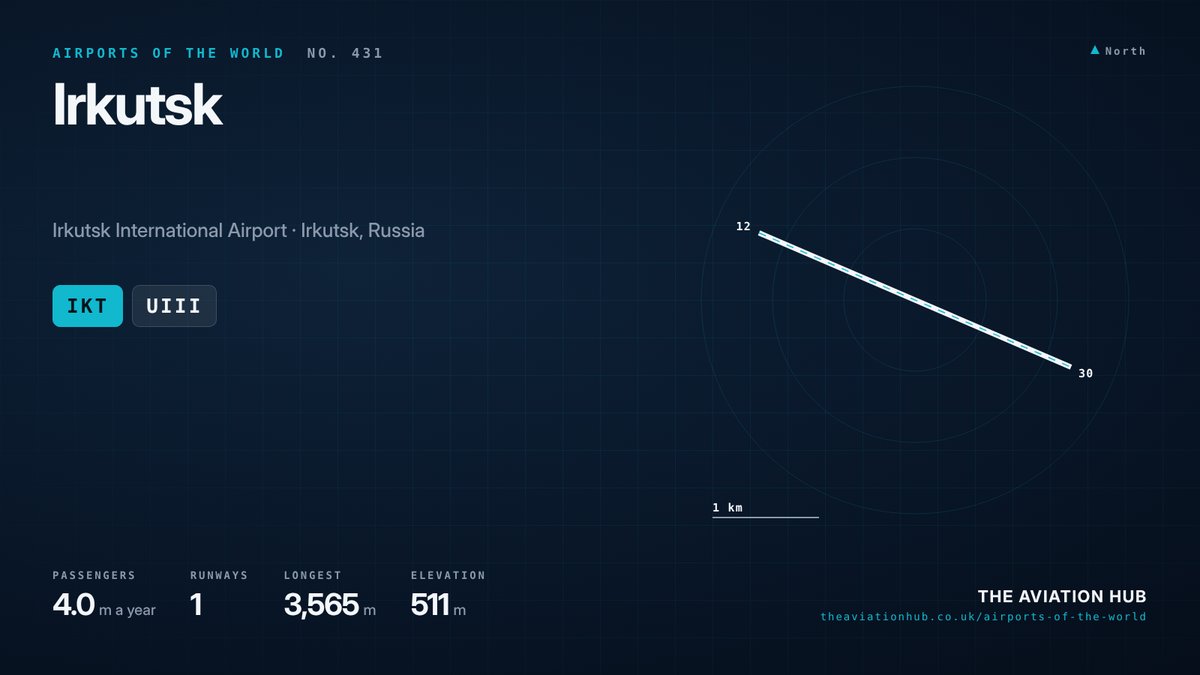
The IATA code is IKT and the ICAO code is UIII. Irkutsk Airport sits around 5 miles (8 km) east of the city centre and roughly 37 miles (60 km) from Lake Baikal. The elevation is 1,675 feet (511 metres). There is one runway, separate domestic and international terminals, a temporary domestic terminal opened in 2025 and a cargo terminal.
Traffic reached about 4.05 million passengers in 2025, up from roughly 3.9 million in 2024. That placed it 22nd among airports in the former Soviet Union. Locally based IrAero flies regional routes, while Aeroflot, Rossiya, S7 and Ural connect the city with western Russia. Details and timetables appear on the airport’s official website.
A Century of Flying in Irkutsk
Aviation arrived on 24 June 1925, when six aircraft flying from Moscow to Beijing landed here. That day marked the start of aviation service in Siberia. Regular domestic links followed through the Soviet era, and the field gained international status in 1954. When it opened, the airfield sat on the edge of town. Irkutsk has since grown around it on almost every side, which explains the cramped terminals and the low approaches over housing.
Irkutsk Airport made history again in 1956. Aeroflot launched Tupolev Tu-104 jet passenger services to the city that year, the first jet airliner passenger route in the Soviet Union. The long, sloping runway grew to handle heavier jets, including the Ilyushin Il-62 and Tupolev Tu-154.
The record also includes tragedy. Vladivostok Air Flight 352, a Tu-154, crashed on approach in 2001, killing all 145 on board. In 2006 S7 Airlines Flight 778, an Airbus A310, overran the runway on landing, and 125 of the 203 people aboard died. Both disasters prompted scrutiny of procedures and infrastructure.
Runways at Irkutsk Airport
A single concrete runway, 12/30, measures 3,565 metres (11,696 feet) long and 45 metres (148 feet) wide. It slopes noticeably, with a height difference of about 30 metres between its two ends. The passenger terminals sit off the western end, unusually close to the threshold.
Arrivals and departures pass over dense housing at the western end, which has fuelled long debate about safety and noise. The runway supports instrument approaches to roughly ICAO Category I standard. Fog is a frequent problem, often linked to the nearby Angara reservoir, and Bratsk, Ulan Ude and other fields act as alternates when visibility drops.
Winter brings temperatures well below minus 30°C. Crews handle deicing and snow clearance as a matter of routine. Long, cold runways and heavy jets make Irkutsk Airport a technically demanding place to operate.
Terminals and Airlines
The domestic terminal handles around 800 passengers an hour, while the international terminal manages about 650 and includes a VIP lounge. Both buildings are dated and cramped, so a temporary domestic terminal opened in June 2025 to cope with growth. The cargo terminal covers 2.2 hectares and processes up to 150 tonnes a day.
Angara Airlines long flew Antonov An-24 turboprops to northern towns, but it lost its operating certificate in November 2025 after a fatal crash. IrAero operates regional jets and turboprops across Siberia and beyond. Aeroflot, Rossiya, S7 and Ural link the city with Moscow and St Petersburg, using a mix of Airbus A320 family and Boeing 737-800 aircraft. Western sanctions since 2022 have complicated maintenance and spare parts for these fleets.
One local quirk stands out. The airport publishes its own free bimonthly newspaper, Irkutsk Sky, covering news from the field and the airlines that serve it.
Routes and Destinations
Daily domestic flights connect Irkutsk with Moscow, St Petersburg, Novosibirsk, Krasnoyarsk, Yekaterinburg, Vladivostok, Yakutsk and Sochi. Moscow is the core trunk route, at about 2,600 miles (4,200 km). Regional flights reach Bratsk, Ust Kut, Bodaybo, Kirensk and other northern towns, many of them hard to reach by road.
International services have shifted towards Asia. China, Mongolia and Central Asian countries feature, alongside seasonal holiday flights to Thailand and Vietnam. Summer brings a surge of Lake Baikal tourism, and winter brings visitors for the frozen lake’s ice scenery. Cargo flows through the cargo terminal, much of it supplying remote northern communities.
Getting to and from Irkutsk Airport
The city location makes access easy. Taxis and app based rides reach the centre in around 15 to 25 minutes. City buses, trolleybuses and minibus taxis stop near the terminals and are the cheapest sensible option for light travellers.
Irkutsk railway station, on the Trans Siberian line, lies across the Angara River, around 30 minutes away by car. Buses to Angarsk run a few times a day. Two paid car parks offer about 180 spaces near the international terminal and 80 near the domestic terminal. Minibuses and tours run to Listvyanka on Lake Baikal, roughly an hour away.
Spotting and Photography
Irkutsk Airport has an unusual spotting tradition. Its first official spotting session took place in 2009, and organised events have continued since. They offer the safest way to photograph aircraft here, since Russia treats airport photography seriously.
Because the runway runs roughly west to east, positions on the southern side keep the sun behind the camera for most of the day. Clear, frozen winter days bring crisp light. The Irkut aircraft factory operates its own airfield on the northwestern edge of the city, building military jets and the MC-21 airliner.
Outside organised events, stay well clear of fences and restricted areas. Expect police questions if you photograph infrastructure, and follow instructions immediately.
What Comes Next
The current site is boxed in by the city, and its terminals were designed for far fewer passengers. In March 2025, federal aviation authorities, Rostec and the regional government agreed on Klyuchevaya as the site for a new airport, with a reported capacity of about 10 million passengers a year. Timing remains uncertain.
Until a new airport opens, Irkutsk Airport will rely on temporary additions and incremental upgrades. Compare its growth with other Siberian fields on our Airports of the World map. The verdict: Irkutsk Airport is a historic but cramped city centre field, and its long term future lies at a new site outside town.
Continue to follow The Aviation Hub for more analysis and insight.
Advertise with us Your brand, in front of an aviation audience Home page and in-article placements, sold directly, one advertiser per slot. From £250 a year. See the rates

