
Islamabad Airport Guide: Pakistan’s New Capital Gateway
Islamabad Airport opened in 2018 and is now Pakistan's busiest by passengers. Twin runways, the terminal, PIA and Gulf routes, and access.
 By The Aviation Hub
5 min read
Updated October 20, 2026
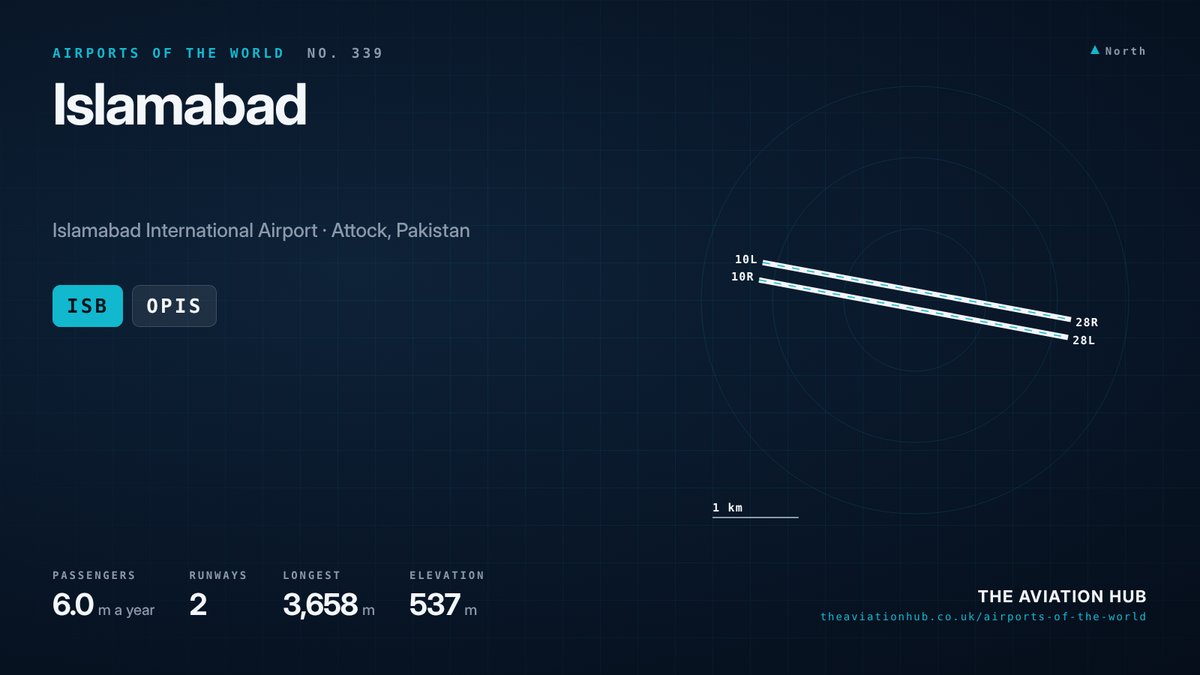
Islamabad Airport, officially Islamabad International Airport, is the gateway to Pakistan’s capital and, since the 2024 to 2025 financial year, the country’s busiest airport by passengers. It opened in May 2018 at Fateh Jang in Attock District, about 16 miles (25 km) southwest of Islamabad and roughly the same distance from Rawalpindi. Two long parallel runways and a large modern terminal replaced the cramped Benazir Bhutto International Airport. Around 6.8 million passengers used it in the latest year.
Islamabad Airport at a Glance
The airport uses the IATA code ISB and the ICAO code OPIS. It sits 537 m (1,761 ft) above sea level on the Potohar Plateau. Two parallel runways and a single terminal building serve the site. The state owns and runs it through Pakistan’s civil aviation authorities, although plans to hand management to a private operator have been in progress since 2022.
Islamabad Airport handled about 6.8 million passengers between July 2024 and June 2025, up 10.2 per cent, overtaking Karachi’s Jinnah International. Aircraft movements reached 36,023 and cargo around 70,500 tonnes. PIA has moved its main international hub here from Karachi. SereneAir is based on site, but it grounded its fleet after its licence was suspended in October 2025. Flight and terminal information is on the airport’s official website.
How Islamabad’s Airport Came to Be
For decades the capital relied on the old airport at Chaklala in Rawalpindi, later named Benazir Bhutto International Airport. It shared a site with an air force base, was hemmed in by the city and could not grow. Passenger numbers there rose about 14 per cent a year, far faster than the national rate of 4 per cent, and a new airport became unavoidable.
Construction at Fateh Jang was meant to take five years but took about 12, and costs ended up roughly three times the original estimate. PIA ran a test flight on 7 April 2018, and Prime Minister Shahid Khaqan Abbasi inaugurated the airport on 1 May 2018. Commercial operations moved across in early May, and the old site returned to purely military use.
On 8 July 2018 an Emirates Airbus A380 made a one off visit, the first A380 landing in Pakistan. The terminal’s double airbridges were designed with the type in mind. Traffic dipped during the pandemic but has since grown steadily, helped by PIA’s decision to concentrate international flying here.
Runways at Islamabad Airport
Two parallel runways serve Islamabad Airport. Runway 10L/28R is 3,658 m (12,001 ft) long and 45 m wide, and runway 10R/28L matches it at 3,658 m (12,001 ft) but is 60 m wide. Both are asphalt and long enough for any airliner in service, including the A380 and fully loaded Boeing 777s bound for Europe.
The runways run east to west across the plateau, with the Margalla Hills visible to the northeast on clear days. Crosswinds can be significant. On 16 April 2023 a Qatar Airways Airbus A350-900 suffered a tailstrike in a crosswind landing on runway 28L, went around and landed safely about 15 minutes later. Around 2,833 acres are being acquired for a third runway.
Terminals and Airlines
The terminal at Islamabad Airport covers 180,000 square metres and was designed for 9 million passengers and 80,000 tonnes of cargo a year. It has 15 gates, some served by buses to remote stands, and 42 immigration counters. The modular design allows expansion towards 25 million passengers. Duty free shops and a food court serve departing passengers.
PIA is the main airline, flying Boeing 777s and Airbus A320s to the Gulf, Saudi Arabia and Europe. Airblue, AirSial and Fly Jinnah cover domestic routes and services to the Gulf and Saudi Arabia. Emirates, Etihad, Qatar Airways, Saudia and Turkish Airlines provide the biggest foreign presence, and Chinese carriers link the capital with China.
Routes and Destinations
The Gulf and Saudi Arabia dominate the network at Islamabad Airport. Dubai, Abu Dhabi, Sharjah, Doha, Bahrain, Kuwait and Muscat carry heavy traffic from the large Pakistani workforce in the region. Riyadh, Jeddah, Dammam and Medina add work and pilgrimage flows, with Umrah and Hajj travel peaking at set times of year.
The UK is the main long haul market, driven by the large British Pakistani community. Routes to London and Manchester have changed often, with Virgin Atlantic leaving on 9 July 2023 and PIA’s UK flights interrupted by a safety ban that lasted from 2020 to 2025. Domestic flights reach Karachi, Quetta and the mountain airports of Gilgit and Skardu. Air China’s Beijing service stops in Karachi but cannot carry local passengers between the two Pakistani cities.
Getting to and from Islamabad Airport
The Metrobus is the cheapest sensible option. A dedicated airport route opened on 18 April 2022, linking the terminal with the Rawalpindi and Islamabad Metrobus network at Peshawar Morr. From there, connections reach the Blue Area, Saddar in Rawalpindi and much of the twin cities. The airport line runs about 25.6 km (16 miles) to Peshawar Morr.
By road, the Srinagar Highway leads into Islamabad and the Grand Trunk Road reaches Rawalpindi, with links to the M1 and M2 motorways. Taxis and ride hailing apps such as inDrive take around 30 to 45 minutes to central Islamabad. Agree fares in advance with street taxis. Parking sits directly in front of the terminal.
Spotting and Photography
Pakistan treats airports as sensitive security sites, and Islamabad Airport is no exception. Photography from outside the perimeter is likely to attract attention from security forces, and military aircraft use the surrounding airspace. The safest views come from inside the terminal and from window seats on arrival.
The plateau setting gives wide horizons, and the Margalla Hills form a backdrop to the northeast on clear winter days. Autumn, after the monsoon, brings the clearest light of the year. Carry identification, never photograph security installations and stop immediately if asked.
What Comes Next
Management is the big question. In December 2022 the government announced plans to outsource the airport to an international operator under a public private partnership. A 15 year lease award in October 2024 drew allegations of favouritism after one bidder was reportedly excluded, and the process has moved slowly. A planned handover to the UAE stalled in early 2026, and the Asian Development Bank now advises on a fresh outsourcing process. A third runway is planned on newly acquired land.
Islamabad Airport has room to grow, with terminal capacity of 9 million a year and a modular design aimed at 25 million. With PIA’s hub now here and Gulf demand strong, it looks set to consolidate its position as Pakistan’s leading passenger airport. Compare it with other South Asian gateways on the Airports of the World map.
Continue to follow The Aviation Hub for more analysis and insight.
Advertise with us Your brand, in front of an aviation audience Home page and in-article placements, sold directly, one advertiser per slot. From £250 a year. See the rates

