
Istanbul Airport rises from cleared forest and former coal pits on the Black Sea coast, around 22 miles (35 km) northwest of the city’s historic core. It opened in 2019 to replace the landlocked Ataturk Airport and has become the hub from which Turkish Airlines flies to more countries than any other carrier. Around 84.5 million passengers passed through in 2025, placing it second in Europe behind Heathrow and eighth in the world. The scale of what was built in under five years is hard to overstate.
Istanbul Airport at a Glance
The IATA code is IST, inherited from Ataturk, and the ICAO code is LTFM. The terminal lies about 22 miles (35 km) from Taksim Square in the Arnavutkoy district on the European side of the city. Elevation is 325 feet (99 m), on a plateau that catches strong northerly winds and winter fog from the Black Sea.
Six runways and a single enormous terminal, with concourses lettered A to G, make up the current airport. Traffic in 2025 was roughly 84.5 million passengers, of whom about 66.6 million were international, plus around 2.1 million tonnes of cargo. Turkish Airlines and Turkish Cargo are based here. The state owns the site through the General Directorate of State Airports Authority and leases it for 25 years to the operator IGA, a consortium of Turkish construction groups. Terminal maps and transfer guides are on the airport’s official website.
How Istanbul’s New Airport Came to Be
Ataturk Airport, in Yesilkoy on the Sea of Marmara, was surrounded by the city on three sides and the sea on the fourth. By the early 2010s Turkish Airlines was growing faster than any European flag carrier and had nowhere to put its aircraft. The government chose a forested site near the Black Sea coast, awarded a 25 year lease in 2013 to the Cengiz, Kolin, Limak, Mapa and Kalyon consortium, and broke ground on 7 June 2014 despite a court order suspending the work.
Construction began in earnest in May 2015 at an estimated cost of 22 billion euros. The environmental report counted more than 650,000 trees to be felled and nearly two million to be moved. Worker deaths became a scandal, with the official toll reaching 55 by October 2019 and far higher figures alleged by the press. Protests at the site were broken up in September 2018.
The opening ceremony took place on 29 October 2018, Republic Day, but the full move from Ataturk slipped four times before it finally happened over a single weekend on 6 April 2019. The name, Istanbul Airport, was only confirmed at the ceremony. Turkish Cargo completed its move in February 2022.
Runways at Istanbul Airport
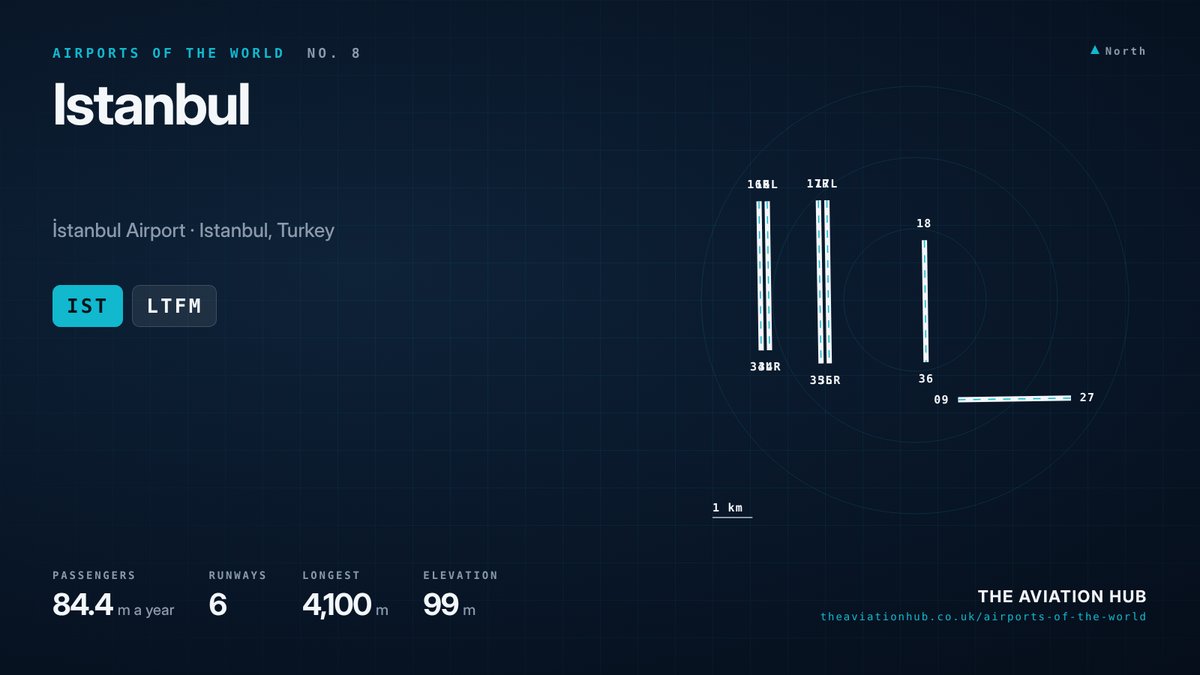
Istanbul Airport has six runways, most aligned roughly north to south to suit the prevailing wind. The two longest, 17L/35R and 17R/35L, each measure 4,100 metres (13,451 feet) of asphalt and flank the terminal on the western side. The second pair, 16L/34R and 16R/34L, are each 3,750 metres (12,303 feet) long and lie further west, with the widest of the group at 60 metres.
Runway 18/36 is 3,060 metres (10,039 feet) long and lies east of the terminal as the third independent runway, with plans to extend it to 3,750 metres. The outlier is 09/27, an east west concrete runway of 2,819 metres (9,250 feet) that gives a crosswind option when gales sweep in off the Black Sea. Three runways routinely operate independently, which the airport introduced in 2020 to lift movement capacity, and the layout was designed so that further parallel strips can be added without touching the terminal. The tulip shaped control tower stands at the centre of it all.
Terminals and Airlines
One terminal handles everything, a 1.4 million square metre building with a central processor and five piers. Concourses A, B, D and F handle international flights, while G is domestic only, and C and E connect directly to the main building. Turkish Airlines dominates every corner, with its wide body Airbus A350-900, Boeing 787-9 and 777-300ER fleets parked along the international piers and its A321neo and 737-800 fleets on the domestic side.
Star Alliance partners such as Lufthansa and Singapore Airlines share the Turkish piers. Other carriers, including Emirates, Qatar Airways, British Airways, Air France and the Chinese airlines, use the international concourses too. The Turkish Airlines lounge at the centre of the terminal is among the largest anywhere. Walking distances are long, so allow time: a transfer from the end of pier A to pier F can take 20 minutes or more.
Routes and Destinations
The Turkish Airlines network from Istanbul Airport reaches well over 300 destinations in more than 120 countries. The dense domestic trunk routes to Ankara, Izmir, Antalya and Trabzon run almost hourly, with Antalya swelling in summer. Across the border, the airport is the natural gateway to the Caucasus, Central Asia, the Middle East and Africa, where Turkish Airlines serves more points than any other foreign carrier.
Europe provides the volume, with London, Frankfurt, Paris, Amsterdam and Berlin all served many times daily. Long haul highlights include New York, Los Angeles, Toronto, Sao Paulo, Tokyo, Singapore and Sydney via Kuala Lumpur, with the Los Angeles flight covering almost 7,000 miles (11,000 km). Cargo matters enormously: Turkish Cargo’s purpose built SmartIST terminal is among the largest in Europe and handles the bulk of the airport’s two million tonnes.
Getting to and from Istanbul Airport
The M11 metro opened in January 2023 and is the cheapest sensible way into town. Trains run from the terminal to Gayrettepe in around 35 minutes, where you change to the M2 line for Taksim and the Golden Horn. A fare costs a few dozen lira (well under £1). An extension to Halkali on the western suburban rail line opened in June 2026, giving a connection to Marmaray trains across the Bosphorus.
Havaist airport coaches serve Taksim, Sultanahmet, Kadikoy and other districts, typically taking 60 to 90 minutes for around 200 lira (£4 to £5). City buses from IETT also run to the airport. Taxis wait outside arrivals around the clock and cost roughly 1,500 lira (£30 to £35) to the centre, with the journey taking about an hour via the O-7 Northern Marmara Motorway. A 12,000 space car park sits in front of the terminal, with cheaper long stay lots further out.
Spotting and Photography
Enthusiasts have found Istanbul Airport harder work than Ataturk, where the seafront gave superb views. The best legal vantage point is the official spotter area on a hilltop west of the field, open on selected Saturdays to visitors who apply for a permit through the airport website. Inside the terminal, the ends of Concourses B and D have single pane windows facing the stands. Departures on the 35s climb out towards the sea, and the village of Yenikoy to the north sits under the approaches to 16R and 17L.
Light is good in the morning on the eastern side and in the evening from the west. The reward is one of the most varied fleets in Europe, with Turkish Airlines alone operating the A350, 787, 777, A330 and the full Airbus and Boeing narrow body ranges, plus visiting Gulf wide bodies and a constant flow of freighters. Turkish authorities are wary of cameras near airport fences, and gendarmerie patrols are common. Photograph from hotels, public roads and the terminal only, keep away from perimeter fences, and put the camera down if asked.
Expansion Plans
The master plan runs to four phases. Phase one delivered the terminal and two pairs of parallel runways for 90 million passengers. Phase two adds a third independent runway and a fourth remote strip, and phase three brings a second passenger terminal for 60 million a year. Phase four envisages satellite terminals and another runway, with eight runways, 16 taxiways and capacity for 150 million passengers targeted by 2027 and an eventual ceiling of 200 million.
Timelines in Istanbul tend to slip, and a mainline rail link to Halkali and across the Yavuz Sultan Selim Bridge has been delayed repeatedly. The direction of travel is not in doubt. With Turkish Airlines still adding aircraft and Europe’s other big hubs full, Istanbul Airport is set to overtake Heathrow within a few years. See where it fits on our Airports of the World map.
Continue to follow The Aviation Hub for more analysis and insight.
Advertise with us Your brand, in front of an aviation audience Home page and in-article placements, sold directly, one advertiser per slot. From £250 a year. See the rates

