
Izmir Airport Guide: Gateway to Turkey’s Aegean Coast
Izmir Airport handled 12.7 million passengers in 2025. Learn about its history, twin runways, terminals, routes, IZBAN rail link and spotting tips.
 By The Aviation Hub
6 min read
Updated October 20, 2026
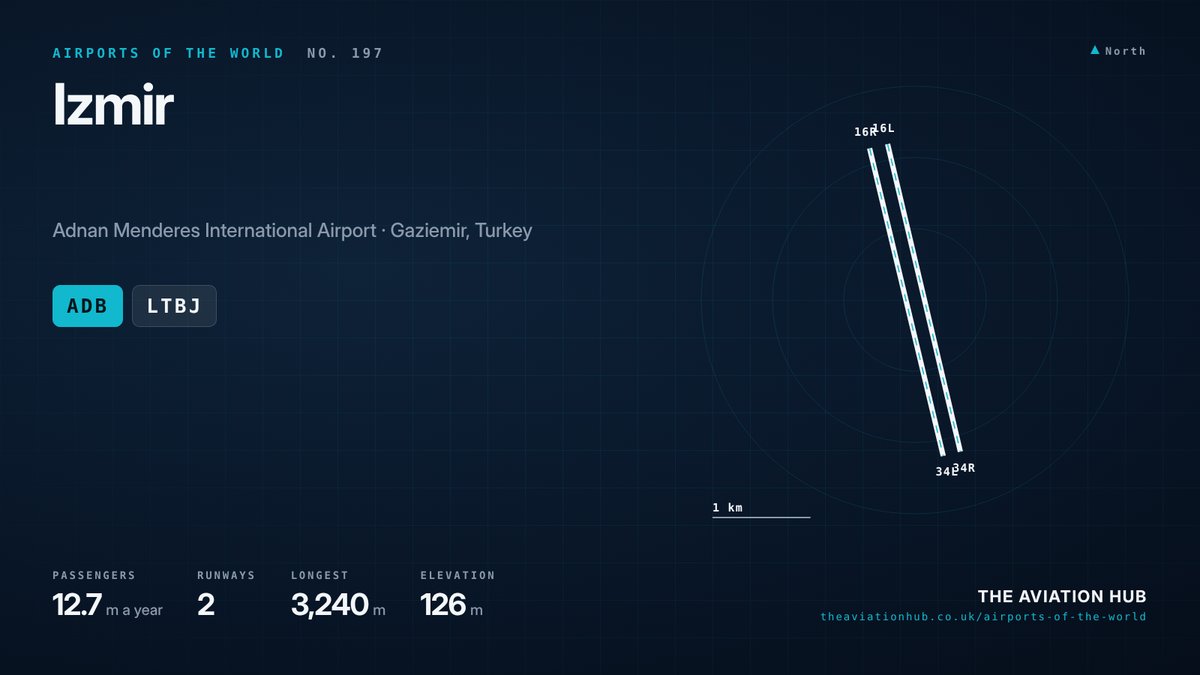
Izmir Airport, officially Izmir Adnan Menderes Airport, is the main air gateway to Turkey’s Aegean coast. It serves one of the country’s largest cities along with resorts such as Cesme, Kusadasi and the ruins of Ephesus. In 2025 it handled about 12.7 million passengers, a mix of domestic travellers, German Turkish families and summer holidaymakers. Two terminals, two runways and a direct rail link make it one of the better connected airports in the country.
Izmir Airport at a Glance
The IATA code is ADB and the ICAO code is LTBJ. The airport lies in the Gaziemir district, about 11 miles (18 km) from central Izmir along the D.550 highway. Elevation is 126 metres (412 feet). There are two parallel runways, though only one is used at a time, and separate international and domestic terminals.
Izmir Airport recorded 12,665,660 passengers in 2025, of whom about 7.6 million flew domestically. Aircraft movements totalled 84,848. That ranks it fifth among Turkish airports overall and fourth for domestic traffic. Pegasus Airlines, SunExpress and AJet all keep bases here alongside Turkish Airlines. TAV Airports operates the terminals under concession from the state airports authority. Flight information is on the airport’s official website.
A Short History of Adnan Menderes
For years Izmir’s airliners used Cigli, a military air base on the northern side of the bay. Sharing with the Turkish Air Force limited growth, and a dedicated civil airport was developed at Gaziemir, south of the city. Cigli reverted to purely military use, which it keeps today.
The airport is named after Adnan Menderes, the Aegean born politician who served as Turkish prime minister through the 1950s. He was overthrown in the 1960 coup and executed in 1961, and he was later rehabilitated. Naming the region’s main airport after him reflects his standing in western Turkey.
Growth in tourism and domestic travel soon outran the original buildings. A new international terminal, designed by Yakup Hazan Architecture, opened in September 2006. A new domestic terminal followed around March 2014. Traffic peaked at 13.4 million passengers in 2018 before the pandemic, and the airport passed its 2019 total again in 2025.
Runways at Izmir Airport
Izmir Airport has two parallel runways of equal length. Runway 16L/34R is 3,240 metres (10,630 feet) long and 45 metres wide with an asphalt surface, and it is the primary runway. Runway 16R/34L is also 3,240 metres (10,630 feet) long and 45 metres wide, built in concrete.
The two cannot be used at the same time. They sit too close together, and 16R/34L lacked a dedicated taxiway, so it mainly serves as a parallel taxiway and a backup runway. In practice the airport operates as a single runway field. That limits hourly capacity during summer peaks, when holiday flights from across Europe arrive in waves.
The runways run roughly north to south through the valley. Northerly winds, including the summer imbat sea breeze, mean runway 34R is in use much of the time, with arrivals coming in from the south. Departures then climb out towards the city and the bay. Southerly winds in winter reverse the pattern.
Terminals and Airlines
The international terminal opened in 2006 and handles all flights outside Turkey. The domestic terminal, opened in 2014, sits beside it and carries the heavy flow of Istanbul and Ankara shuttles. Both are run by TAV, which also manages the duty free, lounges and catering. A new apron of 280,000 square metres, finished in March 2020, raised remote stands from 35 to 61.
Pegasus Airlines is a major operator at Izmir Airport, flying Airbus A320neo and A321neo jets on domestic and European routes. SunExpress, the Turkish Airlines and Lufthansa joint venture, uses Boeing 737-800 and 737 MAX 8 aircraft, much of its network aimed at Germany. AJet, the Turkish Airlines low cost brand, and Turkish Airlines itself complete the main domestic line up. European carriers and summer charters add seasonal capacity.
Routes and Destinations
Istanbul is the busiest route by a wide margin, with flights to both Istanbul Airport and Sabiha Gokcen. Ankara, Antalya, Trabzon, Diyarbakir, Erzurum, Van and Adana are among the other domestic links, connecting Izmir with the east of the country. Domestic travel makes up around 60 per cent of passengers.
Germany is the backbone of the international network, reflecting the large Turkish community there. Frankfurt, Munich, Dusseldorf, Cologne, Stuttgart, Berlin and Hamburg all see regular flights, with the Netherlands, Belgium, Austria and Switzerland close behind. Summer brings extra flights from Britain and Scandinavia for the Aegean resorts. The airport also has links to Tehran, Thessaloniki and other neighbouring markets.
Getting to and from Izmir Airport
Rail is the easiest way into the city from Izmir Airport. IZBAN commuter trains stop at the airport station every 10 minutes at peak times and every 20 minutes off peak, reaching central Izmir in around 25 to 30 minutes. About 14 intercity trains a day each way also call, running north to Basmane and south towards Tire, Odemis, Soke, Aydin and Nazilli.
ESHOT city buses on routes 200, 202, 204 and 206 link the airport with different parts of Izmir. Both trains and buses use the Izmirim card, which makes public transport the cheapest sensible option. Havas airport coaches run about every 20 minutes from the city and take 35 to 60 minutes. Taxis wait outside both terminals, and car hire desks serve travellers heading to the coast. Parking is available beside each terminal.
Spotting and Photography
The north to south layout gives spotters options at both ends. Higher ground and side roads around Gaziemir look across the airfield, and the southern approach to runway 34R crosses open land where arrivals pass low. The terminals also give views over the aprons through their large windows.
Summer weekends bring the most variety, with Pegasus, SunExpress and AJet jets joined by holiday charters from across Europe. Morning light favours the eastern side of the field, while afternoon sun suits the west. Turkey takes security around airports and military sites seriously, so stay on public land and never photograph Cigli or other military areas. Respect local rules at all times.
What Comes Next
The main constraint at Izmir Airport is the runway system. Because the two runways cannot work independently, capacity is lower than the layout suggests, and peak summer hours are already busy. Further taxiway and apron work would help, and a fully independent runway would transform the airport.
The terminals have room to grow, and TAV has invested steadily in stands and de icing facilities. ACI Europe named the airport among the best in its size category in 2020. Izmir Airport is heading for steady growth as tourism on the Aegean coast keeps expanding. Explore other Turkish airports on the Airports of the World map.
Continue to follow The Aviation Hub for more analysis and insight.
Advertise with us Your brand, in front of an aviation audience Home page and in-article placements, sold directly, one advertiser per slot. From £250 a year. See the rates

