
Jacksonville Airport Guide: North Florida’s Main Gateway
Jacksonville Airport serves northeast Florida with two runways and a growing terminal. Codes, airlines, routes, transport, spotting and expansion explained.
 By The Aviation Hub
7 min read
Updated October 20, 2026
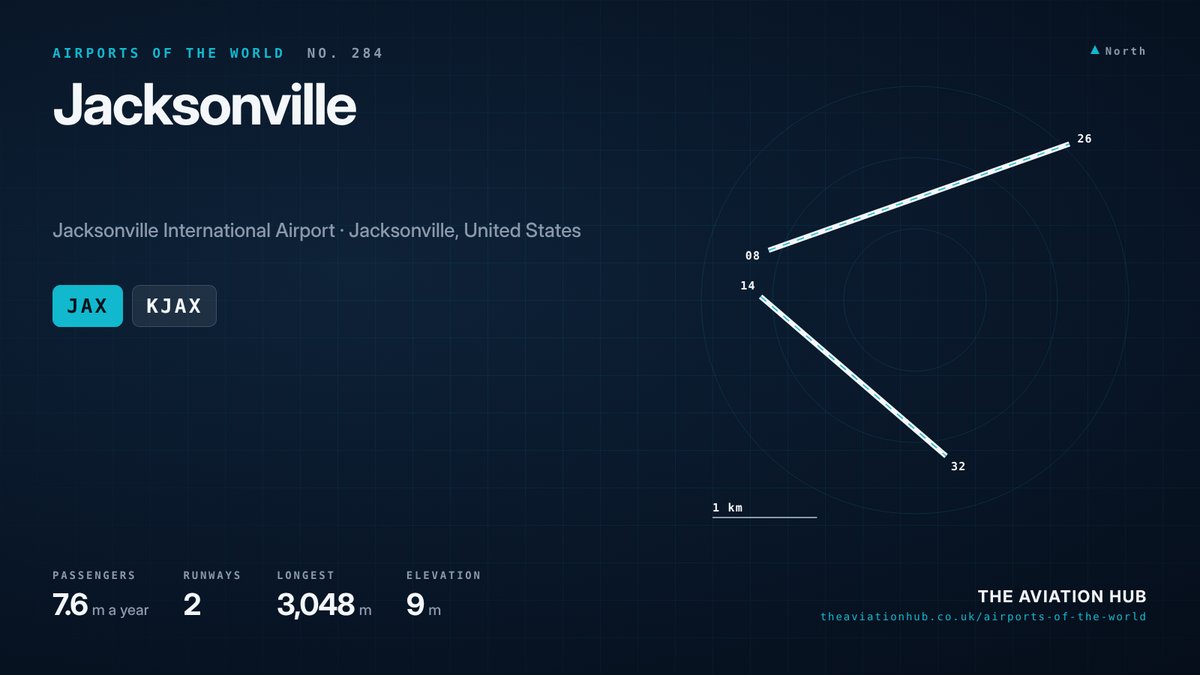
Jacksonville International Airport is the main commercial airport for northeast Florida and southern Georgia, serving a metropolitan area of around 1.7 million people. Jacksonville Airport handles more than seven and a half million passengers a year, a figure that has climbed steadily as the city has grown and as airlines have added capacity to Florida. It sits around 13 miles (21 km) north of downtown beside Interstate 95. The field shares its runways with a fighter wing of the Florida Air National Guard, which adds military traffic to a busy civil schedule.
Jacksonville Airport at a Glance
The IATA code is JAX and the ICAO code is KJAX. The airport lies on flat, wooded ground north of the city, about 13 miles (21 km) from the downtown riverfront, at an elevation of 9 metres (30 ft). Two concrete runways cross in a V shape, and a single terminal with two operating concourses handles all passenger flights. A third concourse is under construction.
Traffic in the 2024 to 2025 fiscal year was roughly 7.6 million passengers, just below the record set a year earlier. American Airlines carries about a quarter of them, followed by Delta, Southwest, United and JetBlue. No airline bases a hub here, but all of the large United States carriers serve their hubs from it several times a day. The Jacksonville Aviation Authority owns and runs the field along with three general aviation airports around the city. Parking rates and flight status are published on the airport’s official website.
How Jacksonville’s Airport Came to Be
Jacksonville’s first commercial airport was Imeson Field, which opened in the 1920s on the north side of the city and served the airlines through the piston era. By the early 1960s the jets had arrived and Imeson could not keep up. The surrounding terrain and development made it impossible to extend the runways to the length that Boeing 707s and Douglas DC-8s needed, so the city looked for a new site.
Construction began in 1965 on open land further north, partly chosen for its proximity to the naval air stations that were and remain a large part of the local economy. The new airport was dedicated on 1 September 1968 and inherited the JAX code from Imeson, which closed to airline traffic and later became an industrial park. The terminal was rebuilt in stages from 2004, with Concourses A and C replaced in the second phase. Concourse B was demolished in 2009 as traffic fell during the recession, and its replacement is only now taking shape.
Runways at Jacksonville Airport
Jacksonville Airport has two concrete runways. The main one, 08/26, is 3,048 metres (10,000 ft) long and 46 metres wide and takes the bulk of airline traffic. The secondary runway, 14/32, is 2,347 metres (7,701 ft) long and the same width. The two meet at their western ends to form a V, so simultaneous operations are limited and controllers normally run one as the primary with the other used for crosswinds or to separate military and general aviation flights.
The length of 08/26 is more than enough for any narrow body and for the occasional wide body charter. The 125th Fighter Wing of the Florida Air National Guard operates from its own base on the airport, having flown F-16s for decades before receiving its first Lockheed Martin F-35A in March 2025. A master plan adopted in 2020 proposes a third runway of around 2,440 metres (8,000 ft) parallel to 08/26 on the southwest side, which would require moving a local road. One of the stranger entries in the airport’s record is a 1988 incident in which two wild pigs ran across the runway and severed the landing gear of an F-16. The pilot ejected safely.
Terminals and Airlines
The terminal at Jacksonville Airport is arranged on three levels. Baggage reclaim is at ground level, ticketing on the floor above and a mezzanine holds the shops, restaurants and the single security checkpoint. Beyond security the building splits into Concourse A and Concourse C, each with ten gates. Concourse B, which filled the gap between them, was removed in 2009 and is being rebuilt with six gates from the outset and space for up to ten more.
American Airlines, Delta and United share the concourses with Southwest, JetBlue, Frontier, Allegiant, Breeze, Avelo and Sun Country, while Air Canada flies in for the summer season. The alliance picture follows the big three: oneworld through American, SkyTeam through Delta and Star Alliance through United and Air Canada. Delta runs a Sky Club in Concourse A and a shared lounge sits behind the airside food court, while three galleries before security show art and local aviation history. FedEx and UPS run cargo flights to their hubs at Memphis and Louisville.
Routes and Destinations
Atlanta is the busiest route from Jacksonville Airport by a wide margin, carrying around 650,000 passengers a year on Delta and Frontier. Charlotte and Dallas Fort Worth, the two big American Airlines hubs, come next, followed by New York JFK and Chicago O’Hare. Miami, Philadelphia, Denver, Boston, Houston, Washington and Baltimore all see daily service. Nearly all of the traffic is domestic, and the network is built around feeding hubs rather than serving leisure destinations.
The longest routes stretch to the West Coast, with Breeze Airways flying seasonally to Los Angeles, about 2,150 miles (3,460 km) away, and San Diego. International flying is limited to a seasonal Air Canada service to Toronto, which returned in May 2026 with Airbus A330s. Demand peaks in spring, when the Players Championship and the beaches draw visitors, and the Florida Georgia college football game has traditionally added an autumn peak. Cargo is steady rather than large.
Getting to and from Jacksonville Airport
Road is the only practical way into Jacksonville Airport for most people. The airport sits beside Interstate 95 and the Airport Road exit, which puts downtown about 20 minutes away in normal traffic and the beaches around 35 to 45 minutes. Taxis and ride hailing services pick up from the ground transportation area outside baggage reclaim, with a fare to downtown of roughly USD 35 to 45 (about £28 to £36). Every major car rental company has a desk in the terminal, and the rental lot is a short walk away.
Public transport is limited but exists. Jacksonville Transportation Authority Route 1 links the terminal to downtown, where it connects with the Skyway monorail and the Greyhound coach station. It is cheap, at a couple of dollars, but slow. There is no rail to the airport. Parking is extensive, with an hourly garage, daily garage, surface economy lots and shuttle served long term parking. A fire in May 2025 damaged part of the daily garage and repairs were still under way afterwards, so check availability before arriving.
Spotting and Photography
Jacksonville Airport is a relaxed place to watch aircraft. The approach to runway 26 crosses Interstate 95 and the surrounding roads, and the area around the airport entrance offers views of arrivals on final with a long lens. The terminal windows on the upper level look out across the apron and are the easiest option in the heat of a Florida summer.
The wind decides whether runway 08 or 26 is in use, so check it and plan around the light. The military traffic is the main draw for many visitors. F-35As and visiting fighters fly from the Air National Guard base, and photographing them is legal from public roads but attracts attention. Stay off the perimeter, do not stop on the interstate shoulder and move on if the airport police ask you to.
What Comes Next
The new Concourse B is the big project of the moment. Ground was broken in May 2024 and the building is due to open in late January 2027, with American Airlines the first to move in. It adds six gates immediately and room for up to ten more as airlines expand. The master plan also looks further out to the parallel runway. Rebuilding the fire damaged garage, with added sprinklers and possibly an extra floor, is a more urgent task.
Jacksonville Airport has room to grow in every direction, a rare thing for a Florida airport, and a city that keeps attracting people and employers. The missing pieces are year round international service and a West Coast network that works year round, and both are likely to come as the metro area passes two million residents. Compare it with the other Florida fields on the Airports of the World map.
Continue to follow The Aviation Hub for more analysis and insight.
Advertise with us Your brand, in front of an aviation audience Home page and in-article placements, sold directly, one advertiser per slot. From £250 a year. See the rates

