
Jakarta Soekarno Hatta Airport Guide: Indonesia’s Busy Gateway
Jakarta Soekarno Hatta Airport in depth: three runways, three terminals, Garuda and Lion Air, the airport railway and the Skytrain that links it together.
 By The Aviation Hub
7 min read
Updated October 20, 2026
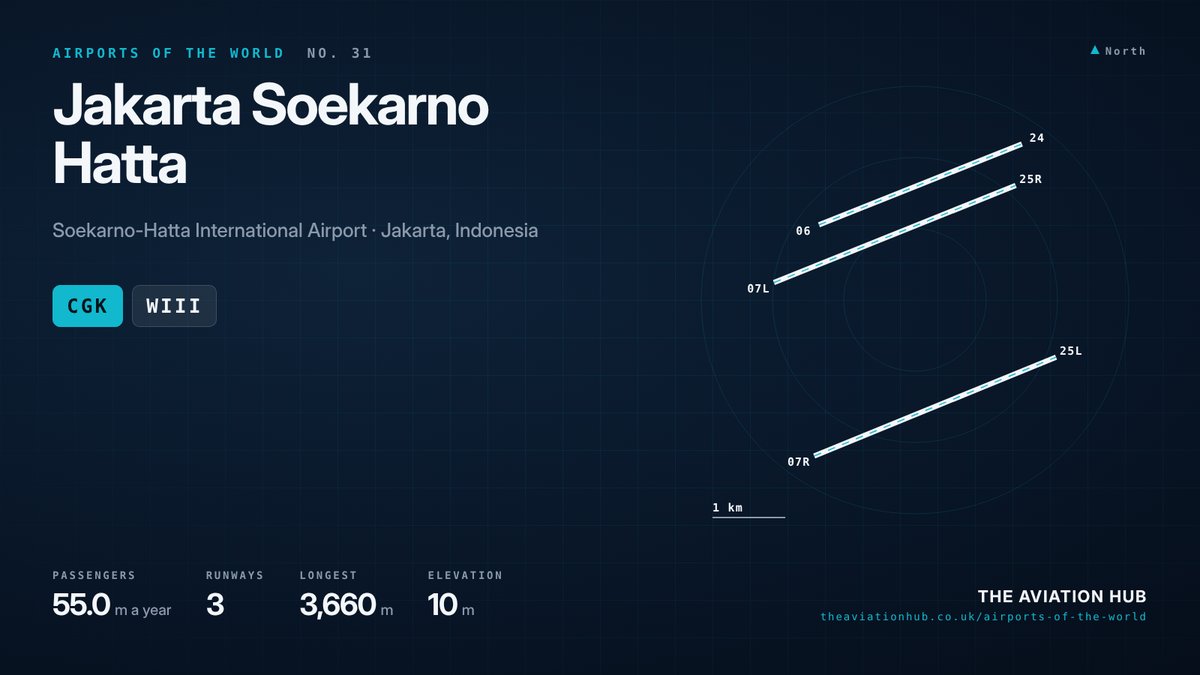
Jakarta Soekarno Hatta Airport is the main gateway to Indonesia and one of the busiest airports in Southeast Asia. It sprawls across reclaimed paddy fields at Cengkareng, west of the capital, and handles the enormous domestic traffic of a nation of 280 million people spread across thousands of islands. Around 55 million passengers passed through in the latest year. Garuda Indonesia, Lion Air, Batik Air and Citilink all call it home, and the Jakarta to Singapore route is one of the busiest international links in the world.
Jakarta Soekarno Hatta Airport at a Glance
The IATA code is CGK, taken from Cengkareng, the district where the airport was built, and the ICAO code is WIII. The field lies in Tangerang in Banten province, about 12 miles (20 km) northwest of central Jakarta, at an elevation of 10 m (34 ft). InJourney Airports, the state owned operator formerly known as Angkasa Pura II, runs the site. The name honours Sukarno and Mohammad Hatta, who proclaimed Indonesian independence in 1945.
Three terminals and three runways serve the airport. Garuda Indonesia, Citilink, Lion Air, Batik Air, Super Air Jet, Indonesia AirAsia, Pelita Air and TransNusa use Jakarta Soekarno Hatta Airport as a hub, and Garuda’s head office sits on the airport grounds. Flight information, the Skytrain timetable and transport options are on the airport’s official website.
How Jakarta’s Airport Came to Be
Kemayoran, Jakarta’s original airport close to the city centre, was overcrowded by the early 1970s and had no room to grow. A Canadian consortium ran a feasibility study and the government chose a site at North Tangerang. Construction ran in two phases from 1975 to 1985, and the airport opened for domestic flights on 1 May 1985. Kemayoran closed the same year, although international flights stayed at Halim until Terminal 2 opened in 1991.
The French architect Paul Andreu, who designed Paris Charles de Gaulle, laid out Terminals 1 and 2 as clusters of low pavilions set in tropical gardens with Javanese roofs. The design won the Aga Khan Award for Architecture in 1995. It was elegant but inefficient, and the pavilions were soon overwhelmed as the low cost boom of the 2000s brought Lion Air and a flood of new domestic passengers.
Terminal 3 opened in 2009 and its vast Ultimate building followed on 9 August 2016, giving Garuda a modern home. A third runway entered service on 15 August 2019, and the airport railway opened at the end of 2017.
Runways at Jakarta Soekarno Hatta Airport
Jakarta Soekarno Hatta Airport has three runways. Runway 07R/25L is the southern parallel at 3,660 m (12,008 ft) and 60 m wide. Runway 07L/25R, the northern parallel, is 3,600 m (11,811 ft). The terminals sit between the two, which is efficient for taxiing but means every expansion has to fit inside the box. The direction follows the seasons, with the 25s used mostly in the northern winter and the 07s mostly in the northern summer. The two parallels share arrivals and departures.
The third runway, 06/24, is 3,000 m (9,843 ft) long and lies to the north of 07L/25R. It opened in August 2019 and is used only in the 24 direction, in daylight and good weather. It is too close to the northern parallel for fully independent operations. An east cross taxiway linking the two main runways opened in December 2019 to cut taxi times and queues.
The tropical weather is the main challenge. Afternoon storms in the wet season from November to March bring heavy rain and standing water, and the field has seen several runway excursions in wet conditions, including a Star Air Boeing 737 that landed long and left the runway in 2003. Sriwijaya Air Flight 182, a Boeing 737-500, crashed into the Java Sea six minutes after departure in January 2021, killing all 62 on board.
Terminals and Airlines
Terminal 1 on the south side is the oldest, with three sub terminals, 1A, 1B and 1C, each with seven gates. Lion Air, Indonesia AirAsia and Citilink run their domestic flights from it. Renovated halls at 1B and 1C reopened in 2025. Terminal 2 on the northwest side has sub terminals 2D, 2E and 2F. The 2D and 2E halls became a low cost carrier terminal in 2019 and now serve Batik Air and foreign budget airlines such as Scoot. 2F has handled Hajj and Umrah flights since 2025, along with the international flights of Lion Air and Citilink.
Terminal 3 is the modern face of Jakarta Soekarno Hatta Airport. Garuda Indonesia runs both its domestic and international operations from it, and it hosts the foreign full service carriers, among them Singapore Airlines, Cathay Pacific, Emirates, Qatar Airways, KLM, Turkish Airlines, Japan Airlines, ANA and the Chinese and Gulf airlines. Pelita Air and TransNusa also use Terminal 3. The building has a 120 room capsule hotel, and a Sheraton sits within the airport complex. A free landside Skytrain links all three terminals and the railway station.
Routes and Destinations
Domestic traffic is the backbone. Jakarta to Surabaya ranked among the ten busiest routes in the world in 2016, and Denpasar, Makassar, Medan, Balikpapan, Palembang and Yogyakarta carry huge volumes. Lion Air, Batik Air, Citilink and Garuda compete on every trunk route with Boeing 737 and Airbus A320 family aircraft, often with departures every few minutes at peak times.
Singapore is the dominant international route and one of the busiest in the world, with Singapore Airlines alone running more than 70 flights a week alongside Garuda, Scoot, Batik and Indonesia AirAsia. Kuala Lumpur is close behind. Garuda flies the Boeing 777-300ER and Airbus A330-900 to Amsterdam, Tokyo, Seoul, Sydney and Jeddah, and the Gulf carriers connect Jakarta to Europe through Dubai, Doha and Abu Dhabi. The Hajj season brings a surge of charter flights to Saudi Arabia. A dedicated freight terminal handles the cargo.
Getting to and from Jakarta Soekarno Hatta Airport
The Soekarno Hatta Airport Commuter Line runs from the station between Terminals 1 and 2 to Manggarai in central Jakarta in about 45 minutes, with around 35 trains a day at 30 minute intervals. The fare is roughly 50,000 to 70,000 rupiah (about £2.50 to £3.50), which makes it the cheapest reliable option when traffic is bad. The free Skytrain connects the station to all three terminals every five minutes.
DAMRI airport coaches and the Jabodetabek Airport Connexion buses run from each terminal to points across Greater Jakarta, including Gambir station and Blok M, from early morning to late evening. The airport toll road links to the Jakarta inner ring road, and the drive to the centre takes 45 minutes in good conditions and well over an hour at rush hour. Blue Bird taxis and ride hailing cars cost about 200,000 to 300,000 rupiah (around £10 to £15) to the city. Multi storey car parks serve each terminal. A planned express rail line to Halim has not yet been built.
Spotting and Photography
Jakarta Soekarno Hatta Airport is not an easy place to spot, but it rewards effort. Airside in Terminal 3, with a valid ticket, the gate areas overlook the apron and the 07L/25R runway through tinted glass. The roads around the perimeter kampungs on the eastern side give views of arrivals on the 25s, and the spotter friendly rooftop of the FM7 Resort hotel faces the 25R approach.
Morning light suits the eastern end, and the late afternoon sun lights departures on the 07s from the terminal side. Haze is a constant problem in the dry season. Security guards and police are sensitive about cameras near the fence, so photograph from inside the terminals or from a hotel room where possible, keep off private land in the villages around the airport and carry your passport.
What Comes Next
The current programme, known as Phase 5, is refurbishing Terminals 1 and 2 to lift total capacity to 61 million passengers a year. The Terminal 3 pier extension of 2018 added eight airbridges, and the east cross taxiway and third runway have eased the worst of the congestion on the ground. A fourth terminal was planned for years but the government scrapped it in November 2024, citing weaker than expected traffic.
Growth now depends on how quickly Indonesia’s airlines rebuild. Garuda has emerged from restructuring with a smaller fleet, Lion Air keeps expanding, and the new government is reviewing the role of Kertajati and Halim. The runways and the Skytrain give Jakarta Soekarno Hatta Airport room to handle 60 million passengers without a new terminal. Jakarta Soekarno Hatta Airport is heading for steady rather than dramatic growth. Compare it with the region’s other hubs on the Airports of the World map.
Continue to follow The Aviation Hub for more analysis and insight.
Advertise with us Your brand, in front of an aviation audience Home page and in-article placements, sold directly, one advertiser per slot. From £250 a year. See the rates

