
Jeddah Airport Guide: Saudia’s Hub and the Gateway to Mecca
Jeddah Airport explained: three long runways, Terminal 1, the famous Hajj tents, Saudia's main hub, the Haramain railway to Mecca and a fourth runway by 2031.
 By The Aviation Hub
6 min read
Updated October 20, 2026
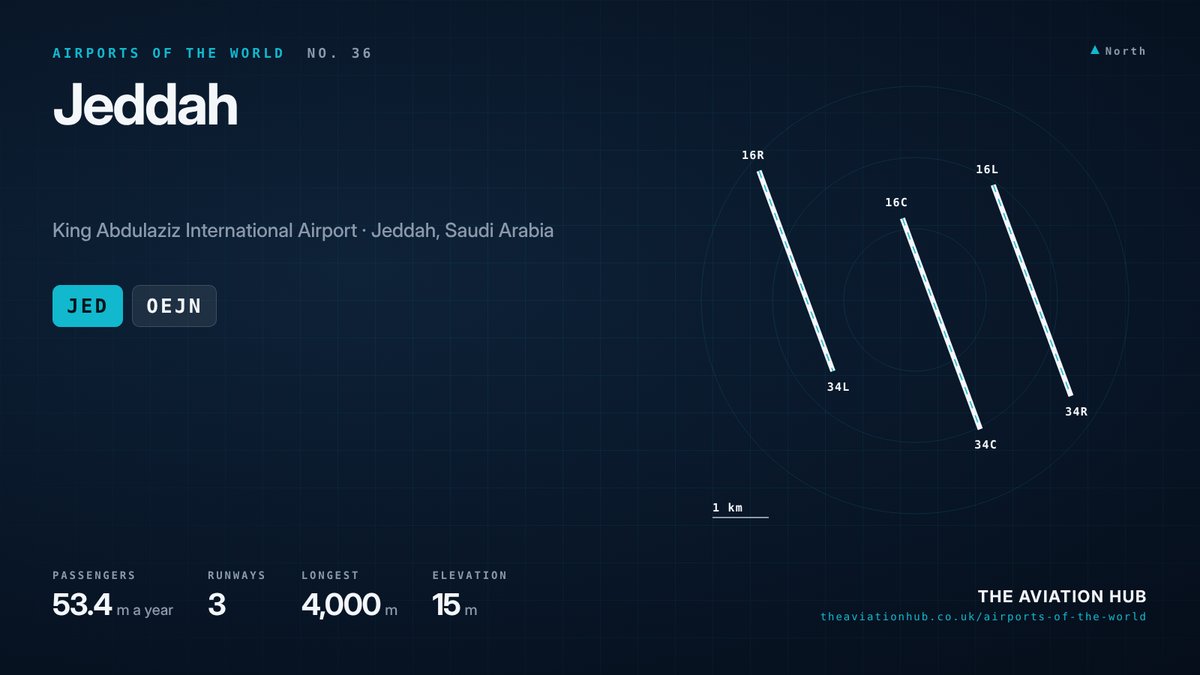
Jeddah Airport, officially King Abdulaziz International, is the main gateway to western Saudi Arabia and to the holy cities of Mecca and Medina. It sits on the Red Sea coast north of the kingdom’s commercial capital and handles more than 50 million passengers a year. Saudia runs its largest hub here, the Hajj Terminal takes in pilgrims from every corner of the Muslim world each year, and a new terminal and fourth runway are on the way. Few airports combine religious, commercial and political significance on this scale.
Jeddah Airport at a Glance
The airport uses the IATA code JED and the ICAO code OEJN. It lies about 12 miles (19 km) north of central Jeddah on a vast 112 square kilometre site at 48 ft (15 m) above sea level. Three parallel runways serve the field, and passengers use Terminal 1, the North Terminal and the seasonal Hajj Terminal. A royal terminal handles state flights.
Jeddah Airport carried around 53.4 million passengers in 2023 with roughly 310,000 aircraft movements, which makes it the busiest airport in Saudi Arabia. Saudia, Flynas and Flyadeal all base aircraft here. The Jeddah Airports Company owns the airport, and since 2022 the Irish state owned DAA International has run it under a five year management contract. Flight information and terminal maps are on the airport’s official website.
How Jeddah’s Airport Came to Be
The old Kandara airport in the middle of the city could not cope with the jet age or with the growing pilgrim traffic of the 1970s. A new airport had been sketched out in 1965 and shelved. The oil boom revived it in 1974, construction ran from 1975 to 1980, and King Khaled inaugurated the field on 12 April 1981. It opened for traffic on 31 May that year and Kandara was demolished. The name honours King Abdulaziz, the founder of the modern Saudi state.
The original South Terminal copied the layout of Washington Dulles, with mobile lounges carrying passengers to the aircraft. The Hajj Terminal, designed by the structural engineer Fazlur Rahman Khan, opened alongside it. Its roof of 210 Teflon coated fibreglass tents in ten modules won the Aga Khan Award for Architecture in 1983 and remains the airport’s signature. The open sided design lets the sea breeze cool as many as 80,000 pilgrims at once.
A development programme approved in 2006 delivered the 136 metre control tower and the enormous Terminal 1. The new terminal opened in stages from 2018 and was formally inaugurated in September 2019. Saudia moved its domestic flights first, then its international network, and Etihad became the first foreign airline to follow in November 2019. The South Terminal closed in 2020 after almost 40 years of service.
Runways at Jeddah Airport
Three parallel runways run roughly north to south, which suits the prevailing winds off the Red Sea. The eastern and central runways, 16L/34R and 16C/34C, are each 4,000 m (13,123 ft) long and 60 m wide. The first is asphalt and the second is concrete. The western runway, 16R/34L, is 3,800 m (12,467 ft) of asphalt. All three can take the Boeing 747-8 and Airbus A380 that still appear during the pilgrimage seasons.
With three parallels, Jeddah Airport can run independent arrivals and departures at the same time, which matters when the Hajj schedule packs hundreds of extra charter movements into a few weeks. The 34 direction is the norm. The field is shared with the Royal Saudi Air Force’s King Abdullah Air Base and its Lockheed C-130 Hercules squadrons, so military traffic mixes with the airliners. A fourth runway is part of the expansion announced in 2023.
Terminals and Airlines
Terminal 1 is the heart of the operation. The building covers roughly 810,000 square metres and was designed for 30 million passengers a year, with 46 contact gates, an automated people mover and a large duty free zone. Saudia runs its domestic and international flights from here alongside its SkyTeam partners, and Flyadeal, the group’s low cost arm, uses the same building, as does Flynas. Etihad, Emirates, Qatar Airways and Turkish Airlines have also moved across.
The North Terminal handles most of the remaining foreign carriers, including the Egyptian, Indian, Pakistani and African airlines that bring pilgrims and workers year round, along with many foreign low cost airlines. The Hajj Terminal opens only for the Hajj and the busiest Umrah weeks, when it processes charter flights from Indonesia, Pakistan, Nigeria, Egypt, Bangladesh and dozens of other countries. Lounges in Terminal 1 are extensive, and Saudia’s Alfursan First lounge is the one worth seeking out.
Routes and Destinations
Riyadh is the busiest route by a distance, with Saudia, Flynas and Flyadeal between them running a shuttle of narrow bodies throughout the day. Dammam, Medina and Abha follow on the domestic side. Internationally, Cairo, Dubai, Istanbul, Karachi, Lahore, Mumbai, Delhi and Jakarta dominate, driven by religious travel and the millions of expatriates working in the kingdom.
Saudia’s long haul network reaches London Heathrow, Paris, New York JFK, Washington, Toronto, Singapore, Jakarta and Manila. The JFK service is among the longest from the airport at about 6,350 miles (10,200 km), beaten by the seasonal flights to Los Angeles. Seasonality is extreme. The Hajj and the holy month of Ramadan bring surges that no other airport experiences, and schedules are reshaped around them each year. Cargo is modest for an airport of this size, though Saudia Cargo runs freighters through its Jeddah base.
Getting to and from Jeddah Airport
The Haramain High Speed Railway station sits beside Terminal 1 on a short branch off the main line. Trains reach Mecca in around 45 minutes and Medina in about two hours, with King Abdullah Economic City and central Jeddah on the way. For pilgrims it has transformed the journey, and it is the cheapest sensible option for anyone heading to the holy cities. Services are frequent but booking ahead is wise around Ramadan.
By road, the Medina Road and the airport expressway take cars and taxis into Jeddah in 25 to 40 minutes depending on traffic. Ride hailing apps are widely used and cost around 50 to 80 riyals (roughly 10 to 17 pounds) to the Corniche. SAPTCO buses and private coaches run to Mecca around the clock. Terminal 1 has a multi storey car park linked to the building by a transport centre, and long stay parking is cheap by European standards.
Spotting and Photography
Photography around Saudi airports is sensitive, and Jeddah Airport has no official viewing area. Inside, Terminal 1’s glass walls and the people mover give good views of the apron and the 34 approaches, and the lounges on the upper level look over the airfield. During the pilgrimage season the Hajj Terminal apron fills with 747s, 777s and A330s from airlines rarely seen elsewhere.
Outside the fence, the roads to the west of the airport offer glimpses of aircraft on finals, and for viewers on that coastal side the afternoon sun from the west lights arrivals on 34L and 34C. The air base and the royal terminal are strictly off limits for cameras. Keep lenses out of sight near the perimeter, do not photograph security staff or military aircraft, and accept that a polite request to stop is not negotiable here.
What Comes Next
The expansion announced in 2023 adds a fourth runway, a new Terminal 2 and an enlargement of Terminal 1, with completion targeted for 2031. The Saudi Vision 2030 programme wants the airport to reach well beyond its current capacity as the country opens up to tourism and bids for a larger share of transfer traffic. Riyadh’s new King Salman International will take some of the limelight, but Jeddah keeps the pilgrim market that no other hub can touch.
Saudia is renewing its fleet with Airbus A321neos and Boeing 787s, and Flyadeal is adding capacity quickly. Jeddah Airport is heading towards 60 million passengers and a four runway layout by 2031. Compare it with Riyadh, Dubai and Doha on the Airports of the World map.
Continue to follow The Aviation Hub for more analysis and insight.
Advertise with us Your brand, in front of an aviation audience Home page and in-article placements, sold directly, one advertiser per slot. From £250 a year. See the rates

