
Jieyang Chaoshan Airport Guide: Three Cities, One Runway
Jieyang Chaoshan Airport serves Shantou, Chaozhou and Jieyang from one runway. Explore its history, terminal, ARJ21 fleet, routes, rail links and growth.
 By The Aviation Hub
5 min read
Updated October 20, 2026
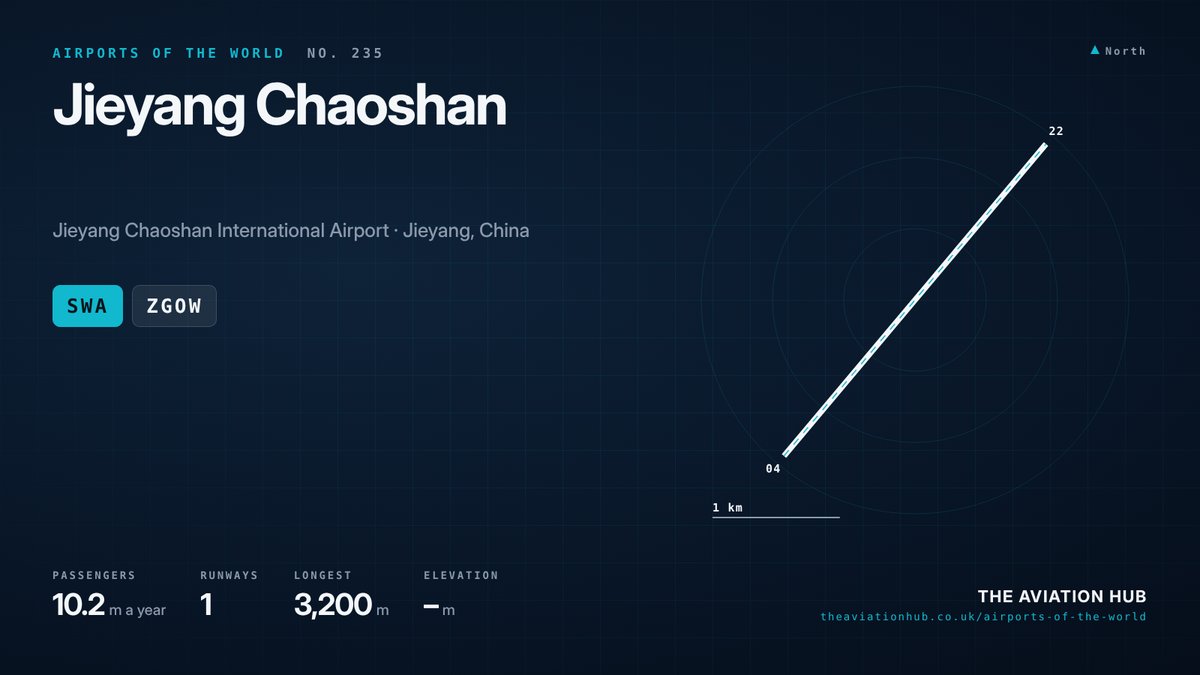
Jieyang Chaoshan International Airport stands in the towns of Paotai and Denggang in eastern Guangdong, China. It serves the three neighbouring cities of Jieyang, Shantou and Chaozhou, a region known as Chaoshan and home to the Teochew people. Jieyang Chaoshan Airport handled about 10.2 million passengers in 2025, an 18 per cent jump on the year before. It is also an unusual stronghold for China’s homegrown regional jet, the Comac ARJ21.
Jieyang Chaoshan Airport at a Glance
The IATA code is SWA and the ICAO code is ZGOW. The SWA code is inherited from Shantou’s old airport. The field lies on the low coastal plain about 8 miles (14 km) east of central Jieyang, roughly 11 miles (17 km) from Chaozhou and 18 miles (29 km) from Shantou. It has one runway and one terminal complex with two wings. In 2025 it recorded about 10.23 million passengers and 81,390 aircraft movements.
China Southern Airlines and China Eastern Airlines both treat Jieyang Chaoshan Airport as a focus city. Around 25 airlines serve the field, including Air China, Spring Airlines, Sichuan Airlines and Shanghai Airlines. Guangdong’s provincial airport group runs it. Flight times and transport information are listed on the airport’s official website.
A Short History of Chaoshan’s Airport
For decades the region relied on Shantou Waisha Airport, a cramped field shared with the military on the edge of Shantou. Planners wanted a single modern airport for all three cities, and they chose a site near the geographic centre of the Chaoshan triangle. Construction began in June 2009.
The project hit trouble just before completion. In November 2011 work was halted because the build had strayed from the approved environmental impact report. A revised report was approved within weeks, and Jieyang Chaoshan Airport opened on 15 December 2011. Waisha closed to commercial flights that same day and remains a military air base.
The airport gained international status in July 2014. Two big upgrades followed. In December 2019 the runway was extended to take wide bodies, and in December 2022 a second terminal wing opened, lifting design capacity from 4.5 million to 14.5 million passengers a year.
Runways at Jieyang Chaoshan Airport
There is one runway, 04/22, with a concrete surface 3,200 metres (10,499 feet) long and 45 metres wide. It was extended from 2,800 metres in 2019 and upgraded to Code 4E, which means it can handle wide body aircraft such as the Boeing 787 and Airbus A330.
The single runway carries every movement at Jieyang Chaoshan Airport, so any closure hurts. On 9 July 2025 a lightning strike damaged the runway surface during a summer storm. The airport closed for emergency repairs, inbound flights diverted, and the runway reopened later that night. Typhoons from July to October bring similar disruption. With more than 81,000 movements in 2025 and a design limit of about 100,000, runway capacity will become a pressing issue within a few years.
Terminals and Airlines
The terminal covers about 113,000 square metres after the 2022 expansion. It has 26 jet bridges, with 22 for domestic flights, two for international and two that can switch between the two. A city check in terminal outside Shantou railway station lets passengers drop bags before travelling to the airport.
China Southern, with its Guangzhou base and Airbus A320neo fleet, and China Eastern, connecting Shanghai and Kunming, carry the largest share of passengers. Spring Airlines adds low cost flights. The most distinctive feature is the Comac ARJ21, also known as the C909. Jieyang Chaoshan Airport is the largest operating base for the type, which accounted for about 34 per cent of all movements between January and August 2025.
Routes and Destinations
Domestic routes dominate at Jieyang Chaoshan Airport. Shanghai, Beijing Capital and Daxing, Chengdu, Kunming, Wuhan and Hangzhou are among the key links, reflecting the region’s trading networks and the large number of Chaoshan entrepreneurs working across China. Shorter routes face strong competition from high speed rail along the Guangdong coast.
International flying draws on the Teochew diaspora, one of the largest overseas Chinese communities in South East Asia. Bangkok, Kuala Lumpur and Singapore are the main foreign destinations. Singapore and Kuala Lumpur, at roughly 1,750 miles (2,800 km), are among the longest routes. Demand peaks around Chinese New Year, when families return to their ancestral villages, and during the summer holidays.
Cargo is growing, with the design allowing for 90,000 tonnes a year, but passengers remain the core business.
Getting to and from Jieyang Chaoshan Airport
Rail is the quickest option. Jieyang Airport railway station sits next to the terminal and links the airport to the regional high speed network, putting Shantou, Chaozhou and Jieyang within easy reach. A further station is planned on the East Guangdong Intercity Railway, with completion expected in 2027.
Airport coaches serve the three cities and are the cheapest sensible choice for travellers heading to districts away from the railway. Journeys typically take 30 minutes to an hour, depending on the city. Taxis and ride hailing cars wait outside arrivals, and expressways connect the airport with the whole Chaoshan area. Car parks sit directly in front of the terminal.
Spotting and Photography
Spotting at Jieyang Chaoshan Airport is quiet and informal. The flat farmland around the field gives open views, and local roads near both runway ends let photographers catch arrivals and departures. The terminal’s large windows also overlook the apron.
The ARJ21 is the main draw for enthusiasts. Few airports anywhere see so many of the type, and the mix of liveries makes for an unusual logbook. China Southern and China Eastern narrow bodies supply the rest of the traffic, with occasional wide bodies on busier routes. Light is good in the dry season from October to March, while summer brings haze, storms and typhoons.
Chinese security staff take an interest in long lenses near airfields. Stay on public roads, avoid fences and anything military, and put the camera away if asked.
What Comes Next
The 2019 and 2022 projects bought time. Traffic of 10.2 million in 2025 is already approaching the 14.5 million design figure, and growth of 18 per cent in a single year suggests the gap will close quickly. The East Guangdong Intercity Railway station will improve access from 2027.
A second runway and further terminal space look inevitable within the decade. Jieyang Chaoshan Airport is heading for a role as eastern Guangdong’s main gateway, and the ARJ21 will remain part of its identity. See where it sits on the Airports of the World map.
Continue to follow The Aviation Hub for more analysis and insight.
Advertise with us Your brand, in front of an aviation audience Home page and in-article placements, sold directly, one advertiser per slot. From £250 a year. See the rates

