
Jinan Airport Guide: Shandong’s Capital City Gateway
Jinan Airport at Yaoqiang serves the capital of Shandong with one long runway and a Shandong Airlines hub. Runways, routes, access and spotting explained.
 By The Aviation Hub
7 min read
Updated October 20, 2026
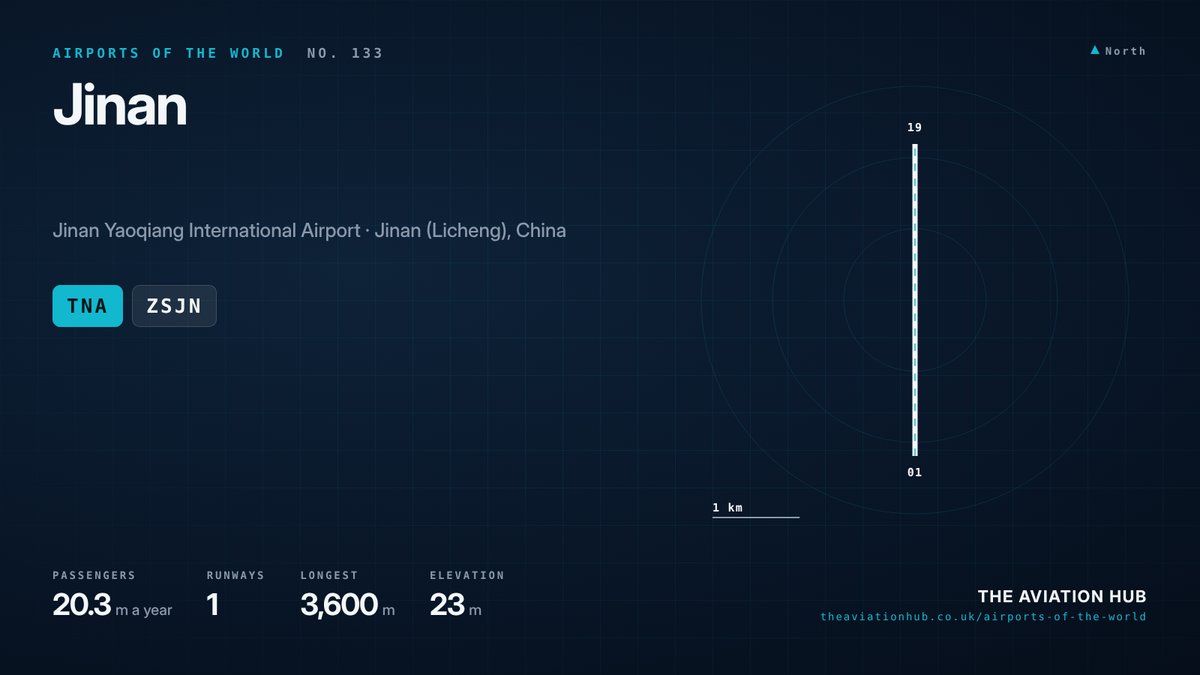
Jinan Yaoqiang International Airport lies about 20 miles (33 km) north east of the centre of Jinan, the capital of Shandong province in eastern China. It is the second busiest airport in the province after Qingdao and sits in the top 25 nationally. Jinan Airport handled a little over 20 million passengers in 2025 on a single runway, which makes it one of the hardest worked pieces of concrete in China. A large terminal with two concourses serves a network dominated by Shandong Airlines and China Eastern, with a modest international spread across east and south east Asia.
Jinan Airport at a Glance
The codes are TNA and ZSJN, the IATA code deriving from Tsinan, the old romanisation of the city’s name. The field sits at 23 m (76 ft) above sea level on the flat plain of the Yellow River, which flows a few miles to the north. It has one runway, 01/19, and one terminal building with a main hall and a South Concourse added in 2015.
Shandong Airport Group, a provincial state owned company, operates Jinan Airport along with Qingdao, Yantai and the other airports of the province. Shandong Airlines, China Eastern and the regional carrier GX Airlines all treat it as a hub or base. Traffic in 2025 reached about 20.3 million passengers, roughly 174,000 tonnes of cargo and 145,000 aircraft movements, which placed it 25th among Chinese airports. Opening times and transport details are on the airport’s official website.
How Jinan’s Airport Came to Be
Jinan was served for decades by Zhangzhuang Airport, a mixed military and civil field close to the city that could not grow. Ground was broken on a replacement at Yaoqiang in November 1990, and the new airport opened on 26 July 1992. It took its name from Yaoqiang, the town in Licheng district where it sits.
The original terminal served for 13 years until a much larger building opened in March 2005, at which point the old one became a cargo facility. Growth through the 2000s was steady rather than spectacular, with Shandong Airlines, headquartered in the city, building up its hub here. The South Concourse opened on 30 December 2015 and lifted the terminal area to about 114,000 square metres.
A North Concourse for international and transfer passengers, with 12 jet bridges, began construction in July 2017. In September 2019 the Civil Aviation Administration of China approved a new master plan that sets a long term target of 80 million passengers a year. That plan, rather than the 1992 airport, now shapes the site.
Runways at Jinan Airport
The single runway, 01/19, is 3,600 m (11,812 ft) long and 45 m wide, surfaced in concrete. It is long enough for any aircraft in service, and Boeing 777s and Airbus A330s use it on the longer routes without restriction. A second parallel taxiway and a larger apron were built from September 2017 to squeeze more movements from the one strip.
The runway runs almost due north and south. Northerly winds in winter put arrivals on 01 from the south over Yaoqiang and the expressway, while the hot summer months tend to favour 19 with approaches from the direction of the Yellow River. Summer thunderstorms and winter fog and haze are the main weather hazards, and the airport has suffered long delays on smoggy days when visibility fell below minima.
Handling 145,000 movements a year on one runway puts Jinan Airport near the practical limit of single runway operation, which is why new runways are the centrepiece of the current expansion. Until they open, peak hour slots are tightly controlled.
Terminals and Airlines
The terminal is a long curved building with the 2005 main hall at its centre and the South Concourse extending the gate line. Check in, security and the domestic departure gates fill most of the floor space, with international and Hong Kong, Macau and Taiwan flights handled in a separate section. Lounges are run by the airport and by Shandong Airlines and China Eastern.
Shandong Airlines is the biggest operator by some distance, flying Boeing 737-800 and 737 MAX 8 aircraft to dozens of domestic cities and to Seoul, Osaka, Bangkok and Singapore. China Eastern comes next with Airbus A320 family jets and A330s, including a service to Sydney. Air China, China Southern, Hainan Airlines, Xiamen Airlines, Spring Airlines, Juneyao and the regional GX Airlines all serve the airport.
Foreign carriers are few. Korean Air and Asiana have flown from Seoul, with Thai and Singapore based airlines appearing seasonally. Condor launched a Frankfurt service in February 2022 that ended in January 2023, and Sichuan Airlines launched a Los Angeles service in December 2016 that no longer runs.
Routes and Destinations
The busiest routes are to the big southern cities. Shanghai, Guangzhou, Shenzhen, Chengdu, Chongqing, Kunming, Xiamen and Hangzhou each see many flights a day. Beijing is close enough for high speed rail to take most of the traffic, so the capital is a thinner route than its size suggests. Harbin, Shenyang, Dalian and Xi’an are also strong.
Internationally the airport serves Seoul, Osaka, Bangkok, Singapore, Kuala Lumpur, Hanoi, Ho Chi Minh City, Hong Kong and Macau, with China Eastern’s flight to Sydney as the longest scheduled route at around 5,400 miles (8,700 km). Cargo is meaningful, with Jinan Airport handling around 174,000 tonnes in 2025, much of it e commerce and the machinery and textiles of Shandong’s industrial belt.
Traffic peaks around Chinese New Year and the October National Day holiday, when domestic flights fill and fares rise sharply. Summer brings the strongest demand for the Korean and Japanese routes.
Getting to and from Jinan Airport
Jinan Metro Line 3 reaches the airport, with the airport station at the end of the line. Connections to the other lines bring the old centre and Jinan West high speed railway station within reach for a fare of a few yuan, the cheapest sensible option.
Airport shuttle buses run to the city centre, Jinan railway station and Jinan West station, and to cities across the province including Tai’an, Zibo and Liaocheng. By road the airport connects to the Jinan ring expressway and to the Beijing to Shanghai and Qingdao to Yinchuan expressways. A taxi to the city centre costs around ¥100 to ¥120 (roughly £11 to £13) and takes 40 to 60 minutes. Large surface and multi storey car parks sit in front of the terminal.
Spotting and Photography
Spotting in China requires care, and Jinan Airport is no exception. The best public views are from inside the terminal, where the gate areas of the South Concourse look onto the apron and the runway beyond. Outside, the roads south of the 01 threshold in Yaoqiang give views of arrivals when the wind is from the north, and the open ground to the north works for 19 arrivals in summer.
Morning light favours the eastern side of the field and afternoons the west. The regular fleet is dominated by Shandong Airlines 737s, but China Eastern A330s and the occasional wide body on busy domestic trunk routes add variety. Freighters from SF Airlines and international operators such as Atlas Air and ASL Airlines add more.
Chinese police take photography near airport fences seriously. Stay on public roads, avoid the perimeter fence, never photograph security installations and carry your passport. If approached, be polite and move on.
Expansion Plans
The second phase expansion, approved under the 2019 master plan, is the biggest project in the airport’s history. It includes two new runways on the western side, which with the existing runway will form a three runway system, a vast new Terminal 2 of about 600,000 square metres and a ground transport centre with a station on the Jinan to Binzhou high speed railway. Completion is targeted for the end of 2026, lifting capacity to about 55 million passengers a year. The long term layout allows for four runways and 80 million passengers a year.
A hotel complex of around 600 rooms was approved in 2018 to support transfer traffic, and the North Concourse adds international gates. The challenge is turning a strong domestic airport into a genuine international one when Qingdao’s new airport at Jiaodong competes for the same long haul routes.
Jinan Airport is heading for a scale far beyond its single runway today, and the next decade will show whether the traffic follows the concrete. Compare it with its neighbours on the Airports of the World map.
Continue to follow The Aviation Hub for more analysis and insight.
Advertise with us Your brand, in front of an aviation audience Home page and in-article placements, sold directly, one advertiser per slot. From £250 a year. See the rates

