
Johor Bahru Airport Guide: Senai and the Singapore Factor
Johor Bahru Airport at Senai carried 3.36 million passengers in 2024. Read about its long runway, AirAsia base, busiest routes and links to the city.
 By The Aviation Hub
5 min read
Updated October 20, 2026
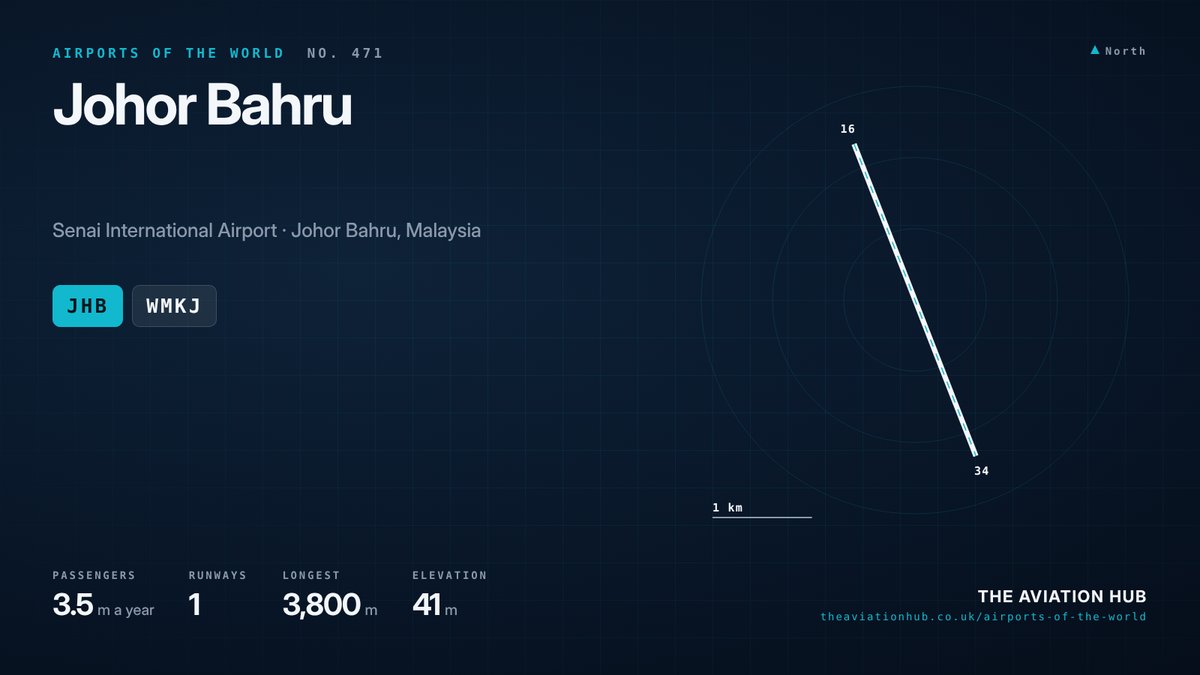
Johor Bahru Airport, officially Senai International Airport, serves Malaysia’s southern state of Johor and a city that sits across a narrow strait from Singapore. It handled about 3.36 million passengers in 2024, most of them on domestic flights to Kuala Lumpur, Penang and Borneo. AirAsia has a base here, and the long runway handles anything from turboprops to wide body freighters. Factories and data centres around the field give it an industrial edge that few regional Malaysian airports share.
Johor Bahru Airport at a Glance
The codes are JHB for IATA and WMKJ for ICAO. The airport lies in Senai, in Kulai District, about 14 miles (22 km) north west of Johor Bahru city centre. Elevation is 41 metres (135 feet). There is one runway and one main passenger terminal, with a separate private aviation terminal beside it.
Traffic reached 3,360,906 passengers in 2024, up 11.7 per cent. Domestic flights accounted for about 2.7 million and international flights for nearly 660,000, the latter up 58 per cent. AirAsia bases aircraft at Johor Bahru Airport, and Malaysia Airlines, Batik Air Malaysia and Firefly also fly here. Senai Airport Terminal Services runs the site, and details are on the airport’s official website.
A Short History of Senai
The airport opened in 1974 as Sultan Ismail International Airport, named after the Sultan of Johor at the time. It later adopted the name of its home town, Senai. Expansion plans were announced as early as 1978, but traffic stayed modest in the shadow of Singapore’s much larger airport.
The 1990s brought ambition. A RM100 million federal upgrade was approved in April 1990, and in 1991 the government backed a Malaysia Airlines plan to route some international passengers through Senai rather than Changi. In April 1992 the airline began weekly flights to Hong Kong. A RM93 million upgrade in 1993 expanded the terminal and runway, added an aerobridge and allowed McDonnell Douglas DC-10 operations.
A further RM84.5 million expansion was finished in April 1998. Low cost flying then transformed the airport in the 2000s, as AirAsia built a domestic network from Johor. Traffic peaked at around 4.25 million passengers in 2019 before the pandemic.
Runways at Johor Bahru Airport
There is a single asphalt runway, 16/34, measuring 3,800 metres (12,467 feet) long and 46 metres wide. That is exceptionally long for a regional airport. It gives the airport the capacity to handle large wide body aircraft such as the Boeing 747 and 777, including freighters.
The runway runs roughly north to south. Winds in southern Malaysia are generally light, with the north east and south west monsoons shifting the favoured direction through the year. Tropical thunderstorms, usually in the afternoon, are the main operational hazard and can bring brief holds or diversions.
Aircraft movements rose almost 40 per cent in 2024 to around 58,800 by the airport’s own count. Even so, the runway has plenty of spare capacity, and growth is not limited by the airfield. Much of that headroom dates from the 1993 upgrade, which extended the runway.
Terminals and Airlines
All scheduled flights use the main terminal. The neighbouring business aviation terminal shares its infrastructure and handles private jets serving Johor’s growing industrial and property sectors. The terminal has been expanding towards a capacity of around five million passengers a year.
AirAsia dominates, flying to Kuala Lumpur, Ipoh, Kuching, Kota Kinabalu, Sibu, Tawau, Langkawi and other domestic points. Its international routes reach Guangzhou, Kunming and Ho Chi Minh City. Indonesia AirAsia flies to Jakarta and Surabaya, and Thai AirAsia to Bangkok Don Mueang. Malaysia Airlines links Johor Bahru Airport with KLIA, while Firefly flies to KLIA and Subang and Batik Air Malaysia serves Subang and Penang. Batik also flies to Bangkok.
Routes and Destinations
Kuala Lumpur is the busiest route by far, with 76 weekly flights in September 2023. Penang followed with 29, then Subang with 26. Kuching and Kota Kinabalu, with 21 and 18 weekly flights, show how important the routes to Malaysian Borneo are.
Internationally, Jakarta and Bangkok Don Mueang led with 18 weekly flights each in 2023, ahead of Ho Chi Minh City and Guangzhou. AirAsia now also flies to Kunming. Some passengers on these flights come from Singapore, crossing the causeway to take advantage of lower fares.
Cargo is unusually significant at Johor Bahru Airport. The field handled around 80,000 tonnes in 2024, up almost a third. The adjacent SAFIZ free industrial zone hosts factories and distribution centres for companies including Mercedes Benz, BMW, Dyson and Celestica.
Getting to and from Johor Bahru Airport
The Causeway Link AA1 airport shuttle runs to JB Sentral, the city’s main transport hub, in around 45 minutes. It is the cheapest sensible option. From JB Sentral, buses and the causeway crossing lead into Singapore, and the new RTS Link rail shuttle to Woodlands is due to start carrying passengers in February 2027.
Taxis and app based ride hailing take around 30 to 40 minutes to central Johor Bahru, depending on traffic. The nearest railway station is at Kulai, a short drive north. By road the airport connects to the North South Expressway, the Senai Desaru Expressway and the Second Link Expressway towards Singapore and the Port of Tanjung Pelepas.
Spotting and Photography
The flat land and industrial estates around Johor Bahru Airport give spotters several options. Roads near the runway ends offer views of aircraft on approach, and the terminal car park provides glimpses of the apron.
AirAsia Airbus A320s and A321neos dominate, with Malaysia Airlines Boeing 737-800s, Firefly ATR 72s and Batik Air Malaysia 737s adding variety. Freighters and business jets bring occasional surprises. Afternoon storms can produce dramatic skies. Stay on public roads, keep away from fences and follow instructions from police or airport security.
What Comes Next
The Johor Singapore Special Economic Zone, agreed by the two governments in 2025, aims to draw investment into the region. Combined with the Sedenak Tech Park data centre cluster next door and the opening of the RTS Link, that should lift both business and leisure demand.
Johor Bahru Airport has runway capacity to spare, so the terminal is the main constraint. If the five million target is reached, it could become a genuine alternative to Changi for Malaysian domestic travel. See how it compares with Singapore and Kuala Lumpur on our Airports of the World map.
Continue to follow The Aviation Hub for more analysis and insight.
Advertise with us Your brand, in front of an aviation audience Home page and in-article placements, sold directly, one advertiser per slot. From £250 a year. See the rates

