
Juan Santamaria Airport Guide: Costa Rica’s Main Gateway
Juan Santamaria Airport is Costa Rica's main gateway near San Jose, with one runway, two terminals and strong US links. Routes, access and spotting tips.
 By The Aviation Hub
6 min read
Updated October 20, 2026
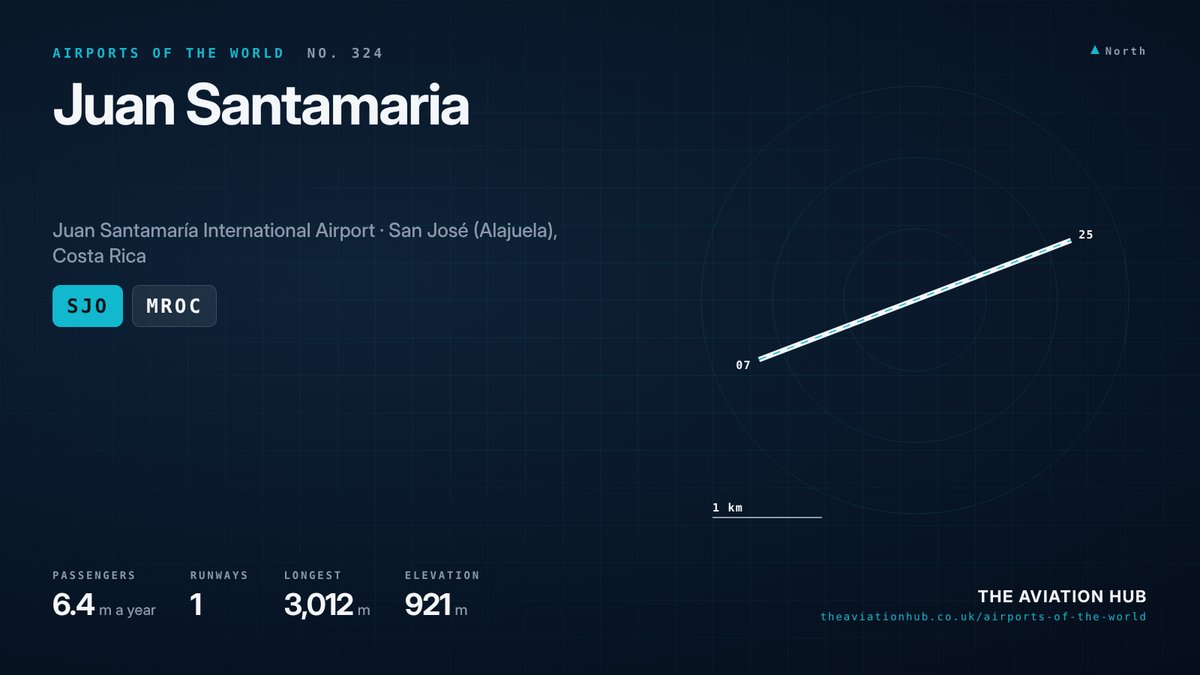
Juan Santamaria Airport is the principal international gateway to Costa Rica and one of the busiest airports in Central America. It sits beside the town of Alajuela, around 12 miles (20 km) northwest of downtown San Jose on the floor of the Central Valley. A single runway at more than 900 m above sea level handles everything from Sansa Cessna Caravans to Iberia Airbus A330s. Close to 7 million passengers used the airport in 2025, most of them tourists arriving from the United States and Canada.
Juan Santamaria Airport at a Glance
The airport uses the IATA code SJO and the ICAO code MROC. It lies at an elevation of 921 m (3,021 ft), high enough to trim aircraft performance on hot afternoons. One asphalt runway, 07/25, serves all traffic. Two terminals operate: the Main Terminal, usually labelled M, for international flights, and the smaller Domestic Terminal, labelled D, next to it.
Passenger traffic reached around 6.7 million in 2025 across roughly 108,000 aircraft movements, a new record after 6.5 million in 2024. Avianca Costa Rica, Sansa Airlines, Volaris Costa Rica and Costa Rica Green Airways all call the airport home, while Copa Airlines treats it as a focus city. Aeris Holding Costa Rica operates the terminal under a government concession. Live arrivals and parking rates are published on the airport’s official website.
How San Jose’s Airport Came to Be
Costa Rica’s first airport sat in the capital itself, on land that is now Parque La Sabana. By the 1950s it was too small and too close to the city, so the government funded a replacement near Alajuela in 1951. The new field opened on 2 May 1958 as Aeropuerto Internacional El Coco, named for the locality where it was built.
The airport was later renamed for Juan Santamaria, the drummer boy from Alajuela who died in 1856 fighting the American adventurer William Walker and became a national hero. LACSA, the former national carrier, grew up here before folding into Avianca. The Aeris concession from 2009 brought a modern terminal, more boarding bridges and the first serious investment in decades. A Concorde visit for the 1999 airshow remains a highlight for older enthusiasts. Juan Santamaria Airport has since ridden the tourism boom that has made Costa Rica a leading ecotourism destination.
Runways at Juan Santamaria Airport
Runway 07/25 measures 3,012 m (9,882 ft) long and 46 m wide with an asphalt surface. The length is generous on paper, but the 921 m elevation and warm afternoons reduce performance, especially for wide bodies heading for Europe. Iberia, Lufthansa, Air France and KLM wide bodies all operate comfortably. There is no second runway and no crosswind option.
Operations favour runway 07 for most of the year, with arrivals from the west over the coffee country beyond Alajuela and departures climbing towards the volcanoes of the Central Valley. Runway 25 comes into use when the wind swings to the west. Juan Santamaria Airport has seen a handful of runway incidents, including a 2022 DHL Boeing 757 freighter that slid off the runway after a hydraulic failure and was written off without injury. Pavement condition has been a recurring political issue and the runway has been resurfaced several times.
Terminals and Airlines
The Main Terminal is a long single building with the international gates arranged along a pier. Avianca is the largest presence, with Avianca Costa Rica and Avianca El Salvador linking San Jose to the group’s hubs in San Salvador and Bogota and to US cities including Miami, New York JFK and Washington Dulles. Copa Airlines flies the Panama City trunk several times a day with Boeing 737s. Volaris Costa Rica adds low cost services to Mexico and Orlando.
United, American, Delta, JetBlue, Southwest, Alaska, Frontier and Breeze give the airport one of the deepest US networks in Latin America for its size, with JetBlue and United offering the most year round destinations. Air Canada, Air Transat and Porter cover Canada. Iberia flies daily to Madrid year round and is the only European airline to do so, while Iberojet, Air France, KLM, Lufthansa and Edelweiss add more European links and British Airways returns seasonally to London Heathrow. The Domestic Terminal belongs to Sansa Airlines and its Cessna Caravans, which hop to Liberia, Tamarindo, Quepos, Tortuguero and the Osa Peninsula.
Routes and Destinations
Panama City and Miami are among the heaviest international routes from Juan Santamaria Airport, each carrying a mix of business, connecting and leisure traffic. Houston, Newark, Fort Lauderdale, Los Angeles and Dallas Fort Worth all see daily or better service. Madrid is the busiest transatlantic route thanks to Iberia’s daily A330. Mexico City and San Salvador anchor the regional network.
The longest scheduled sector is Edelweiss’s Zurich flight at roughly 5,800 miles (9,400 km), with Lufthansa’s Frankfurt service close behind. Traffic peaks hard in the North American winter from December to April, when Costa Rica’s dry season draws sun seekers, and dips in the wet months of September and October. Cargo is a significant business. The airport handled around 109,000 tonnes in 2025, with fresh pineapples, flowers and medical devices flowing out and DHL, FedEx and UPS freighters a regular sight.
Getting to and from Juan Santamaria Airport
There is no rail service. A commuter line between Alajuela and San Jose passes close to the airport but does not stop there. Public buses are the cheapest option by far. Services to downtown San Jose run around the clock from a stop at the airport entrance on Route 1, roughly every ten minutes in working hours, for a fare of under 1,000 colones (less than £2). The journey takes 30 to 45 minutes depending on traffic on Route 1.
Licensed orange airport taxis wait outside arrivals and accept colones or US dollars. Expect around US$30 to US$35 to central San Jose, a trip of 25 to 40 minutes. Ride hailing apps operate in a legal grey area but are widely used. Rental cars are popular because most visitors head for the coast; the major agencies have desks in the terminal and shuttle lots nearby. Drivers reach the airport from Route 1, the General Canas highway, with paid parking in front of the terminal.
Spotting and Photography
Juan Santamaria Airport is a rewarding stop for enthusiasts thanks to its mix of US majors, European wide bodies and Latin American carriers. There is no official terrace, but the gate windows in the Main Terminal give clear views of the apron and runway. Outside, the roads around the western end, under the approach to runway 07, offer good angles on arrivals.
The dry season from December to April brings the best light and the fullest schedules, with the strongest afternoon sun on runway 07 arrivals. Mornings in the wet season are usually clear before the cloud builds. A lens of 200 mm to 400 mm covers most positions. Stay on public roads, avoid blocking driveways in the residential areas under the approach and move on politely if the Fuerza Publica or airport security ask you to.
What Comes Next
The government and Aeris announced a US$62.2 million expansion in March 2025 to enlarge the terminal westwards, build a new domestic terminal and a parallel taxiway, and improve baggage handling. Costa Rica’s government has long debated a brand new airport at Orotina, west of the Central Valley at a lower elevation, but funding and planning remain unresolved and the project has slipped repeatedly. For the next decade, the existing site will carry the load.
The single runway and constrained site cap long term growth, and the second airport at Liberia takes a rising share of leisure traffic to the Pacific coast. Even so, Juan Santamaria Airport remains the hub of Costa Rican aviation and should keep growing with tourism. See where it sits among the region’s airports on the Airports of the World map.
Continue to follow The Aviation Hub for more analysis and insight.
Advertise with us Your brand, in front of an aviation audience Home page and in-article placements, sold directly, one advertiser per slot. From £250 a year. See the rates

