
Kagoshima Airport Guide: Volcano Views and Island Links
Kagoshima Airport links southern Kyushu with Tokyo, Osaka and a chain of subtropical islands. Read about its runway, terminals, routes and access.
 By The Aviation Hub
6 min read
Updated October 20, 2026
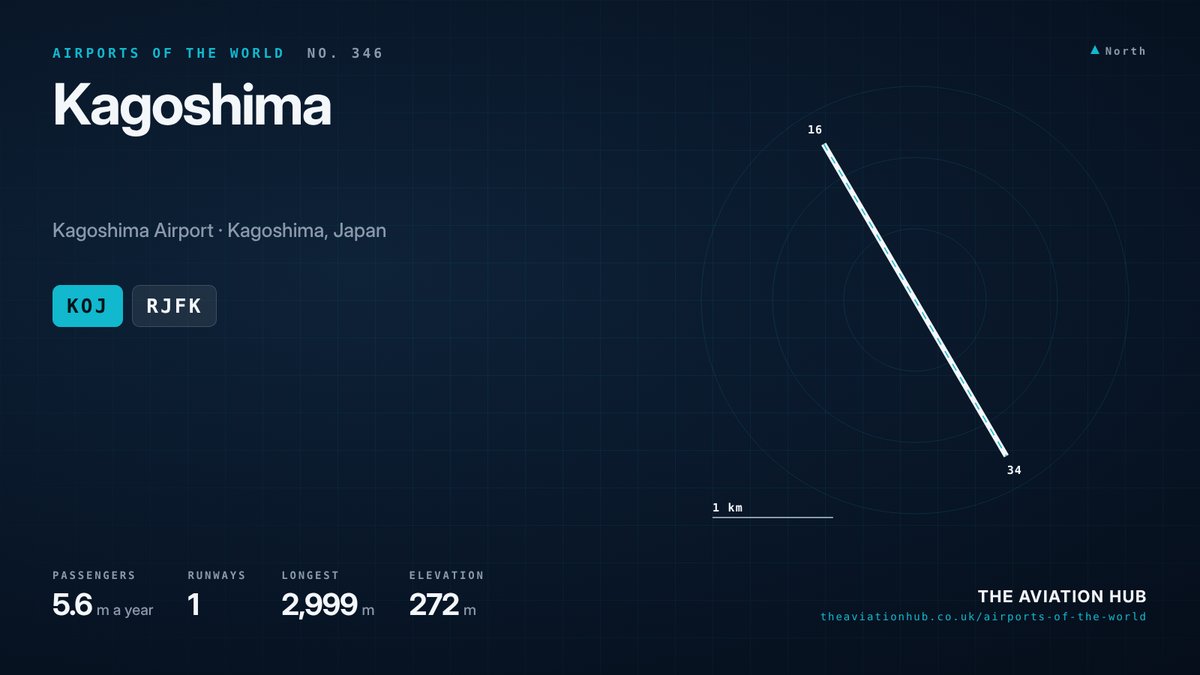
Kagoshima Airport is the main air gateway to southern Kyushu, set on a hilltop plateau in the city of Kirishima. Around 5.6 million passengers pass through in a typical year, making it a busy regional airport in Japan. It matters for two reasons. It feeds one of the country’s heaviest trunk routes to Tokyo, and it is the lifeline for the Satsunan Islands strung out towards Okinawa. Sakurajima, the active volcano across Kagoshima Bay, is never far from the operational picture.
Kagoshima Airport at a Glance
The airport carries the IATA code KOJ and the ICAO code RJFK. It lies about 19 miles (30 km) north east of Kagoshima city centre at an elevation of 272 m (891 ft). A single asphalt runway, 16/34, serves all traffic, with a large domestic terminal and a small international building alongside.
Kagoshima Airport handled roughly 6.1 million passengers in 2018 and has been close to that level since the pandemic recovery. Japan Air Commuter, the Japan Airlines regional affiliate, is based here, as is a Skymark operation, while JAL and ANA run the big trunk services. The Ministry of Land, Infrastructure, Transport and Tourism manages the airfield, and Kagoshima Airport Building Co. runs the terminals. Timetables and bus details are on the airport’s official website.
A Short History of Flying in Kagoshima
Kagoshima’s first airport was a former Imperial Japanese Navy airfield in the Kamoike district, close to the city centre. It became the main civil airport in 1957 but was hemmed in by houses and the bay, with no room for jets to grow. A new site was found on the Mizobe plateau, well inland, and the present airport opened there in 1972. The old Kamoike field was redeveloped as a new town.
The runway opened at 2,500 m and was lengthened to its current 3,000 m in 1980, allowing wide body jets to operate fully loaded to Tokyo. Several foreign airlines served the field in the 1970s and 1980s. In 2006 the airport saw the final scheduled flight of the NAMC YS-11, the postwar Japanese turboprop, flown by Japan Air Commuter.
Today the domestic terminal is a polished, passenger friendly building. In 2024 Skytrax ranked it seventh among the world’s best domestic airports, a strong result for a regional field.
Runways at Kagoshima Airport
Runway 16/34 measures 2,999 m (9,840 ft) and is 46 m wide with an asphalt surface. It runs roughly north to south along the plateau, with the land falling away towards river valleys on either side. That length comfortably handles the Boeing 767s and 787s on the Tokyo route and the 737s and Airbus A320 family jets that fly elsewhere.
The plateau location brings its own weather. Low cloud and fog form readily in the rainy season, and the airport is equipped with instrument landing aids to cope. The bigger hazard is volcanic ash. Sakurajima erupts frequently, and when the wind carries ash north towards the plateau, airlines may cancel or delay flights while the runway is inspected and swept. The Kirishima mountains, also volcanic, rise to the north east of the field.
Terminals and Airlines
Kagoshima Airport has a domestic terminal with nine gates and an international terminal with a single gate. Both JAL and ANA operate lounges in the domestic building. The terminal is compact and easy to navigate, and outside it a free foot bath fed by local hot spring water is a well known quirk.
JAL and ANA dominate the domestic side, with Skymark adding competition on Tokyo Haneda and Solaseed Air flying ANA codeshare services. Low cost carriers Peach and Jetstar Japan provide cheaper links on routes such as Tokyo Narita and Osaka Kansai. Japan Air Commuter, whose headquarters is at the airport, flies ATR turboprops to the islands, and New Japan Aviation is also headquartered here. International flights are operated mainly by Korean carriers and China Airlines.
Routes and Destinations
Tokyo Haneda is the dominant route and ranks among the five busiest air corridors in Japan, with JAL, ANA, Skymark and Solaseed all flying it many times daily. Osaka Itami, Nagoya Centrair and Okinawa Naha are the other major domestic links. The shinkansen to Fukuoka and Osaka competes hard on shorter routes.
The island network is what makes Kagoshima Airport distinctive. Japan Air Commuter flies to Yakushima, Tanegashima, Amami Oshima, Kikai, Okinoerabu and Yoron, and J-Air serves Tokunoshima. For many of these islands the flight is far quicker than the ferry. These short hops run all year and carry residents, freight and tourists.
International services focus on Seoul Incheon and Taipei Taoyuan, with charter flights to Busan. Hong Kong and Shanghai links have operated at various times. Demand peaks in Golden Week, the August Obon holiday and the New Year period, when families travel home to southern Kyushu.
Getting to and from Kagoshima Airport
There is no rail station at the terminal, and train access is poor. Limousine buses are the main option, running about every 20 minutes to Kagoshima Chuo station in about 40 minutes, depending on traffic, and also serving the Tenmonkan district. Fares are ¥1,500 (around £7.50) each way, and this is the cheapest sensible route into the city.
Buses also serve Kirishima’s hot spring resorts and other towns in the prefecture. By road, Kagoshima Airport sits next to the Mizobe Kagoshima Airport interchange on the Kyushu Expressway, giving fast links south to the city and north to Kumamoto and Miyazaki. A taxi into central Kagoshima costs considerably more than the bus. Car hire is popular for exploring the region, and parking is available beside the terminals.
Spotting and Photography
The domestic terminal at Kagoshima Airport has an observation deck overlooking the apron and runway, the obvious starting point for spotters. It gives a clear view of JAL and ANA wide bodies on the Tokyo shuttle and the ATR turboprops heading for the islands. On a clear day the Kirishima peaks form a striking backdrop.
Roads around the plateau offer approach shots at both ends, though the terrain and tree cover mean some exploring is needed. Afternoon light is generally kinder from the terminal side. Japanese airports tolerate spotters well, but fences and restricted areas are taken seriously. Stay on public land, keep clear of roads used by airport vehicles, and follow any instructions from staff.
What Comes Next
No major runway or terminal project is on the immediate horizon. The emphasis is on rebuilding international routes, which have been slower to return than domestic ones, and on promoting inbound tourism from Korea, Taiwan and Hong Kong. Several Kyushu airports, including Fukuoka and Kumamoto, have moved to private concessions, and a similar model is an option for Kagoshima Airport in future.
Volcanic ash and competition from the shinkansen will remain constant factors. Yet the Tokyo route and the island network give the airport a stable base of demand that few regional fields can match. Expect steady growth and a slow return of international traffic. See how it compares with other Japanese airports on our Airports of the World map.
Continue to follow The Aviation Hub for more analysis and insight.
Advertise with us Your brand, in front of an aviation audience Home page and in-article placements, sold directly, one advertiser per slot. From £250 a year. See the rates

