
Kaliningrad Airport Guide: Russia’s Baltic Exclave Lifeline
Kaliningrad Airport links Russia's Baltic exclave with the rest of the country. Explore its history, runway, airlines, routes and access by road.
 By The Aviation Hub
5 min read
Updated October 20, 2026
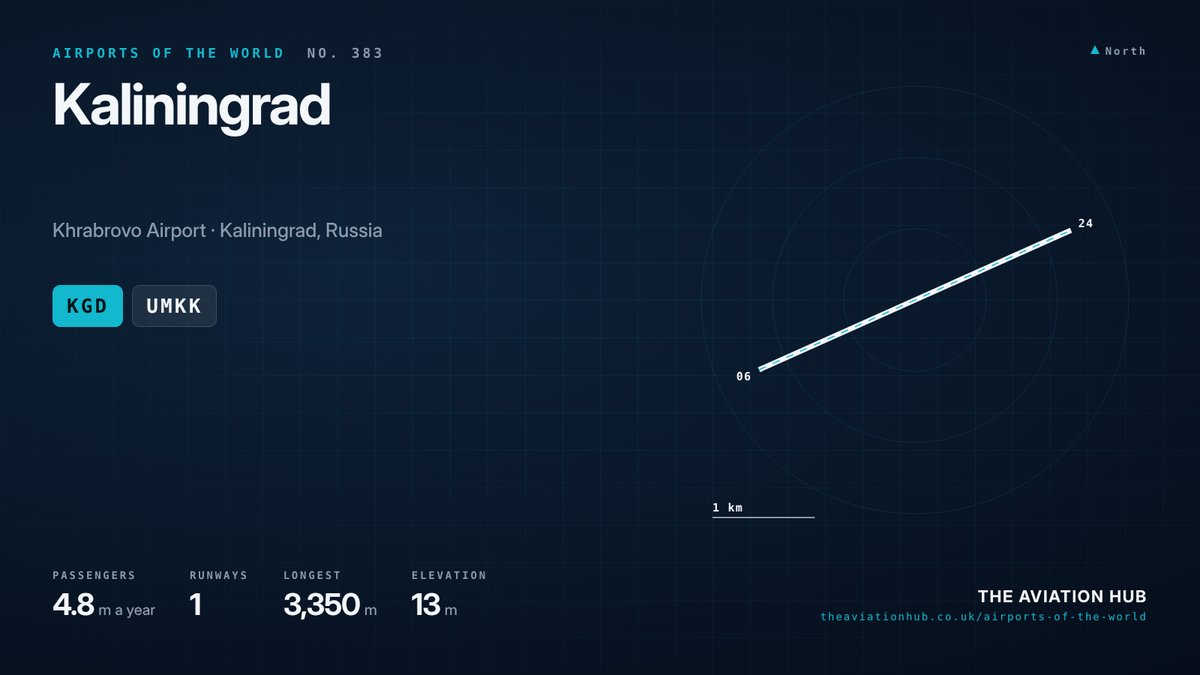
Kaliningrad is a piece of Russia cut off from the rest of the country, wedged between Poland, Lithuania and the Baltic Sea. For most residents the fastest way home is by air, which makes Kaliningrad Airport far more than a regional field. Named Khrabrovo after a nearby village, and since 2019 officially honouring Empress Elizabeth Petrovna as well, it handled more than 4.8 million passengers in 2024. It ranks among the ten busiest airports in Russia and carries a long and unusual history.
Kaliningrad Airport at a Glance
The IATA code is KGD and the ICAO code is UMKK. The field lies about 15 miles (24 km) north of Kaliningrad city centre, at an elevation of just 13 m (42 ft). It has one runway and a modern terminal opened in 2017. Kaliningrad Airport recorded 4,814,395 passengers in 2024, a rise of almost 12 per cent on the year before. No single airline runs a hub here, but Aeroflot, Rossiya, Pobeda, Nordwind and Smartavia all fly heavily. Novaport, the group controlled by Roman Trotsenko, has owned the airport since 2016. Timetables and services appear on the airport’s official website.
A Short History of Khrabrovo
The region’s aviation story starts in German Königsberg. In 1922 the airline Deruluft began scheduled flights from the city’s Devau airfield to Moscow, an early international route. The Khrabrovo site itself appeared in German records as Powunden airfield and was used by the military during the Second World War.
After 1945 the territory became Soviet, the city was renamed Kaliningrad and the airfield passed to the Civil Air Fleet. Military use continued alongside it. Western intelligence watched Ilyushin Il-28 bombers there in the 1950s, still calling the base Powunden until the early 1960s. Civil growth came slowly. Tupolev Tu-134 jets arrived in 1977, a passenger terminal opened in 1979 and the larger Tu-154 followed in 1988.
The post Soviet years were turbulent. The local operator, Kaliningrad Avia, went into receivership in 2001. Its successor KD Avia tried to turn the city into a transfer point between Russian regions and Western Europe using Boeing 737s, but the airline collapsed at the end of the decade. A new terminal opened in 2007, and Novaport bought Kaliningrad Airport in 2016. The biggest overhaul came before the 2018 FIFA World Cup, when the city hosted matches.
Runways at Kaliningrad Airport
A single concrete runway, 06/24, handles every movement. It measures 3,350 m (10,991 ft) long and 45 m wide. The World Cup programme lengthened and strengthened it, added a high speed exit taxiway and installed new lighting, radio and weather equipment. That work was completed on 27 April 2018.
The runway is long enough for wide body aircraft, which helps when charter airlines send larger jets on leisure routes. Westerly winds off the Baltic tend to favour Runway 24, though conditions change quickly on this flat, exposed coast. Part of the airfield remains a Russian Navy base. The Baltic Fleet’s 398th Independent Air Transport Squadron and a Russian National Guard aviation detachment share the field with airline traffic.
Terminals and Airlines
Passengers use the terminal that entered service in July 2017, built for the World Cup and designed to cope with summer peaks. It has a compact layout and a modest selection of shops and cafes. Reconstruction of the wider terminal complex was officially completed in April 2018.
Aeroflot and its sister airlines Rossiya and Pobeda carry the largest share of traffic on the trunk routes. Nordwind and Smartavia each serve a wide spread of Russian cities from Kaliningrad Airport, while other Russian carriers add further capacity. Belavia provides the main foreign link, flying to Minsk. Most aircraft are Airbus A320 family jets and Boeing 737s, with occasional larger types on charters.
Routes and Destinations
Moscow is the dominant market. Flights run to Sheremetyevo, Vnukovo and Domodedovo throughout the day, and Saint Petersburg is the second key link. Direct services also reach Yekaterinburg, Novosibirsk and other regional cities, giving residents a way across Russia without changing in Moscow.
Geography shapes every flight. Since 2022 the European Union has barred Russian airlines from its airspace, so services to the mainland now route over the Baltic Sea through international airspace. That adds time and fuel to every trip, and for now it rules out any return of the Western European links the airport once enjoyed. Summer brings leisure charters to Antalya and Sharm El Sheikh, while the Baltic coast draws domestic holidaymakers into Kaliningrad Airport. Traffic peaks between June and August.
Getting to and from Kaliningrad Airport
There is no rail link to the terminal. The cheapest option is bus line 244э, which runs to the main bus station beside Kaliningrad’s South railway station. The journey usually takes 30 to 40 minutes, depending on traffic.
Taxis and app based cars are quicker, reaching the city centre in around 25 minutes. Kaliningrad Airport sits close to the regional ring road, so the seaside resorts of Zelenogradsk and Svetlogorsk are also easy to reach by car. Zelenogradsk is the gateway to the Curonian Spit. Car hire and parking are available at the terminal.
Spotting and Photography
Caution matters more here than at most airports. Kaliningrad is a heavily militarised region and part of the field is an active naval aviation base. Photographing the perimeter, military aircraft or installations can lead to detention, and foreign visitors attract extra scrutiny.
The safest views come from inside the terminal, where windows overlook parts of the apron. Enthusiasts visiting Kaliningrad Airport should limit themselves to civil airliners seen from public areas and should carry identification. The flat landscape means arrivals are visible from some distance, but that is not an invitation to use a long lens near the fence. Respect local laws, obey any instruction from police or security staff and avoid anything that looks like surveillance.
What Comes Next
The World Cup works left the airport with modern infrastructure and spare capacity. Passenger numbers have recovered strongly since the pandemic, helped by Russians choosing domestic holidays on the Baltic coast. Further growth depends on airline fleet availability and the political climate around the exclave.
Kaliningrad Airport will remain a lifeline whatever happens. With rail journeys through Lithuania complicated by transit rules, flying is the default way for residents to reach the rest of Russia. Expect steady traffic and incremental improvements rather than major new projects. For more airports in the series, try the Airports of the World map.
Continue to follow The Aviation Hub for more analysis and insight.
Advertise with us Your brand, in front of an aviation audience Home page and in-article placements, sold directly, one advertiser per slot. From £250 a year. See the rates

