
Kansas City International Airport serves a metropolitan area of more than two million people straddling the Missouri and Kansas state line. For half a century it was known for an unusual design that let passengers drive almost to the gate. Kansas City Airport replaced that layout in 2023 with a single new terminal, and traffic hit a record of about 12.1 million passengers in 2024. Southwest dominates the schedule, and the airport’s three runways give it far more capacity than it currently uses.
Kansas City Airport at a Glance
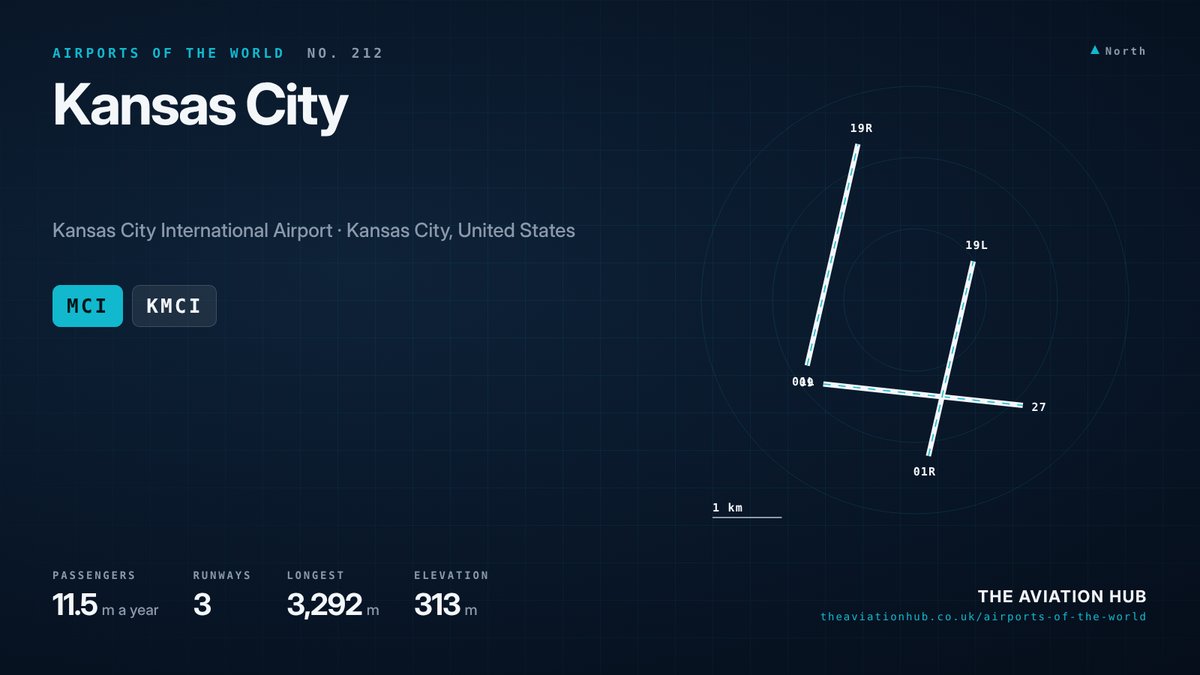
The IATA code is MCI and the ICAO code is KMCI. Locals usually call it KCI. The airport lies about 15 miles (24 km) north west of downtown Kansas City in Platte County, Missouri, on rolling farmland. Elevation is 1,026 ft (313 m). There are three runways and one terminal with 40 gates across two concourses.
Passenger numbers reached about 11.5 million in 2025, a dip of roughly 5 per cent on the 2024 record. Southwest carries close to half of all passengers, with Delta, American and United following. The City of Kansas City, Missouri, owns the airport through its aviation department. Parking rates and flight times are on the airport’s official website.
How Kansas City’s Airport Came to Be
Kansas City’s first major airport sat on the river bottoms beside downtown. It was cramped, hemmed in by bluffs and the Missouri River, and the Great Flood of 1951 put it under water. The site at the current airport began life in the 1950s as Mid Continent International Airport, and the MCI code survives from that name.
TWA, which had deep roots in Kansas City, kept its main overhaul base at Mid Continent. Voters approved a 150 million dollar bond in 1966 to turn the site into the city’s main airport. It opened on 11 November 1972, when all scheduled passenger flights moved from the downtown field.
The 1972 design used three C shaped terminals with short walks from car to gate. It was convenient but poorly suited to the security screening that soon followed. TWA had hoped to build a hub here, but moved it to St. Louis after the city refused to rebuild the terminals to its specification. Voters backed a replacement in 2017, and the new terminal opened on 28 February 2023.
Runways at Kansas City Airport
The longest runway is 01L/19R at 3,292 m (10,801 ft) and 46 m wide. Its parallel twin, 01R/19L, measures 2,896 m (9,500 ft) and has a concrete surface. The crosswind runway 09/27 is the same length at 2,896 m (9,501 ft) and has an asphalt surface.
The parallels are spaced widely enough for independent arrivals and departures. Southerly winds dominate in summer, so Runways 19L and 19R see the most use, with aircraft landing from the north over open country. Winter cold fronts swing the flow to the north and bring Runways 01L and 01R into play.
Runway 09/27 handles strong westerly or easterly winds, which are common when storms cross the Great Plains. Kansas City Airport is hardly short of capacity. With three long runways and a single terminal, it could handle far more flights than the current schedule demands. The airport also records a high rate of wildlife strikes, with farmland and wetlands close to the boundary.
Terminals and Airlines
The new terminal cost around 1.5 billion dollars and replaced the old circular buildings. Concourse A has gates A1 to A20 and Concourse B has gates B40 to B69. Security is consolidated in one checkpoint, and a 6,200 space garage sits directly in front. The design allows growth to 50 gates.
Southwest is the largest airline at Kansas City Airport, with a passenger share of about 49 per cent and a broad point to point network. Delta, a SkyTeam member, links the city with its Atlanta, Detroit, Minneapolis and Salt Lake City hubs. American, a oneworld member, flies to Dallas Fort Worth, Charlotte, Chicago and Phoenix. United, a Star Alliance member, serves Chicago, Denver, Houston and Washington Dulles. Alaska Airlines and Frontier add capacity on leisure and West Coast routes.
Routes and Destinations
Denver was the busiest route from Kansas City Airport in 2025 with about 528,000 passengers, ahead of Atlanta at roughly 444,000 and Chicago O’Hare at about 344,000. Dallas Fort Worth and Phoenix follow, each close to 290,000. Las Vegas, Orlando and the major Texas and Florida cities fill out the top tier.
International flying is limited to leisure routes to Mexico and the Caribbean. Cancun, Los Cabos, Montego Bay and Punta Cana are served, mostly in winter and spring. Icelandair’s Reykjavik route, Kansas City’s first transatlantic link, ended in 2019, and Air Canada dropped Toronto for summer 2025.
Traffic peaks in spring break and early summer. Cargo is significant for a city of this size, with integrator flights serving Kansas City’s position near the geographic centre of the continental United States.
Getting to and from Kansas City Airport
Interstate 29 runs past the airport, and Interstate 435, the beltway around the metropolitan area, passes close by. Driving from Kansas City Airport to downtown takes around 25 to 30 minutes outside rush hour. A taxi costs roughly 55 to 65 dollars (about £45), and Uber and Lyft both operate from a dedicated pick up area.
The cheapest sensible option is the RideKC bus, which runs roughly hourly between the terminal and downtown for a standard fare. There is no rail link. Proposals date back to the 1960s, and the city commissioned fresh transit studies ahead of the 2026 FIFA World Cup.
A consolidated rental car facility sits near the terminal, linked by shuttle. Shared shuttle vans serve regional cities and several military bases.
Spotting and Photography
The flat terrain and three runways at Kansas City Airport give plenty of options. Public roads near the ends of the parallel runways offer close views of arrivals on 19L and 19R, the busiest pattern for most of the year. The terminal’s glass walls look over the apron and give good views of the Southwest fleet.
The afternoon sun favours the west side of the parallel runways in summer. Thunderstorms build quickly across the plains, which can produce dramatic skies but also sudden ground stops.
Enthusiasts should also visit the TWA Museum at the Charles B. Wheeler Downtown Airport, the old main field, which tells the story of the airline that shaped Kansas City aviation. Wherever you watch, stay on public land, never stop on the interstate and respect airport police instructions.
What Comes Next
The big rebuild is complete, and the demolition of the old Terminals B and C began in July 2024. That frees land for future gates, cargo facilities and parking. The terminal can grow to 50 gates when demand returns to growth.
The challenge is airline service rather than infrastructure. Kansas City wants more nonstop routes, a transatlantic link and stronger hub carrier frequencies. Transit links to downtown remain a long running debate.
Kansas City Airport is heading into a period of consolidation, with the facilities in place and the route network still catching up. Compare it with other Midwest gateways on the Airports of the World map.
Continue to follow The Aviation Hub for more analysis and insight.
Advertise with us Your brand, in front of an aviation audience Home page and in-article placements, sold directly, one advertiser per slot. From £250 a year. See the rates

