
Kaohsiung Airport Guide: Taiwan’s Southern Gateway
Kaohsiung Airport is Taiwan's second international gateway, with one runway, two terminals and a metro link. Runways, airlines, routes and spotting tips.
 By The Aviation Hub
6 min read
Updated October 20, 2026
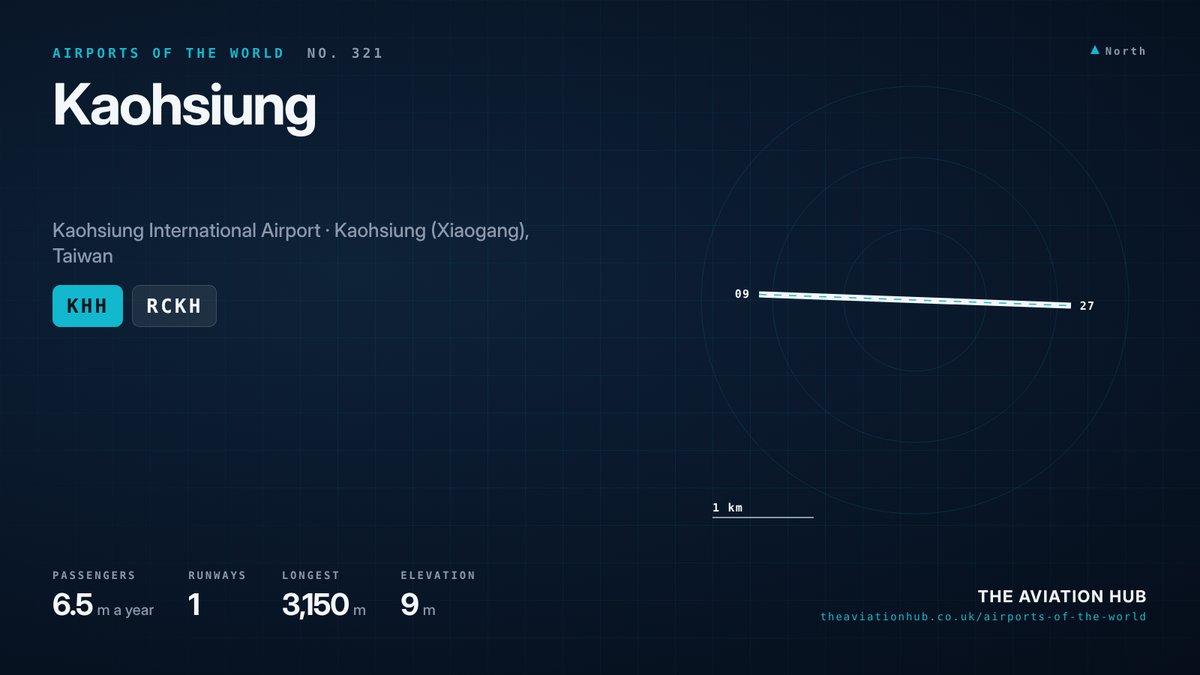
Kaohsiung Airport sits in Siaogang District on the southern edge of Taiwan’s largest port city, roughly 6 miles (9 km) from the downtown waterfront. It is the island’s second international airport after Taoyuan and the main air gateway for the whole of southern Taiwan. A single runway, two terminals and a metro station on the doorstep make it a compact, easy field to use. Close to 7 million passengers passed through in 2025, a figure that has climbed sharply since the pandemic as Japanese, Korean and Southeast Asian routes returned.
Kaohsiung Airport at a Glance
The airport carries the IATA code KHH and the ICAO code RCKH. Locals still call it Siaogang Airport after the district it occupies. The field lies at an elevation of just 9 m (31 ft) on flat reclaimed land between the city and the coast. One concrete runway, 09/27, handles all movements.
Two terminals sit side by side, one for international flights and one for domestic services. Passenger traffic reached around 6.97 million in 2025, up close to 19 per cent on the previous year, alongside roughly 59,000 aircraft movements and about 53,000 tonnes of air freight. Uni Air and Mandarin Airlines treat the airport as a hub, while China Airlines, EVA Air and Tigerair Taiwan use it as a focus city. The Civil Aeronautics Administration of Taiwan runs the airport. Timetables and parking details are published on the airport’s official website.
A Short History of Siaogang
The site began life in 1942 as an Imperial Japanese Army air base during the colonial period. It stayed in military hands until 1945. The Taiwanese government converted it to a domestic civil airport on 1 July 1965, and international status followed in 1969. Scheduled international flights started in 1972, initially to Hong Kong and Tokyo, which remained the only overseas destinations through the 1970s and 1980s.
The dedicated international terminal opened in 1997 and remains the main building today. EVA Air briefly flew nonstop to Los Angeles in 1998, but the route lasted only six months and the airport has not seen a scheduled transpacific service since. Cross strait flights to mainland China arrived in 2009 and expanded quickly. Kaohsiung Airport has since settled into a clear role as a regional international field, feeding Northeast and Southeast Asia rather than chasing long haul traffic.
Runways at Kaohsiung Airport
Runway 09/27 measures 3,150 m (10,335 ft) long and 60 m wide with a concrete surface. The length is comfortable for an Airbus A330-300 or Boeing 777-300ER on regional sectors, and China Airlines regularly schedules wide bodies to Hong Kong and Tokyo. There is no parallel or crosswind runway, so any closure for maintenance stops all traffic.
Runway 09 is preferred and in use most of the time, with arrivals over the Taiwan Strait and the container terminals of Kaohsiung Harbour. Runway 27 comes into use when westerly winds blow, bringing approaches in over the city’s southern suburbs. Kaohsiung Airport closes overnight for noise reasons, which limits late arrivals and early departures. Typhoon season from July to October brings the occasional full closure.
Terminals and Airlines
The International Terminal handles every overseas flight. China Airlines and its regional subsidiary Mandarin Airlines are the largest operators, flying to Hong Kong, Tokyo Narita, Osaka Kansai, Seoul Incheon, Bangkok, Manila, Singapore and several mainland Chinese cities. EVA Air provides a second full service network to many of the same points. Cathay Pacific flies the Hong Kong trunk route several times a day.
Low cost carriers now make up a large share of the departure board. Tigerair Taiwan bases aircraft here for Japanese and Korean leisure routes. Peach, Jetstar Japan, AirAsia, VietJet, Cebu Pacific, Thai AirAsia and Thai Lion Air all appear on the international screens. The Domestic Terminal next door is Uni Air and Mandarin Airlines territory, with ATR 72-600 turboprops shuttling to the Penghu islands, Kinmen and Hualien, while Daily Air’s small Dornier 228s serve the outlying strips at Qimei and Wang an.
Routes and Destinations
Hong Kong is the dominant international route from Kaohsiung Airport by a wide margin, carrying about 1.25 million passengers in 2025 across China Airlines, EVA Air, Cathay Pacific and Hong Kong Express. Tokyo Narita and Osaka Kansai each handled around 560,000 passengers, with Seoul Incheon at roughly 415,000 and Macau at around 325,000. Japan is the standout growth market, and Jetstar Japan and Starlux add services to Naha and Kobe from late 2026 and early 2027.
Domestically, Penghu is the big earner with around 778,000 passengers a year, followed by Kinmen at about 404,000. Both routes swell in summer when Taiwanese holidaymakers head for the islands. The longest scheduled sectors from the airport, to Sapporo, Kuala Lumpur and Singapore, all run to around 1,850 miles (3,000 km). Cargo throughput of roughly 53,000 tonnes is modest next to Taoyuan but useful for southern Taiwan’s electronics and seafood exporters.
Getting to and from Kaohsiung Airport
The Kaohsiung Metro Red Line is the obvious choice. Kaohsiung International Airport station sits beneath the terminals, and trains reach Kaohsiung Main Station in about 20 minutes for a fare of around NT$35 (roughly 90p). Stay on the same line to Zuoying for the Taiwan High Speed Rail link to Taichung and Taipei, where the fastest trains cover the full journey in around 95 minutes.
Local buses stop outside both terminals and a direct coach runs south to Fangliao and the beaches at Kenting, a journey of around two and a half hours. Taxis to the city centre cost about NT$300 to NT$400 and take 20 to 30 minutes outside rush hour. Multi storey and surface car parks sit in front of the terminals, and the airport lies minutes from the National Freeway 1 terminus for drivers heading north.
Spotting and Photography
Kaohsiung Airport is one of Taiwan’s friendlier fields for enthusiasts. The covered bridge between the two terminals and the upper deck of the car park west of the terminal both look across the apron and the runway beyond, and they cost nothing to use. Light there works for most of the day, except early and late on summer days.
Outside the fence, the western end by the threshold of runway 09, a short walk from Caoya metro station, gives close views of arrivals from late morning until sunset. Jinfu Road nearby covers the same approach. A long lens of 300 mm or more is useful from the perimeter roads. Military aircraft appear from time to time, so do not photograph them closely, stay off private land and follow any instructions from airport police, who patrol the fence regularly.
What Comes Next
The Civil Aeronautics Administration has long planned a new combined terminal to replace the ageing domestic and international buildings, with a design capacity well above the current 7 million passengers. Construction has moved slowly, but the project remains the centrepiece of the airport’s future. Shorter term growth will come from the Japanese market, where Starlux, Tigerair Taiwan and the Japanese low cost carriers keep adding frequencies.
Constraints are real. The single runway, overnight curfew and dense housing to the north cap how far traffic can grow, and Taoyuan will keep the long haul business. Even so, Kaohsiung Airport is on a clear upward path as southern Taiwan’s link to the rest of East Asia. See how it compares with other Asian gateways on the Airports of the World map.
Continue to follow The Aviation Hub for more analysis and insight.
Advertise with us Your brand, in front of an aviation audience Home page and in-article placements, sold directly, one advertiser per slot. From £250 a year. See the rates

