
Karachi Airport Guide: Jinnah International Explained
Karachi Airport, officially Jinnah International, is the gateway to Pakistan's largest city. Read about its runways, terminals, Gulf routes and transport links.
 By The Aviation Hub
6 min read
Updated October 20, 2026
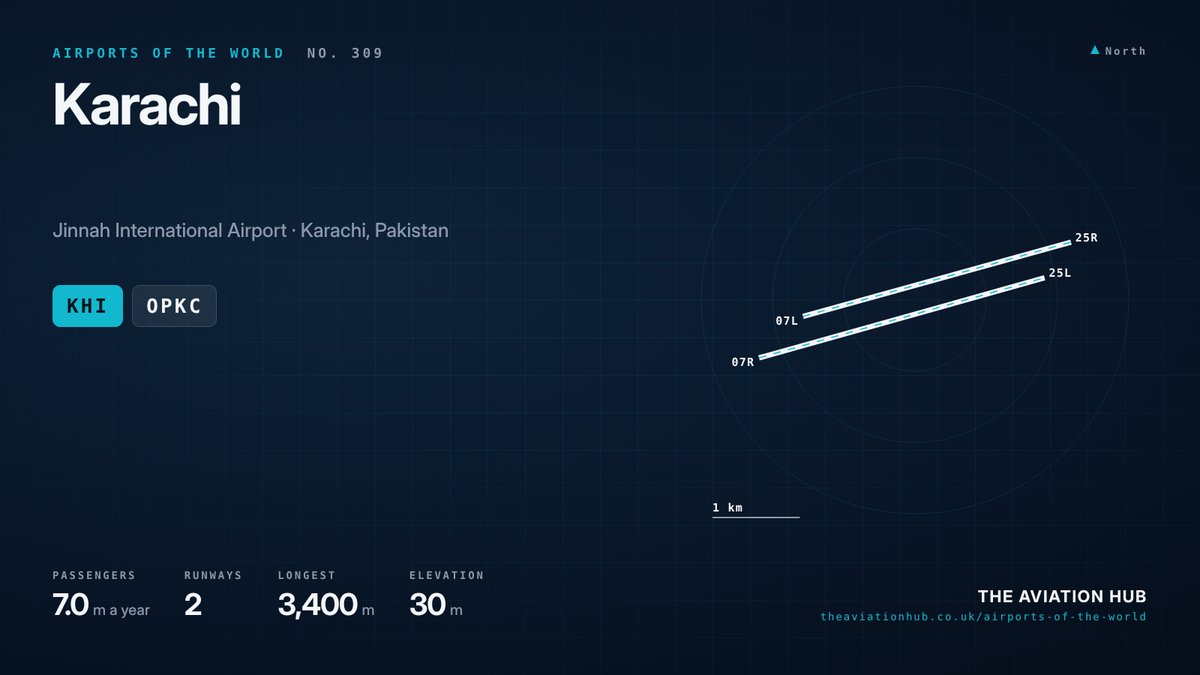
Karachi Airport, officially Jinnah International Airport, is the main gateway to Pakistan’s largest city and its commercial capital. It handled about 6.7 million passengers in the year to June 2025, with heavy flows to the Gulf and Saudi Arabia. The field has nearly a century of history, from imperial flying boats and airships to PIA’s golden era. It remains the base for most of Pakistan’s private airlines.
Karachi Airport at a Glance
The IATA code is KHI and the ICAO code is OPKC. The airport lies roughly 9 miles (15 km) east of the old city centre, between Malir and Gulistan e Jauhar, and is reached along Sharea Faisal. Elevation is 100 feet (30 m). There are two parallel runways and one main passenger building, the Jinnah Terminal, with older buildings kept for Hajj flights and offices. Pakistan’s state airport authority operates the site.
Karachi Airport handled 6,711,131 passengers between July 2024 and June 2025, up almost 4 per cent, with about 45,000 aircraft movements and more than 100,000 tonnes of cargo. Pakistan International Airlines treats the city as a focus point, though its main hub has shifted to Islamabad. Airblue, Fly Jinnah and AirSial all have hubs here, while SereneAir’s flights have been suspended since October 2025. Live flight information is published on the airport’s official website.
A Short History of Drigh Road
Karachi was a natural staging post on the air route from Britain to India and Australia. Imperial Airways arrived on 30 March 1929, and a vast hangar was built between 1927 and 1929 for the R101 airship, which crashed in France and never arrived. On 15 October 1932, J.R.D. Tata took off from Drigh Road in a Puss Moth with the first Tata airmail to Bombay, founding what became Air India.
The permanent terminal, now Terminal 1, opened on 5 December 1938. During the Second World War the field became a major American transhipment and maintenance base for China and Burma. After independence it was Pakistan’s main international airport. A second runway, 07L/25R, opened on 25 January 1961, and the R101 hangar came down the same year. PIA’s Ispahani Hangar followed in 1968.
The airport grew as PIA flew wide bodies across Europe, Asia and North America. PIA built Terminal 2 in 1978, and a fire badly damaged it in 1984. The Jinnah Terminal opened in August 1992, and the airport took the founder’s name. Security incidents have marked its history, including the Pan Am Flight 73 hijacking in 1986 and the militant attack of June 2014 that killed at least 28 people.
Runways at Karachi Airport
Karachi Airport has two parallel concrete runways. Runway 07R/25L is 3,400 m (11,155 ft) long and 46 m wide; it reached that length in a 1994 extension. Runway 07L/25R is 3,200 m (10,500 ft) long and 46 m wide. Both 25L and 25R have Category I instrument landing systems, and a rebuilt runway reopened on 19 February 2026 after an 18 month project costing about Rs 8 billion.
The prevailing southwesterly sea breeze means runway 25 is in use most of the time, with arrivals crossing the dense suburbs of Malir and Model Colony. That approach is part of the airport’s grim history. On 22 May 2020 PIA Flight 8303, an Airbus A320, crashed into Model Colony on a second approach after a failed landing, killing 97 of the 99 people aboard. The runways are long enough for any wide body, including Boeing 777s and Airbus A330s used on Gulf and Saudi routes.
Terminals and Airlines
The Jinnah Terminal handles almost every scheduled passenger at Karachi Airport. It splits into two satellite concourses, with the East Satellite for international flights and the West Satellite for domestic services. Business lounges run by banks and by airblue sit on the international side. Terminal 1 houses the aviation authority headquarters, with the control tower on its roof, while Terminal 2 handles Hajj traffic.
PIA flies Airbus A320s, ATR 72s and Boeing 777s from here. Airblue and AirSial use A320 family jets on domestic trunk routes and to the Gulf, while Fly Jinnah, the low cost joint venture with Air Arabia, flies A320s across Pakistan and the Middle East. Foreign airlines include Emirates, Qatar Airways, Etihad, Saudia, flydubai, Air Arabia, Oman Air and Turkish Airlines. The PIA engineering base remains among the largest maintenance facilities in the country.
Routes and Destinations
Islamabad is the busiest route from Karachi Airport, with about 105 weekly flights, followed by Lahore with 69. Domestic flying is a fierce fight between PIA, airblue, AirSial and Fly Jinnah, mostly on A320s. Peshawar, Quetta, Multan and Faisalabad add regional demand. Internationally, Dubai leads with around 78 weekly flights, ahead of Jeddah at 36 and Sharjah at 27.
The Gulf and Saudi Arabia dominate because of migrant workers and pilgrims. Riyadh, Doha, Muscat, Abu Dhabi and Istanbul are major links, while Bangkok and Kuala Lumpur add Asian connections. Biman began flights to Dhaka in January 2026, and Centrum Air scheduled Tashkent flights from 3 September 2026. PIA’s Toronto service, about 7,250 miles (11,700 km) away, has been the longest route. Hajj and Umrah seasons bring large charter peaks.
Getting to and from Karachi Airport
Most passengers arrive by road along Sharea Faisal, the main artery linking the airport with the city centre, Saddar and Clifton. Journey times range from 25 minutes at night to over an hour at peak. Ride hailing through inDrive is the simplest choice, usually costing roughly Rs 1,500 to 2,500 (£4 to £7) to central districts. Careem ended its ride hailing service in Pakistan in July 2025. Licensed taxis wait outside arrivals, and a heptagonal car park holds more than 3,000 vehicles.
Public transport is limited. Buses, minibuses and auto rickshaws serve the airport roads, but carrying luggage on them is hard work. Karachi Airport railway station, a commuter stop, sits about 1.2 miles (2 km) southwest of the terminal, though services are sparse. Karachi Cantonment is the nearest mainline station for intercity trains to Lahore and beyond. For most visitors, a pre booked car remains the sensible option.
Spotting and Photography
Karachi Airport is not a place for casual spotting. It sits beside Pakistan Air Force Base Faisal, security is tight after past attacks, and photographing the airfield from public roads can draw police attention. Enthusiasts rely on window seats, approved terminal areas and, occasionally, organised visits arranged through official channels.
The traffic mix is still interesting. PIA 777s, Gulf wide bodies, Saudia, Fly Jinnah, Air Arabia and cargo freighters share the apron. With runway 25 in use most days, arrivals pass over Malir in the afternoon with the sun behind the observer. Always carry identification, never photograph military aircraft or checkpoints, and stop immediately if asked. Local rules are strict and enforced.
What Comes Next
The Jinnah Terminal is rated for about 12 million passengers a year, so capacity growth depends on better use of the existing building rather than new ones. The 2026 runway rebuild and new routes to Dhaka and Tashkent point to a period of steady investment.
The bigger shifts are commercial. PIA passed to an Arif Habib led consortium in June 2026, and that privatisation, along with the government’s interest in private management of major airports, could reshape operations. Gulf demand will keep growing with Pakistan’s population. The verdict: Karachi will remain the country’s commercial gateway, but its airport needs modernisation to match Islamabad and Lahore. Compare it with other South Asian airports on our Airports of the World map.
Continue to follow The Aviation Hub for more analysis and insight.
Advertise with us Your brand, in front of an aviation audience Home page and in-article placements, sold directly, one advertiser per slot. From £250 a year. See the rates

