
Kathmandu Airport Guide: Into the Himalayan Valley
Kathmandu Airport is Nepal's main gateway, set in a mountain valley. Explore its tabletop runway, terminals, airlines, Everest flights and transport.
 By The Aviation Hub
5 min read
Updated October 20, 2026
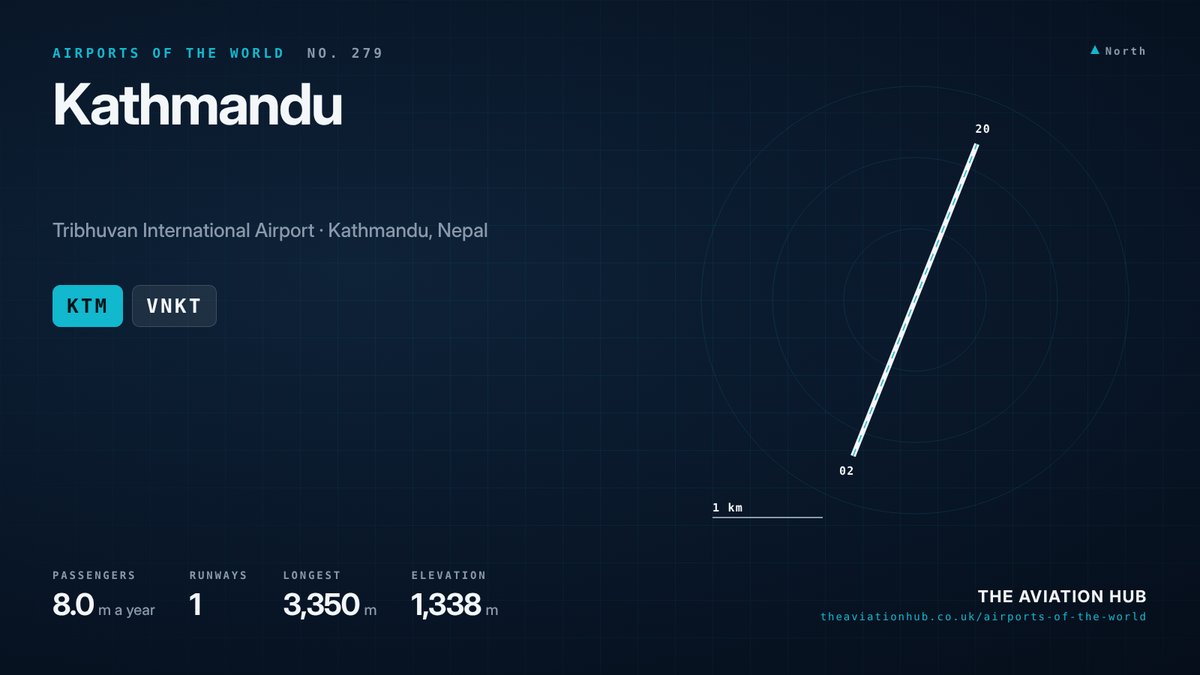
Kathmandu Airport, officially Tribhuvan International Airport, sits in a bowl of hills at the eastern edge of Nepal’s capital, close to the sacred Pashupatinath temple. It is the country’s main international gateway and handled roughly 9.5 million passengers in 2024 on a single runway. Trekkers bound for Everest, migrant workers heading for the Gulf and Malaysia, and pilgrims all pass through. The mountain setting makes it one of the more demanding major airports in Asia for pilots.
Kathmandu Airport at a Glance
The codes are KTM for IATA and VNKT for ICAO. The airport lies about 4 miles (6 km) east of Thamel, the main tourist district, and around 1 km from Pashupatinath. Its elevation is 1,338 metres (4,390 feet). There is one runway, an international terminal, a domestic terminal and a VIP terminal for state guests.
The Government of Nepal owns the site and the Civil Aviation Authority of Nepal operates it. Nepal Airlines and Himalaya Airlines run international hubs at Kathmandu Airport, while Buddha Air, Yeti Airlines, Shree Airlines, Sita Air, Tara Air, Guna Airlines and Saurya Airlines base their domestic fleets here. Qatar Airways, IndiGo and flydubai are the biggest foreign carriers. Flight information is on the airport’s official website.
How Kathmandu’s Airport Came to Be
The site was known as Gauchaur, a Nepali name for a place where cows graze. The first aircraft landed on 23 April 1949, a Beechcraft Bonanza carrying the Indian ambassador. Nepal was only beginning to open up to the world, and the grass field soon handled regular services from India.
King Mahendra formally inaugurated the airport on 15 June 1955 and renamed it in memory of his father, King Tribhuvan. It gained international status in 1964 as Tribhuvan International Airport. The present terminal complex opened on 18 February 1990, and a new domestic terminal followed in 2016.
The airport’s history is also marked by tragedy. In 1992 a Thai Airways Airbus A310 crashed into the mountains on approach, killing all 113 on board, and two months later a Pakistan International Airlines Airbus A300 crashed with the loss of all 167, the worst air accident in Nepal. In 2018 a US Bangla Airlines Bombardier Dash 8 crashed on landing, killing 51.
Runways at Kathmandu Airport
Kathmandu Airport has a single asphalt runway, 02/20, measuring 3,350 metres (10,991 feet) long and 45 metres wide. It replaced the old 16/34 grass strip in 1964. The runway has a slope of about 1.2 per cent and sits on a tabletop, with ground falling away at the ends. At this elevation, long runways matter, because thin air reduces engine and wing performance.
There is no instrument landing system. Terrain around the valley makes a standard ILS impractical, so pilots rely on a VOR/DME approach and a more modern RNAV/RNP procedure, with extra VOR/DME equipment installed along the extended approach path. Most arrivals come in from the south to runway 02 over the ridges that ring the valley.
Fog and congestion are recurring problems. Winter mornings often bring poor visibility, and in March 2015 a Turkish Airlines Airbus A330 skidded off the runway in fog, blocking it for days. In July 2024 a Saurya Airlines Bombardier CRJ200 crashed on take off, killing 18 of the 19 people on board.
Terminals and Airlines
The international terminal handles all foreign flights and was designed for around 1,350 departing passengers an hour, though peaks have reached about 2,200. Radisson runs a lounge for premium passengers, and Thai Airways operates its own lounge. The domestic terminal, opened in 2016 and extended for Buddha Air in 2022, handles about 765 passengers an hour.
Nepal Airlines was the largest international carrier at Kathmandu Airport in 2023, with about 645,000 passengers, just ahead of Qatar Airways with 627,000. Himalaya Airlines, IndiGo and flydubai followed. Domestically, Buddha Air dominates with more than half the market, ahead of Yeti Airlines and Shree Airlines.
Routes and Destinations
Kathmandu Airport serves more than 40 destinations in 17 countries. Delhi and other Indian cities are core links, while Doha, Dubai, Kuala Lumpur and other Gulf and Malaysian cities carry heavy migrant worker traffic. Bangkok, Istanbul and several Chinese cities also feature. Tourist demand peaks in the clear autumn and spring trekking seasons.
Domestic routes link the capital with Pokhara, Biratnagar, Bharatpur, Nepalgunj and other towns. Flights to Lukla for Everest trekkers are famous, though in peak seasons they have often operated from Ramechhap to ease congestion at the capital. Buddha Air, Yeti, Shree and Sita Air also run early morning Everest sightseeing flights that return about an hour later.
Getting to and from Kathmandu Airport
Most visitors take a taxi. Prepaid and metered taxis wait at both terminals around the clock, and the ride to Thamel takes 30 to 45 minutes depending on traffic, typically costing around NPR 800 to 1,000 (roughly £5). Ride hailing apps also operate in the city.
The cheapest sensible option is the Sajha Yatayat bus, which connects the international terminal with central Kathmandu and Lalitpur. A free shuttle links the main airport gate with the domestic terminal. By road the airport sits close to the Ring Road, which links it with the rest of the Kathmandu Valley. There is no rail link.
Spotting and Photography
The setting is spectacular. Rooftops and hillsides in the neighbourhoods around Kathmandu Airport, such as Sinamangal and the slopes near Pashupatinath, give views across the runway. In the clear autumn air after the monsoon, the Himalaya can appear on the northern horizon, creating a striking backdrop.
The fleet is unusual. Buddha Air ATR 72s, Tara Air and Sita Air Twin Otters and Dorniers, and helicopters heading for the mountains share the runway with Qatar Airways, flydubai and IndiGo jets. Haze and fog can hide everything in winter and spring. Nepalese authorities are sensitive about security, so keep to public spaces, stay away from fences and respect any instructions from police or the army.
What Comes Next
Capacity is the central problem. Asian Development Bank funded plans include a full parallel taxiway, a new international terminal, conversion of the old international terminal for domestic flights, and relocation of the Nepal Airlines hangar and army facilities. A dedicated helicopter terminal is also planned.
The government has also promoted Gautam Buddha International at Bhairahawa and Pokhara International as alternatives, though airlines have been slow to shift. Kathmandu Airport will remain the gateway to Nepal for years to come, crowded and challenging but irreplaceable. See how it compares with other South Asian airports on our Airports of the World map.
Continue to follow The Aviation Hub for more analysis and insight.
Advertise with us Your brand, in front of an aviation audience Home page and in-article placements, sold directly, one advertiser per slot. From £250 a year. See the rates

