
Kazan Airport Guide: Inside Tatarstan’s Main Gateway
Kazan Airport serves the capital of Tatarstan on the Volga. Read about its long concrete runway, terminals, airlines, routes, rail link and recent history.
 By The Aviation Hub
6 min read
Updated October 20, 2026
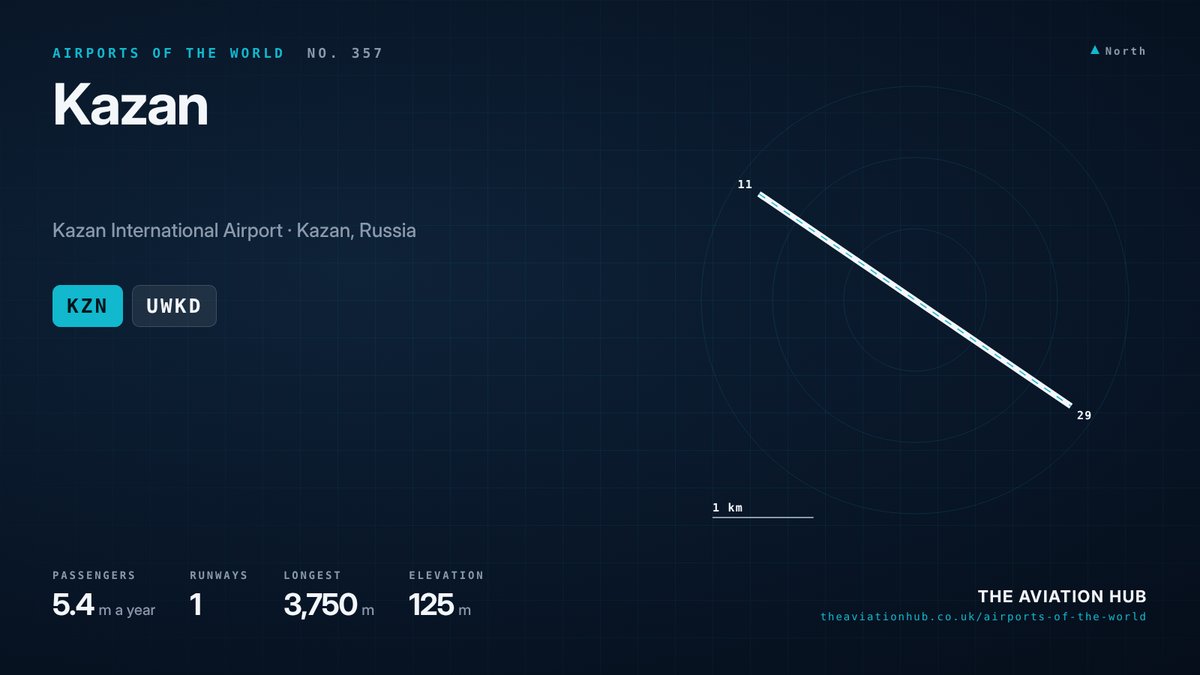
Kazan Airport, officially Gabdulla Tukay Kazan International Airport, is the main air gateway to the Republic of Tatarstan in Russia. It sits on open land south east of Kazan, the historic Tatar capital on the Volga. About 5.4 million passengers used it in 2025, placing it among the busier regional airports in Russia. Major sporting events in the 2010s brought a new terminal and a rail link, and the airport has since adapted to a very different operating environment.
Kazan Airport at a Glance
The airport uses the IATA code KZN and the ICAO code UWKD. It lies about 16 miles (25 km) south east of central Kazan at an elevation of 125 m (411 ft). One concrete runway, 11/29, handles all traffic. Passengers use Terminals 1 and 1A, and a new domestic terminal began test operations in October 2026.
Kazan Airport handled about 5.4 million passengers in 2025, well above the 3.5 million recorded in 2019. UVT Aero uses it as a hub, while Aeroflot, Pobeda, Nordwind and Red Wings are among the larger operators. Turkish Airlines is one of the best known foreign carriers. The airport is run by the joint stock company Kazan International Airport. Up to date schedules are on the airport’s official website.
How Kazan’s Airport Came to Be
The city’s original airfield, Kazan 1, sat much closer to the centre. A new airport, known as Kazan 2, was completed on 15 September 1979 to handle jet traffic. When Kazan 1 closed in 1984, the new field took over all domestic flights, and it gained international status on 21 February 1986. Regular international services began in 1992 with a route to Istanbul.
The airport’s modern shape came under the Tatarstan presidents Mintimer Shaimiev and Rustam Minnikhanov. Terminal 1A opened on 7 November 2012, and the renovation of Terminal 1 was finished in June 2013, in time for the Summer Universiade held in Kazan. The 2018 FIFA World Cup brought further traffic. In 2019 the airport was renamed after Gabdulla Tukay, the Volga Tatar poet, critic and publisher.
The darkest moment came on 17 November 2013. Tatarstan Airlines Flight 363, a Boeing 737-500, crashed while attempting a go around, killing all 50 people on board. Investigators found the captain had not completed proper flight training, and the scandal led to hundreds of pilot licences being revoked across Russia.
Runways at Kazan Airport
Runway 11/29 is 3,750 m (12,303 ft) long and 60 m wide, with a concrete surface. The new runway built in the modernisation programme, equipped with full edge lighting, allowed round the clock operations. Its length comfortably handles wide body aircraft such as the Boeing 777 and Airbus A330 used on charter flights.
Weather is the main operational factor. Volga winters are long and cold, with heavy snow and temperatures well below minus 20 degrees, so de icing and snow clearance are routine for months. Fog and freezing rain bring occasional delays. Since 2022 the airport has also faced temporary closures when air defence alerts or drone threats affect central Russia. These can halt departures at short notice.
Terminals and Airlines
Kazan Airport long relied on two linked passenger buildings. Terminal 1A opened in 2012, and the renovated Terminal 1 sits alongside it. Together they were designed for about 2.5 million passengers a year, roughly half of today’s traffic. A new domestic terminal of about 38,000 square metres, with nine gates and capacity for 5.7 million passengers a year, began operating in test mode on 15 October 2026. UVT Aero moved first, with other airlines set to follow in stages.
UVT Aero, a regional airline from Tatarstan, flies Bombardier CRJ200s to a wide range of Russian cities. Aeroflot and its low cost subsidiary Pobeda link Moscow and other hubs, while Nordwind and Red Wings fly scheduled services and Azur Air flies holiday charters. Turkish Airlines is a prominent foreign carrier, and airlines from Central Asia serve their home cities. Alliances matter little, although Turkish Airlines brings Star Alliance connections through Istanbul. Airlines from the EU and North America have stayed away since 2022.
Routes and Destinations
Moscow is the dominant market from Kazan Airport, with flights to Sheremetyevo, Vnukovo and Domodedovo throughout the day. St Petersburg and Sochi are other major domestic routes, alongside a long list of cities across the Urals, Siberia and southern Russia.
Istanbul is one of the most popular international routes, flown by Turkish Airlines, Pobeda and Nordwind. Leisure charters reach Turkey, Egypt and the Gulf, with peaks in the summer and the New Year holidays. Tashkent, Dushanbe and other Central Asian capitals carry migrant workers and family traffic. Some foreign routes have been halted, including Air Arabia services, which are suspended until at least March 2027. Western sanctions have also limited access to spare parts, a pressure felt across the Russian fleet.
Getting to and from Kazan Airport
A dedicated airport rail service, launched for the 2013 Universiade, links Kazan Airport with the city’s main railway station in around 25 to 30 minutes. It is the most predictable way into the city, although frequencies are limited, so check the timetable before travelling.
Buses run between the terminals and the city centre and are the cheapest sensible option, though slower than the train. The drive into central Kazan takes about 30 to 40 minutes outside rush hour. Taxis and ride hailing services operate from the forecourt, with fares far lower than in Western Europe. Car parks sit in front of the terminals. British travellers should note that the Foreign Office currently advises against all travel to Russia.
Spotting and Photography
Spotting at Kazan Airport is not recommended for foreign visitors. Russian law treats photography near transport infrastructure with suspicion, and security services have detained enthusiasts at airports in the past. Any viewing should be limited to what is visible from inside the terminals, without long lenses or notebooks of registrations.
For those with legitimate reasons to be there, the terminal windows overlook the apron, where UVT Aero CRJs mix with Aeroflot and Pobeda narrowbodies and the occasional Turkish Airlines jet. Winter light is low and soft but brief. Never photograph military or security installations, stay well away from fences, and comply immediately with any instruction from police or airport staff.
What Comes Next
Traffic has grown strongly since 2019, as Russian airlines shifted capacity to domestic routes and to friendly foreign markets. The new domestic terminal will add room for about 5.7 million passengers a year once every airline has moved across. The bigger constraints sit outside the airport, in sanctions, aircraft availability and airspace restrictions.
For now the airport serves a strong regional economy, and Tatarstan’s oil, chemical and engineering industries keep demand steady. Kazan Airport is likely to keep growing at home, while its international role depends on events far beyond the Volga. See how it compares with other airports in the region on our Airports of the World map.
Continue to follow The Aviation Hub for more analysis and insight.
Advertise with us Your brand, in front of an aviation audience Home page and in-article placements, sold directly, one advertiser per slot. From £250 a year. See the rates

