

A KLM Cityhopper Embraer E195-E2 was forced to return to Amsterdam Schiphol Airport after its crew reported a rudder failure during the initial climb, prompting a careful crosswind assessment before the aircraft landed safely on a different runway to the one it had departed from.
Climb Interrupted Over Amsterdam
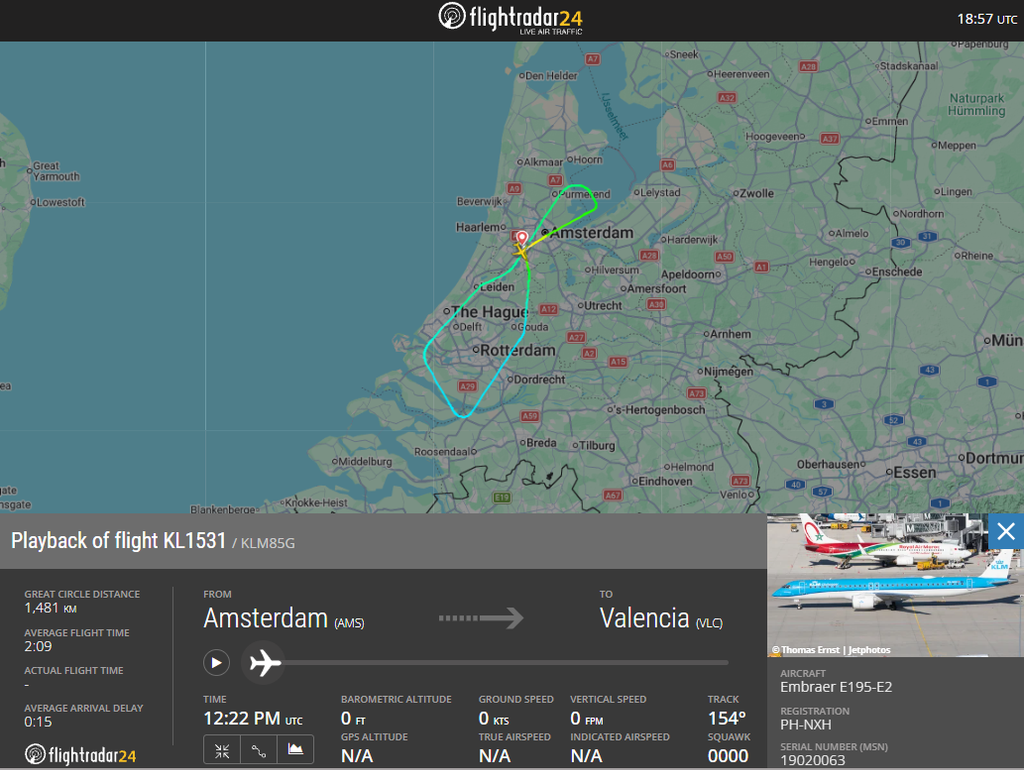
The aircraft, registration PH-NXH, was operating flight KL1531 from Amsterdam to Valencia in Spain.
The crew departed from Amsterdam’s runway 18L and began a normal climb out of the airport.
As the aircraft passed flight level 130, the crew stopped the climb and declared that the rudder had failed.
The crew advised air traffic control that they needed to return to Amsterdam and confirmed that the aircraft could accept a crosswind component of no more than 3 knots for landing.
A rudder failure is treated seriously by any crew because the rudder helps keep an aircraft aligned with the runway centreline during crosswind landings.
With that authority reduced, the crew’s 3 knot limit effectively ruled out any runway at Amsterdam where the wind was blowing more strongly across the direction of travel, leaving controllers to search for a suitable option among the airport’s several runways.
Crew Selects Runway 24 for the Return to Amsterdam
With the rudder failure limiting the crew’s ability to counter crosswind on landing, controllers at Amsterdam worked to identify a runway within the aircraft’s stated limit.
Analysis showed that the crosswind component for runway 24 measured only 2 knots, comfortably inside the 3 knot maximum the crew had requested.
The crew accepted runway 24 for the approach and landed safely at Amsterdam about 30 minutes after the flight had departed.
Flight tracking data for PH-NXH, available on Flightradar24, records the full climb, level off at flight level 130, and the return track back into Amsterdam.
Replacement Aircraft Completes the Valencia Rotation
Following the return to Amsterdam, KLM Cityhopper arranged a replacement aircraft to complete the flight to Valencia.
A second Embraer E195-E2, registration PH-NXK, operated the rotation and reached Valencia with a delay of about 3.5 hours against the original schedule.
Passengers who had been aboard the original PH-NXH departure from Amsterdam were transferred onto the replacement aircraft to continue their journey.
Aircraft Returns to Service Within Hours
PH-NXH returned to service at Amsterdam about 6 hours after landing, suggesting engineers were able to address the reported rudder fault relatively quickly once the aircraft was back on the ground.
Aircraft Profile: PH-NXH
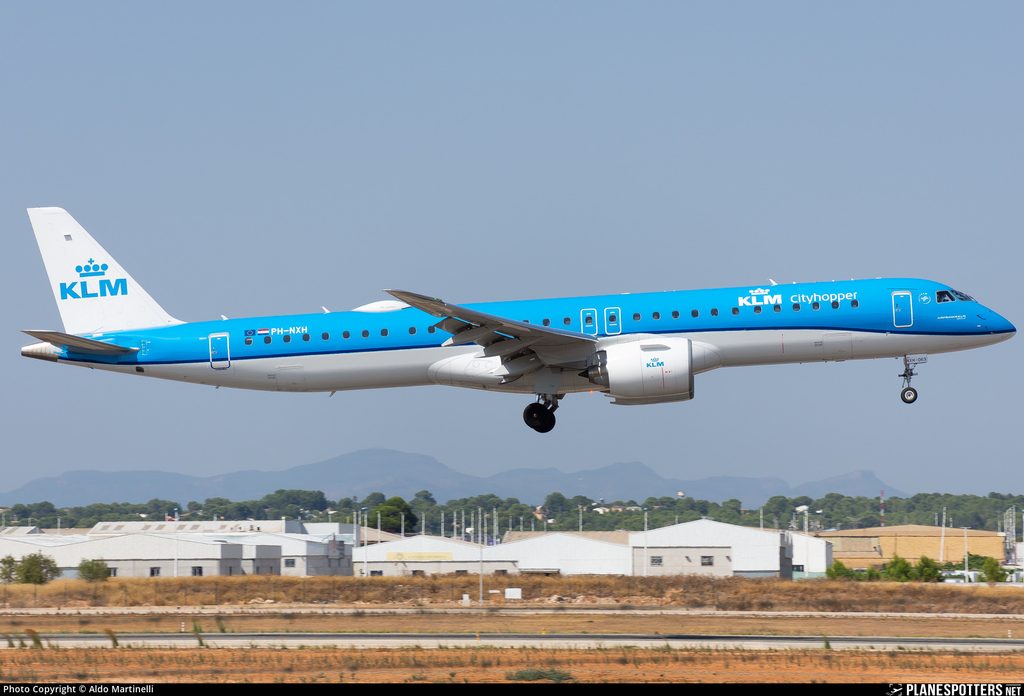
PH-NXH is an Embraer E195-E2, built to the ERJ 190-400 STD specification, carrying manufacturer serial number 19020063.
The airframe first flew on 2 February 2022 wearing the test registration PR-EAC, having been produced at Embraer’s Sao Jose dos Campos site in Brazil. At the time of the incident, the aircraft was 4.6 years old.
The aircraft was delivered to KLM Cityhopper on 25 February 2022 in a 136 seat configuration and is leased from ICBC.
It was ferried from Sao Jose dos Campos via Recife and Tenerife South to Amsterdam between 25 and 26 February 2022 as part of its delivery flight, before entering service on 16 March 2022.
The aircraft is fitted with two Pratt & Whitney PW1921G engines and carries the hex code 486491 and the KLM Cityhopper fleet number NXH-063.
PH-NXH spent time in storage at Amsterdam between 6 February and 21 June 2024 before returning to service.
The cabin was reconfigured to its current 136 seat layout in December 2025, having previously flown in a 132 seat configuration. The airframe remains listed as active.
Continue to follow The Aviation Hub for more analysis and insight!