
Kobe Airport Guide: The Island Field on Osaka Bay
Kobe Airport sits on an artificial island in Osaka Bay. Its history, runway, Skymark base, new international terminal, Port Liner and ferry links.
 By The Aviation Hub
5 min read
Updated October 20, 2026
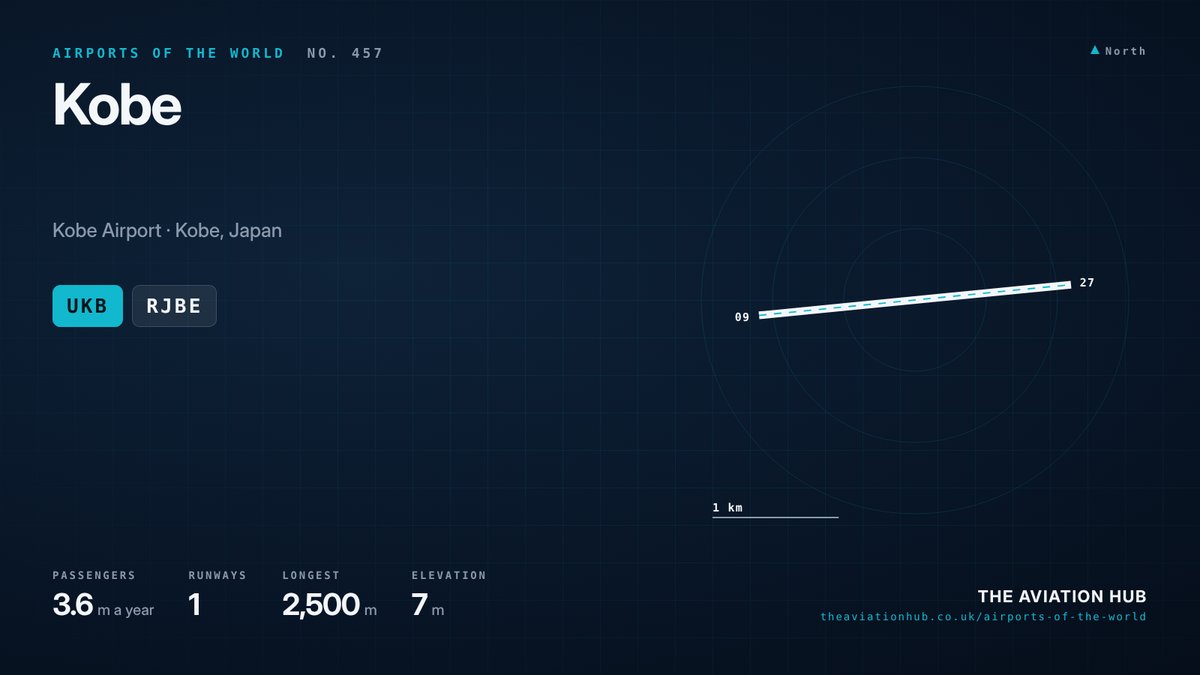
Kobe Airport sits on a man made island in Osaka Bay, just south of Port Island and a short train ride from central Kobe. It is one of three airports serving the Kansai region, alongside Kansai International and Osaka Itami, and it was long restricted to domestic flights. That changed in April 2025, when a new international terminal opened. Around 3.6 million passengers used it in 2024, most of them flying with Skymark Airlines.
Kobe Airport at a Glance
The IATA code is UKB and the ICAO code is RJBE. The airport lies about 5 miles (8 km) south of Sannomiya, Kobe’s main downtown hub, at an elevation of 22 feet (7 m). It has one runway, a domestic terminal and an international terminal, and the whole site covers 156 hectares. Kobe Airport handled 3,576,118 passengers and 33,300 aircraft movements in 2024.
Kobe City owns the airport, and since 1 April 2018 it has been operated by Kansai Airports Kobe, a company formed by Orix, Vinci Airports and Kansai Airports. Skymark Airlines and Fuji Dream Airlines are based here. Timetables and access details are on the airport’s official website.
How Kobe’s Airport Came to Be
Kobe City first proposed an airport next to Port Island in 1971. The plan was scaled back and then stalled for lack of money. The turning point came after the Great Hanshin earthquake of January 1995, when the national government backed the project as part of the city’s recovery.
The decision was controversial. Kobe was carrying heavy debts from the earthquake, and in 2000 a petition signed by 87,000 people sought to recall the mayor over the airport. Construction went ahead from September 1999, and the airport opened on 16 February 2006. Japan Airlines operated the first flight and All Nippon Airways the first scheduled service.
Japan Airlines withdrew from Kobe Airport on 1 June 2010 as part of its bankruptcy restructuring. Skymark filled the gap and became the dominant carrier. Private management arrived in 2018, and the international terminal followed on 18 April 2025, opening just days after Expo 2025 began in Osaka.
Runways at Kobe Airport
There is one runway, 09/27, with an asphalt surface measuring 2,500 metres (8,202 feet) long and 61 metres wide. It suits the Boeing 737 and Airbus A320 families and regional jets such as the Embraer E175, which make up nearly all of the traffic. Approaches cross open water, so the island setting keeps noise away from homes.
Movements are limited by agreement rather than by the runway. The Transport Ministry caps scheduled domestic operations to protect the roles of Kansai International and Itami. On 31 May 2024 a light aircraft from the Hirata Gakuen flight school landed with its wheels up during a touch and go. Nobody was hurt, but the runway closed and 34 flights were cancelled.
Terminals and Airlines
Terminal 1 handles domestic flights and Terminal 2 handles international services. Both are compact, with short walks and quick security, which makes the airport popular with local travellers. The international flights are technically operated as charters, a legacy of the rules that long kept the airport domestic.
Skymark carries about two thirds of all passengers at Kobe Airport, flying Boeing 737-800s to Tokyo Haneda, Sapporo Chitose, Sendai, Naha, Kagoshima and other cities. ANA flies to Haneda and Chitose, and Fuji Dream Airlines connects smaller regional cities with Embraer jets. Internationally, Korean Air serves Seoul Incheon, EVA Air and Starlux fly to Taipei Taoyuan, and Starlux also links Taichung.
Routes and Destinations
Tokyo Haneda is the core route, served by both Skymark and ANA, carrying business and leisure travellers who prefer the quick ride into central Kobe over a trip to Itami. Sapporo, Naha and Kagoshima are important leisure markets. Skymark’s low fares draw passengers from across Hyogo and western Osaka.
International flying is new and growing. Jeju Air joined the Seoul Incheon route in summer 2026, and Aero K flies seasonal charters to Cheongju. Taiwan and Korea provide most of the inbound tourists. Cargo is minimal. Kobe Airport functions as a convenient city airport rather than a long haul gateway.
Getting to and from Kobe Airport
The Port Liner automated transit line reaches Kobe Airport Station, beside the terminal, and runs to Sannomiya in about 18 minutes. It is the cheapest sensible option and connects with JR, Hankyu, Hanshin and the subway at Sannomiya. The extension to the airport opened on 2 February 2006.
Buses run to Shin Kobe, Sannomiya and Kobe stations every 25 to 40 minutes. The Kobe Kanku Bay Shuttle ferry crosses Osaka Bay to Kansai International in about 30 minutes, a useful link for international connections. Travellers heading for the Shinkansen can take the bus to Shin Kobe or change to the subway at Sannomiya. Taxis reach Sannomiya in around 15 minutes. Parking is available on the island next to the terminals.
Spotting and Photography
Kobe Airport offers fine views for enthusiasts. The terminal’s rooftop observation deck looks across the runway to Osaka Bay, with the Rokko mountains and the Kobe skyline behind. Sunsets over the bay are spectacular, and evening shots of aircraft against the city lights are a local speciality. The southern shore of Port Island, across the narrow channel, offers another angle on arrivals and departures.
The traffic is dominated by Skymark 737s, with ANA jets, Fuji Dream Embraers in their rainbow of colours and the new international arrivals. Japanese airports are relaxed about photography in public areas, but stay behind barriers, follow staff instructions and respect other visitors on the deck.
What Comes Next
International growth is the big story. Regional agreements allowed charter style international flights from 2025, with fully scheduled international services expected around 2030. The Kansai Three Airports Council, which brings together local governments and business groups, decides how traffic is shared between Kobe, Itami and Kansai International. Supporters argue the domestic cap is out of date, because it was set when Kansai International was expected to operate far more flights than it does today.
The verdict: Kobe Airport is evolving from a domestic outpost into a genuine third gateway for Kansai, but its future depends on how far regulators loosen the caps. Compare it with its two Kansai neighbours on the Airports of the World map.
Continue to follow The Aviation Hub for more analysis and insight.
Advertise with us Your brand, in front of an aviation audience Home page and in-article placements, sold directly, one advertiser per slot. From £250 a year. See the rates

