
Kochi Airport Guide: Kerala’s Solar Powered Gulf Gateway
Kochi Airport was built with money from Keralites abroad and now runs on solar power. Explore its runway, terminals, Gulf routes, transport and spotting.
 By The Aviation Hub
6 min read
Updated October 20, 2026
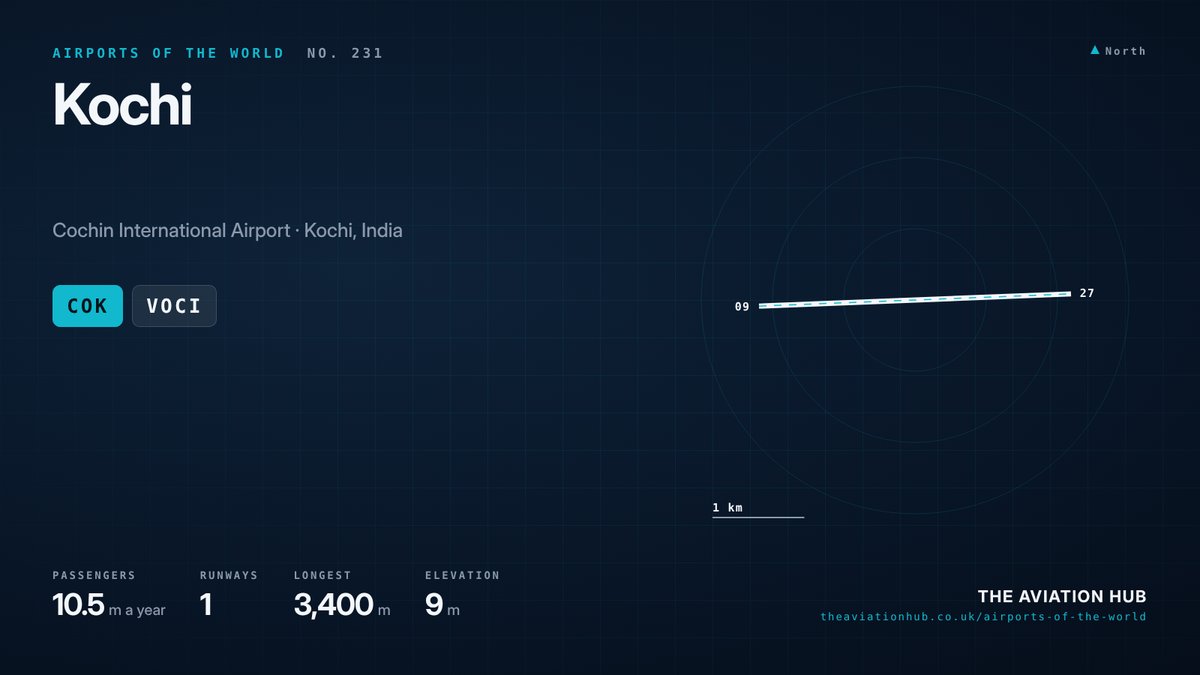
Cochin International Airport stands at Nedumbassery, on low lying land about 16 miles (25 km) north east of central Kochi in the Indian state of Kerala. It was the first airport in India built as a public private partnership, funded largely by Keralites working abroad. Kochi Airport handled about 11.3 million passengers in the year to March 2026, and its links to the Gulf make it a lifeline for one of the world’s largest migrant communities. It is also famous for running entirely on solar power.
Kochi Airport at a Glance
The IATA code is COK and the ICAO code is VOCI. The field sits just 30 feet (9 m) above sea level, between National Highway 544 and the MC Road. It has a single runway, two domestic terminals, one international terminal and a cargo terminal. In the 2025 to 2026 financial year it recorded around 11.3 million passengers, roughly 71,700 aircraft movements and about 68,000 tonnes of cargo.
Air India treats Kochi Airport as a focus city, while Air India Express and IndiGo keep operating bases here. More than 25 airlines serve upwards of 55 destinations. The operator is Cochin International Airport Limited, known as CIAL, a company owned by the Kerala government alongside thousands of private shareholders. Flight information and transport details are on the airport’s official website.
How Kochi’s Airport Came to Be
For six decades the city made do with an airstrip on Willingdon Island, built in 1936 by the Kingdom of Cochin for officials developing the port. The British turned it into a military airfield during the Second World War, and the Indian Navy later ran it as INS Garuda while allowing civil flights. By the 1980s the Gulf boom had created huge demand that the cramped naval field could not meet.
The solution was unusual. Rather than wait for central government money, Kerala set up CIAL and invited investment. Around 10,000 non resident Indians bought shares, and the airport was built on a fresh site at Nedumbassery. President K. R. Narayanan inaugurated it on 25 May 1999, commercial flights began on 10 June and all operations moved across from the naval field on 1 July 1999.
Two milestones followed. Terminal 3 opened in March 2017 for international traffic, and in 2015 Kochi Airport became the first airport in the world to run fully on solar power, earning a United Nations Champions of the Earth award in 2018.
Runways at Kochi Airport
There is one runway, 09/27, with an asphalt surface 3,400 metres (11,155 feet) long and 45 metres wide. A full parallel taxiway keeps the runway clear between movements. The strip handles Code E wide bodies such as the Boeing 777-300ER flown by the Gulf carriers, as well as the Airbus A320neo and Boeing 737 MAX fleets that carry most passengers.
The runway runs east to west, and the sea breeze from the Arabian Sea means runway 27 sees the most use. The monsoon from June to September is the real operational challenge. Heavy rain reduces braking action, and in 2011 a Gulf Air flight skidded off the runway in a downpour, injuring several passengers. In August 2018 catastrophic floods across Kerala closed the airport for more than two weeks, with water covering the runway and aprons.
Terminals and Airlines
Terminal 3 handles every international flight at Kochi Airport. It opened in 2017 with 84 check in counters and 80 immigration counters, and its sloping roofs echo traditional Kerala architecture. Emirates, Etihad, Qatar Airways, Saudia, Gulf Air, Oman Air, Kuwait Airways, Air Arabia and flydubai bring a heavy wide body and narrow body presence from the Gulf.
Terminal 1 was the original international building. After renovation it reopened in December 2018 as the main domestic terminal, with 56 check in counters and seven aerobridges. IndiGo, Air India, Air India Express and Akasa Air dominate the domestic flying, using Airbus A320neo family jets and Boeing 737s. A smaller Terminal 2 supports domestic operations at peak times.
A 50,000 square foot transit lounge, opened in September 2024, gives travellers a place to rest between flights without leaving the airport.
Routes and Destinations
Domestic trunk routes are the busiest at Kochi Airport by frequency. Bengaluru and Mumbai each saw around 13 daily departures in May 2026, with Delhi at about 10 and Hyderabad at seven. Chennai, Kolkata and the smaller cities of southern India fill out the network.
Internationally, the Gulf rules. Abu Dhabi alone has about nine flights a day, and Dubai, Sharjah, Doha, Muscat, Bahrain, Kuwait, Riyadh, Dammam and Jeddah follow. These flights carry Malayali workers and their families, and demand spikes around Onam, Eid, Christmas and the school holidays. South East Asia is a second market, with links to Singapore and Kuala Lumpur, and SriLankan Airlines serves Colombo. Saudi routes such as Jeddah, roughly 2,600 miles (4,200 km) away, are among the longest.
Cargo matters too. Seafood, fruit and vegetables travel to the Gulf in bellyholds, and a warehouse extension opened in January 2026 raised annual capacity to 125,000 tonnes.
Getting to and from Kochi Airport
The airport has no rail station of its own yet. Angamaly station is about 3 miles (5 km) away, and a dedicated Cochin Airport station is planned on the main line. Kochi Metro runs feeder buses from Aluva station, which is the cheapest sensible route into the city, and an extension of the metro to Kochi Airport is planned.
By road, the field sits beside National Highway 544, which links it to Aluva, Ernakulam and Thrissur. A taxi to Ernakulam or Fort Kochi takes 45 minutes to well over an hour, depending on traffic, and prepaid taxi counters operate in both terminals. Kerala state buses and app based cabs also serve the terminals, and parking is plentiful.
Spotting and Photography
Kochi Airport offers good variety but needs care. Indian airports are sensitive places, and photography near the perimeter can attract quick attention from security staff. The safest views are from inside the terminals, where gate windows overlook the apron.
Outside, the roads and paddy fields around the eastern and western ends of the runway give views of arrivals. The best variety comes in the evening and late at night, when Gulf wide bodies from Emirates, Etihad and Qatar Airways arrive in waves. The vast solar arrays beside the airfield make an unusual foreground. Monsoon skies are dramatic but light is unreliable.
Stay on public roads, avoid lingering by fences and stop immediately if asked. Carry identification and be ready to explain yourself politely.
What Comes Next
CIAL is pushing beyond passengers. A large maintenance, repair and overhaul facility is planned, and a naval aircraft enclave has been under construction since 2013. The new railway station and the metro extension would give the airport proper rail access for the first time.
The pressure point is the single runway and a flood prone site. Gulf demand shows no sign of fading, and Kerala’s travel boom keeps adding domestic flights. Kochi Airport is heading for continued growth, powered by the sun and by Malayalis abroad, as long as it can stay dry in the monsoon. See how it compares with Thiruvananthapuram and Kozhikode on the Airports of the World map.
Continue to follow The Aviation Hub for more analysis and insight.
Advertise with us Your brand, in front of an aviation audience Home page and in-article placements, sold directly, one advertiser per slot. From £250 a year. See the rates

