
Kolkata Airport Guide: Eastern India’s Historic Gateway
Kolkata Airport at Dum Dum is the hub for eastern and northeastern India, with two runways and a new metro link. Runways, routes and access explained.
 By The Aviation Hub
7 min read
Updated October 20, 2026
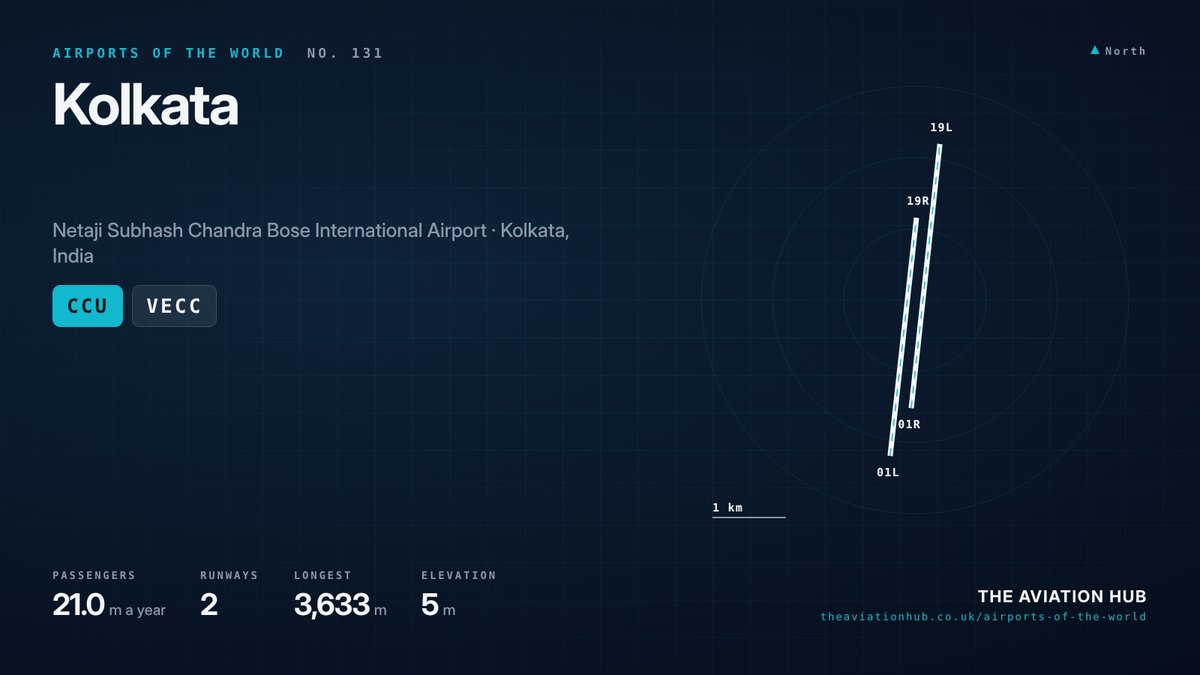
Netaji Subhas Chandra Bose International Airport lies at Dum Dum, about 10 miles (16 km) north east of the centre of Kolkata in West Bengal. It is the principal gateway for eastern and northeastern India and the sixth busiest airport in the country. Kolkata Airport handled close to 22 million passengers in the year to March 2025, the great majority of them domestic. Two parallel runways and a single integrated terminal serve a network that stretches from Delhi and Mumbai to the hill states of the north east, Bangladesh, Bhutan and the Gulf.
Kolkata Airport at a Glance
The codes are CCU and VECC, the IATA code preserving the old spelling of Calcutta that the city used until 2001. The field sits at just 5 m (16 ft) above sea level on the flat Gangetic delta. It has two runways, 01R/19L and 01L/19R, and one passenger terminal, the integrated Terminal 2 that opened in 2013.
The Airports Authority of India owns and operates Kolkata Airport, one of the few large Indian airports not handed to a private concession. IndiGo is by far the largest airline, with Air India, Air India Express, Akasa Air and SpiceJet also running substantial operations. Traffic in the 2024 to 2025 financial year was around 21.8 million passengers, split roughly 19.4 million domestic and 2.4 million international, a rise of about 10 per cent. Terminal maps and flight information are on the airport’s official website.
A Short History of Dum Dum
Flying at Dum Dum began on open ground beside the Royal Artillery armoury in the early years of the twentieth century. KLM started scheduled stops in 1924 on its route to the Dutch East Indies, which makes this one of the oldest airports in India. Calcutta became a vital staging post on the imperial air routes between Europe, Australia and the Far East, and Amelia Earhart passed through on her final flight in 1937.
The airport served as a major Allied base in the Second World War. Tragedy followed in peacetime. On 2 May 1953 a BOAC de Havilland Comet broke up in a storm shortly after take off, killing all 43 aboard, one of the first fatal accidents of the jet age. A Pan Am Boeing 707 struck a tree on approach in heavy rain in 1968 and six people died.
The airport was renamed after the Bengali nationalist leader Subhas Chandra Bose in 1995. The modern era began on 20 January 2013 with the inauguration of the integrated Terminal 2, and all flights moved there that March. The old domestic and international buildings closed and the domestic terminal awaits demolition.
Runways at Kolkata Airport
The primary runway, 01R/19L, is 3,633 m (11,919 ft) long and 46 m wide, surfaced in asphalt. The secondary runway, 01L/19R, is 3,271 m (10,732 ft) long, with displaced thresholds that shorten the landing distance, and the same width, also asphalt. They lie close together, so the shorter runway often serves as a taxiway while the main runway handles the flow. The primary runway has been rated at about 35 movements an hour, with improvements in 2025 raising total capacity to around 45.
Kolkata Airport is notorious for winter fog, when the dense morning murk of the Ganges delta can ground flights for hours. A Category IIIB instrument landing system on 19L went live on 27 November 2025, allowing landings in visibility as low as 50 m and easing the seasonal disruption. Southerly winds dominate for most of the year, so 19L is the usual arrival runway, with the 01 direction used in the cooler months.
Extending the secondary runway northwards is impossible because a mosque more than a century old stands near its threshold. Expansion has therefore been pushed to the southern end. Spotters note that Indian Air Force transport aircraft are regular visitors.
Terminals and Airlines
Terminal 2 is a large L shaped building of glass and steel with 18 aerobridge gates and a further 55 remote stands reached by bus. It handles domestic and international flights under one roof, with international gates grouped at one end. The ceilings carry artwork inspired by the poet Rabindranath Tagore, a reminder of where you are. Modular extensions commissioned in 2026 added domestic space and a new international immigration and customs area.
IndiGo dominates with Airbus A320neo and A321neo aircraft and ATR 72 turboprops to the smaller cities of the north east. Air India and Air India Express fly Airbus A320 family and Boeing 737 MAX jets, and Air India runs the lounges and maintenance hangars. Akasa Air and SpiceJet complete the domestic picture.
International carriers include Emirates, Qatar Airways, Etihad, flydubai, Air Arabia, Singapore Airlines, Thai Airways, Malaysia Airlines, AirAsia, Biman Bangladesh, US Bangla, Druk Air and Bhutan Airlines. The international apron is busy in the evening and early morning when the Gulf and south east Asian flights arrive.
Routes and Destinations
Delhi and Mumbai are the heavyweight routes, each flown many times a day by several airlines, followed by Bengaluru, Hyderabad and Chennai. Guwahati, Bagdogra, Agartala and Imphal connect the north eastern states, for which Kolkata Airport is the natural gateway, and Bhubaneswar, Patna and Ranchi feed in from the neighbouring states.
Internationally the airport serves Dhaka and Chittagong in Bangladesh, Paro in Bhutan, Kathmandu, Bangkok, Singapore, Kuala Lumpur, Dubai, Doha and Abu Dhabi. The Gulf routes are the longest scheduled services, with Doha the furthest at around 2,300 miles (3,700 km), and there is no direct flight to Europe or North America. Cargo is significant, with the airport handling fresh produce and textiles and with freighters from Blue Dart and the integrators.
Getting to and from Kolkata Airport
The metro finally arrived on 22 August 2025 when Jai Hind station opened beneath the airport approach on the Yellow Line from Noapara. It is described as the largest underground metro station in India and will later be served by the Orange Line from New Garia. Changing at Noapara puts the city centre around 45 minutes away for a fare of a few tens of rupees, the cheapest sensible option by far.
The old elevated rail branch closed in 2016 and was dismantled, so the nearest mainline stations are Dum Dum Cantonment and Durganagar. Prepaid taxi counters in the arrivals hall charge roughly ₹400 to ₹600 (about £4 to £6) to central Kolkata, and Ola and Uber pick up from a designated zone. The journey takes 45 minutes to over an hour along VIP Road, depending on traffic. Air conditioned WBTC buses run to Howrah, Esplanade and Salt Lake between about 7am and 11pm.
Spotting and Photography
Kolkata Airport is a difficult place to photograph from outside, as security around Indian airports is strict and photography near the fence attracts rapid attention. The best views are from inside Terminal 2, where the departure lounges look onto the aprons and the main runway beyond. The Jessore Road side near the northern thresholds has given views of arrivals in the past, but police presence is common.
Arrivals usually come in from the north onto 19L through the warmer months and from the south onto 01R in winter. Morning light favours the eastern side. Highlights include Singapore Airlines Airbus A350-900s, Emirates Boeing 777-300ERs, Druk Air A319s and Indian Air Force Ilyushin Il-76 and Boeing C-17 transports.
Do not point a camera at the fence, military ramps or security staff. Stay inside the terminal or on the public road, and put the camera away if asked.
What Comes Next
The Airports Authority of India has approved a new terminal on the site of the old domestic building, with its first phase aimed at international traffic, as part of a programme valued at around ₹4,500 crore. Parking stands are to rise from 73 in 2025 to 132 by 2033. A new air traffic control complex with a 56 m tower began trials in 2025, although an electrical fault that October halted operations for two weeks.
The constraints are the mosque at the northern end, the dense suburbs on every side and the fog. A proposed second airport for the region at Bhangar has been discussed for years without a decision.
Kolkata Airport will keep growing with the north east and with India’s domestic boom, but it will do so within a tight fence. See how it compares with the rest of the country on the Airports of the World map.
Continue to follow The Aviation Hub for more analysis and insight.
Advertise with us Your brand, in front of an aviation audience Home page and in-article placements, sold directly, one advertiser per slot. From £250 a year. See the rates

