
Kos Airport Guide: Hippocrates’ Island and Its Charter Boom
Kos Airport carried more than three million passengers in 2025. Read about its history, runway, terminal, charter airlines, routes and island transfers.
 By The Aviation Hub
5 min read
Updated October 20, 2026
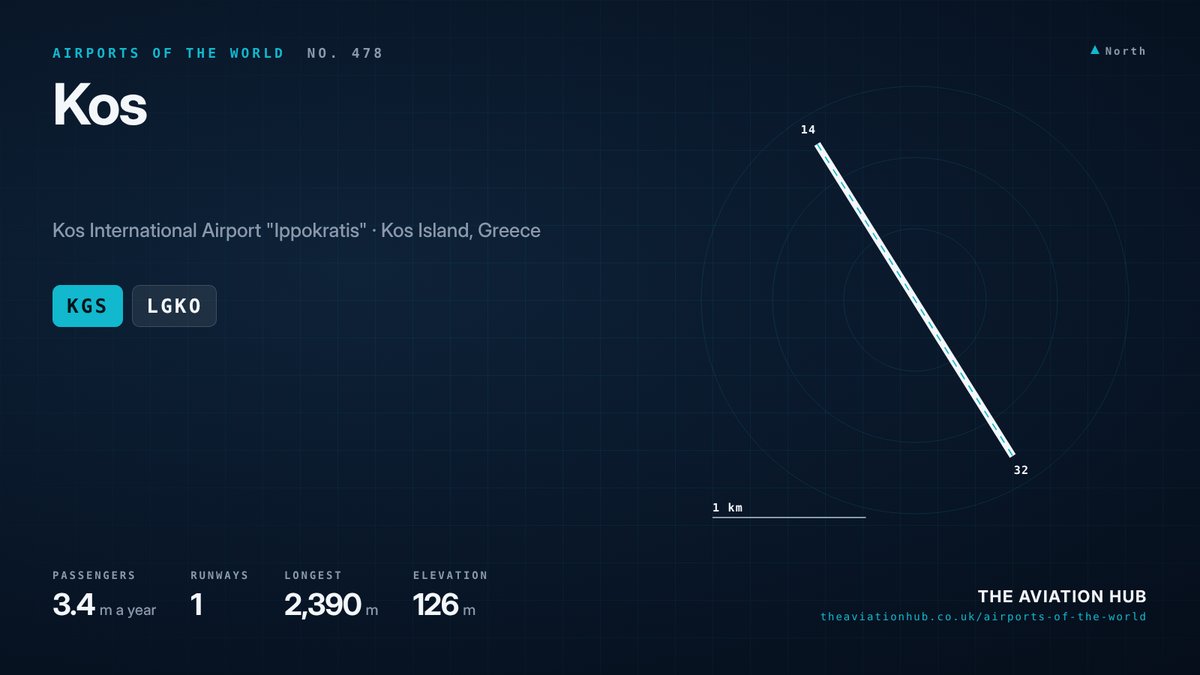
Kos Airport sits on the central plateau of Kos, a long, narrow Dodecanese island just off the Turkish coast. Named after Hippocrates, the father of medicine who was born on the island, it is a classic Greek summer airport. More than three million passengers passed through in 2025, almost all of them between April and October. British, German, Polish and Dutch holidaymakers dominate, arriving on charter and low cost flights for the beaches of Kardamena, Tigaki and Kefalos.
Kos Airport at a Glance
The codes are KGS for IATA and LGKO for ICAO. The airport lies near the village of Antimachia, about 15 miles (24 km) south west of Kos town. Elevation is 126 metres (412 feet). There is one runway and one passenger terminal.
Traffic reached 3,176,063 passengers in 2025, up from about 3.07 million in 2024. Aegean Airlines treats Kos Airport as a focus city, linking it with Athens and Thessaloniki. easyJet, Ryanair, Jet2.com, TUI and Condor carry the summer crowds. Fraport Greece runs the airport under a 40 year concession, and timetables are on the airport’s official website.
A Short History of Kos’s Airport
The airport opened on 4 April 1964, when Kos was still a quiet agricultural island. Tourism grew quickly through the following decade, and the runway was extended to around 2,400 metres in 1974 to take larger jets. Charter flights from Northern Europe followed.
A new terminal was built in 1980 to cope with rising traffic, and it was renovated and expanded in 1997. The airport takes its formal name, Ippokratis, from Hippocrates, whose teaching tradition is linked with the Asklepieion healing sanctuary near Kos town.
The island made headlines across Europe in 2015, when thousands of refugees crossed by boat from Turkey and landed on its beaches. Tourism weathered the crisis and kept growing. Privatisation then reshaped the airport. Fraport and its Greek partner Copelouzos took over Kos and 13 other regional airports on 11 April 2017 for 40 years. Immediate upgrades brought better lighting, airside markings, toilets, WiFi and fire safety, and a new terminal and fire station followed, with works completed in 2021.
Runways at Kos Airport
There is a single asphalt runway, 14/32, measuring 2,390 metres (7,841 feet) long and 45 metres wide. That suits the Airbus A320 and Boeing 737 families that carry nearly all passengers, and it can handle Boeing 757s and occasional wide body charters.
The runway runs north west to south east across the plateau. Summer is dominated by the meltemi, the strong northerly wind of the Aegean, which usually favours runway 32 with arrivals from the south east. Gusty crosswinds can make for lively landings on the windiest afternoons.
In 2013 an Air Explore Boeing 737 made an emergency landing at Kos Airport after its left engine overheated. The engine caught fire after the jet reached the gate, and the crew evacuated passengers by slide. Nobody was hurt.
Terminals and Airlines
All flights use the single terminal, a 24,000 square metre building completed by Fraport Greece in 2021. It handles domestic, Schengen and non Schengen traffic, and British flights require passport control. Summer Saturdays can be crowded, when charter waves arrive within a few hours, although the rebuild raised the number of check in desks from 16 to 28.
Aegean provides the year round domestic backbone, flying to Athens and Thessaloniki, with seasonal Heraklion. easyJet, Ryanair and Jet2.com run large summer networks from British and European airports. TUI carries package holidaymakers from the UK and Germany, while Condor and other German carriers serve the German market. Polish and Dutch charter airlines add further capacity.
Routes and Destinations
The United Kingdom is the largest market, with about 768,000 passengers in 2024. Germany follows closely at around 712,000. Domestic Greek traffic came third at about 326,000, mostly on the Athens route, ahead of Poland and the Netherlands at roughly 225,000 each.
That pattern tells the story of Kos Airport. Manchester, London, Birmingham, Bristol and other British airports send heavy summer traffic, while German demand spreads across many cities. The Polish market has grown strongly in recent years.
The season starts around Easter, peaks in July and August and ends in late October. Winter traffic is limited to the Athens link and a few domestic services. There are no long haul flights and little cargo. Shoulder months have grown as low cost airlines add capacity in May, June and October, when the sea is still warm and fares are lower.
Getting to and from Kos Airport
There is no rail on the island. Public buses run from the airport to Kos town, Mastichari, Kardamena and Kefalos, and they are the cheapest sensible option for travellers with light luggage. Timetables are built around the summer season.
Taxis operate around the clock outside the terminal, with the drive to Kos town taking about 30 minutes. Many visitors arrive on package holidays, and operators such as Jet2holidays and TUI provide free coach transfers. The airport sits on the main road between Kos town and Kefalos. Mastichari, a few miles north, has ferries to the island of Kalymnos. From the harbour in Kos town, boats run to neighbouring Dodecanese islands and across the strait to Bodrum in Turkey, a popular day trip for visitors.
Spotting and Photography
Kos Airport is a good summer spotting destination. Quiet roads around Antimachia give views of aircraft on approach and departure, and the open plateau offers clear sightlines with the sea and Turkish coast in the distance.
Summer Saturdays bring the best variety, with Jet2 Boeing 737-800s, easyJet Airbus A320neos, Ryanair 737s, TUI 737 MAX 8s and Condor A320s, plus Polish and Dutch charters. Greek law restricts photography of military sites, and the island lies in a sensitive border area. Keep to airliners, stay on public land and follow police instructions.
What Comes Next
Fraport’s new terminal and fire station, finished in 2021, have already modernised the airport. Traffic now sits above three million passengers a year, and Saturday peaks are the main pressure point.
Kos Airport looks set to keep growing gently as low cost airlines extend the season into spring and autumn. Overtourism concerns and limits on island infrastructure may cap the pace. See how it compares with Rhodes and other Greek islands on our Airports of the World map.
Continue to follow The Aviation Hub for more analysis and insight.
Advertise with us Your brand, in front of an aviation audience Home page and in-article placements, sold directly, one advertiser per slot. From £250 a year. See the rates

