
Krabi Airport Guide: Limestone, Beaches and a Busy Runway
Krabi Airport is the holiday gateway to Ao Nang, Railay and the islands. Read about its history, runway, terminals, airlines, routes and transport.
 By The Aviation Hub
5 min read
Updated October 20, 2026
Limestone cliffs, island hopping and quiet beaches have turned Krabi into one of southern Thailand’s most popular holiday regions. Krabi Airport is the main way in. Opened in 1999, it sits just outside Krabi town on the Andaman coast and handles roughly three to four million passengers a year. It serves Ao Nang, Railay, Koh Lanta and the Phi Phi Islands, and acts as a less crowded alternative to Phuket across Phang Nga Bay.
Krabi Airport at a Glance
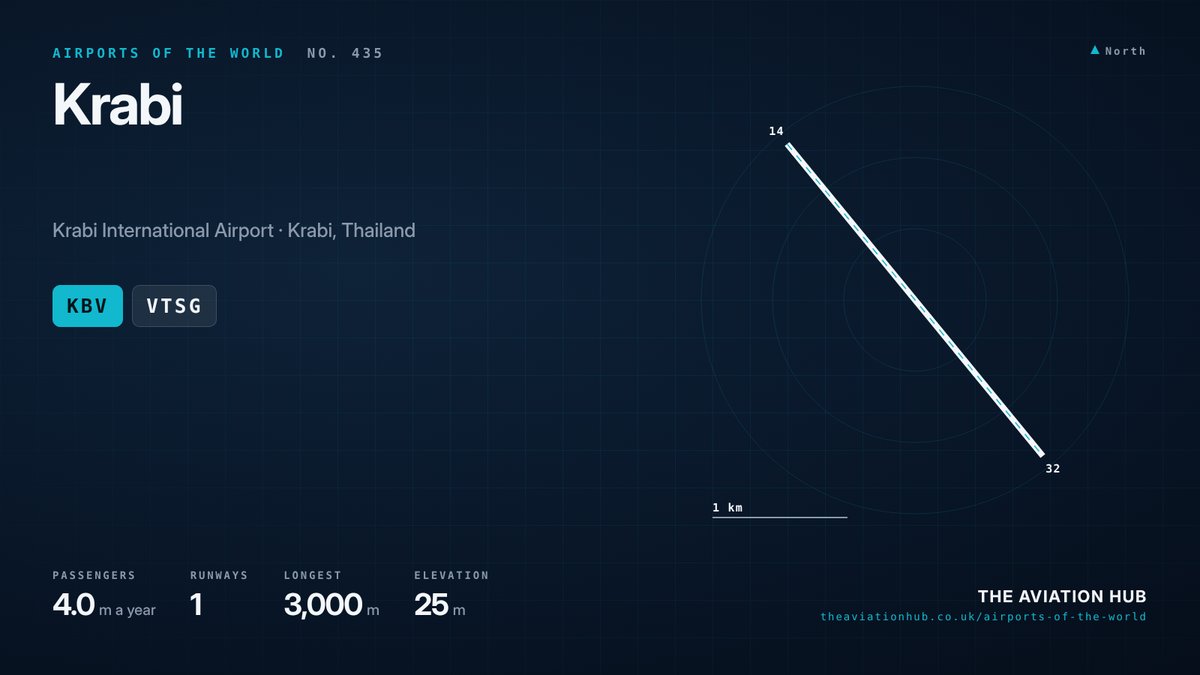
The IATA code is KBV and the ICAO code is VTSG. Krabi Airport lies about 4 miles (7 km) east of downtown Krabi, in Nuea Khlong district. The elevation is 82 feet (25 metres). There is one runway and two terminal buildings, with a third terminal forming part of a long running expansion programme.
The field handled about 3.1 million passengers in 2025, split between roughly 2.3 million domestic and 0.8 million international travellers. Traffic peaked at about 4.3 million in 2017. Thai AirAsia keeps a base here. Unlike Phuket, the field is run by the government’s Department of Airports rather than Airports of Thailand. Flight information is on the airport’s official website.
How Krabi’s Airport Came to Be
Krabi grew as a destination in the 1980s and 1990s, as backpackers discovered Railay’s cliffs and the Phi Phi Islands. Most visitors then arrived by long bus journeys or by ferry from Phuket. A local airport was the obvious next step.
Krabi Airport opened on 10 July 1999 and soon attracted domestic flights from Bangkok. The 2004 Indian Ocean tsunami devastated the Phi Phi Islands and parts of the Krabi coast, and tourism took several years to recover. Low cost airlines then transformed the airport’s fortunes. Thai AirAsia and Nok Air brought cheap fares, and international links followed with Kuala Lumpur and Singapore. Seasonal charter flights from Europe added winter traffic.
The airport has had its share of hiccups. On 10 February 2016 a planned power shutdown went wrong when backup generators failed. The terminal was without power from 09:00 to 15:30, and immigration officers handwrote the details of around 2,000 arriving passengers. Police later confirmed that no blacklisted visitors had entered.
Runways at Krabi Airport
A single asphalt runway, 14/32, measures 3,000 metres (9,842 feet) long and 45 metres (148 feet) wide. That length handles narrow body jets such as the Airbus A320neo and Boeing 737-800 with ease. It also allows wide body aircraft on some medium haul routes.
The runway runs northwest to southeast, with the karst hills of the Krabi coast in view. Wind direction shifts with the monsoon, and both ends see regular use. Tropical downpours are frequent in the southwest monsoon from May to October, and afternoon storms can briefly hold departures.
With one runway, capacity is tight during the high season peaks. The expansion programme adds aircraft parking to cope with waves of arrivals.
Terminals and Airlines
Two terminal buildings handle domestic and international flights. A 6.6 billion baht programme, approved in 2018, funds a third terminal, renovation of the existing buildings, a new car park, extra aircraft stands and power upgrades. A related project aims to double capacity to eight million passengers a year.
Thai AirAsia is the largest operator at Krabi Airport, flying Airbus A320 jets to both Bangkok airports and other Thai cities. Thai Lion Air, Thai Vietjet, Nok Air and Thai Airways have also served Bangkok. AirAsia and Scoot connect with Kuala Lumpur and Singapore. Gulf carriers and European charter operators add seasonal flights.
Routes and Destinations
Bangkok is the busiest destination, split between Suvarnabhumi and Don Mueang, with dozens of daily flights. Chiang Mai and Koh Samui add domestic links, the latter useful for travellers combining Thailand’s two coasts. Kuala Lumpur and Singapore are the strongest international routes.
Flights connect Krabi Airport with Dubai and Sharjah, and Etihad adds seasonal services to Abu Dhabi. IndiGo links the city with India. Seasonal flights to Helsinki, Copenhagen and Warsaw are the longest routes, at more than 5,000 miles (8,000 km). Many are timed for the high season from November to April, when the Andaman Sea is calm and dry. Summer is quieter, as the southwest monsoon brings rain and rough seas to the islands.
Getting to and from Krabi Airport
Airport buses link the terminals with Krabi town and Ao Nang, and they are the cheapest sensible option for most visitors. Krabi town is about 20 minutes away by road, while Ao Nang takes around 40 minutes. Taxis and private transfers operate from desks in the arrivals hall at fixed prices.
Many travellers head straight for the islands. Minivans and ferries connect with Koh Lanta, while boats for the Phi Phi Islands and Railay leave from piers in Krabi town and Ao Nang. There is no rail line in the province. Car hire desks and a car park sit beside the terminals.
Spotting and Photography
Krabi Airport offers a striking backdrop, with limestone hills rising behind arriving aircraft. Public roads around the perimeter give views of both approaches. The mix of Thai low cost jets, Gulf carriers and European charters keeps the high season interesting. Thai AirAsia’s red and white Airbus A320 family jets provide the bulk of movements year round.
In the dry high season the sun sits in the southern sky for much of the day. Positions on the southwestern side of the runway generally keep it behind the camera. Afternoon storms in the wet season can produce dramatic skies over the karsts.
Thailand tolerates airport photography more than many countries, but rules still apply. Stay on public land, keep clear of fences and follow instructions from police or airport staff.
What Comes Next
The current expansion is designed to take capacity to eight million passengers a year. Limited space and urban growth mean the airport is not expected to grow beyond that final phase. A new Andaman airport in Phang Nga Province has been proposed to absorb future demand from both Krabi and Phuket. Phuket itself is under heavy pressure at peak times, which strengthens the case for both projects.
Tourism demand should keep Krabi Airport busy as the expansion is completed, especially if more long haul carriers commit to the region. Compare it with Phuket and other Thai airports on our Airports of the World map. The verdict: Krabi Airport is a growing leisure gateway with room for one more big step, after which the region’s next growth will need a new airport.
Continue to follow The Aviation Hub for more analysis and insight.
Advertise with us Your brand, in front of an aviation audience Home page and in-article placements, sold directly, one advertiser per slot. From £250 a year. See the rates

