
Krakow Airport Guide: Poland’s Fast Growing Southern Hub
Krakow Airport at Balice is Poland's second busiest, with one runway and 13 million passengers. History, routes, rail access and spotting explained.
 By The Aviation Hub
6 min read
Updated October 20, 2026
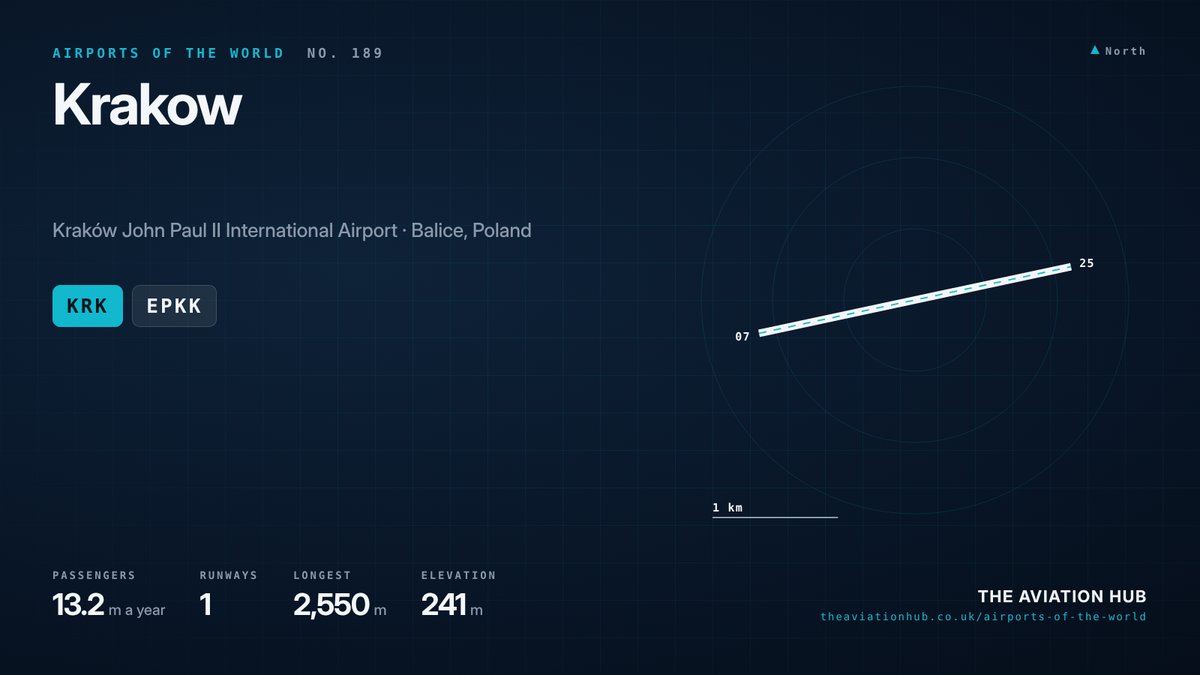
Krakow Airport, officially John Paul II International Airport Krakow Balice, is the second busiest airport in Poland and the gateway to the country’s historic former capital. It lies at Balice, just west of the city, and shares its runway with a Polish Air Force transport unit. Passenger numbers jumped almost 20 per cent in 2025 to around 13.2 million, driven by Ryanair, Wizz Air and a tourism boom. A single runway and a terminal already judged too small make it one of the most pressured airports in central Europe.
Krakow Airport at a Glance
The IATA code is KRK and the ICAO code is EPKK. The terminal lies about 7 miles (11 km) west of the Main Market Square in the village of Balice. Elevation is 241 metres (791 feet). There is one concrete runway with a grass emergency strip alongside, and one passenger terminal completed in December 2016, joined to the older 1993 building.
Traffic in 2025 reached roughly 13.2 million passengers, up from 11.1 million in 2024 and 9.4 million in 2023. Ryanair has based aircraft here since March 2013 and is the largest carrier. Wizz Air, LOT Polish Airlines and Ryanair’s Polish subsidiary Buzz treat Krakow Airport as a focus city. easyJet, Norwegian, Lufthansa, British Airways, KLM and flydubai fill out the schedule. The operator is Krakow Airport, a company majority owned by the state through Polish Airports and the regional government. Timetables are on the airport’s official website.
How Krakow’s Airport Came to Be
Balice was a military airfield after the Second World War, and construction of civil facilities began in 1964. The airport opened to civil aviation in 1967 and remained formally a military site until 28 February 1968. For the next two decades LOT ran a handful of domestic flights to Warsaw and the field stayed small.
The fall of communism changed everything. A new terminal opened in 1993, international routes multiplied and in 1995 the airport was named after Pope John Paul II, born in nearby Wadowice and Archbishop of Krakow from 1963 to 1978. The official name was shortened for marketing in 2007. The arrival of Ryanair, easyJet and Wizz Air after Poland joined the European Union in 2004 turned Krakow into a weekend city break destination for half of Europe.
A seven storey car park opened in 2010 and construction of the current terminal began in April 2013. It was completed in December 2016 with a design capacity of about 8 million passengers a year. In 2019 the airport recorded the largest passenger increase of any airport in Europe, around 24 per cent, before the pandemic cut traffic by 69 per cent in 2020. Recovery has been equally dramatic.
Runways at Krakow Airport
Krakow Airport has one concrete runway, 07/25, measuring 2,550 metres (8,366 feet) by 60 metres. A grass emergency runway of the same length lies parallel to it. The paved runway is long enough for the Boeing 737-800s and Airbus A321neos that dominate the schedule and for the LOT Boeing 787 on the Chicago route, though heavy departures on hot days can be weight limited.
Runway 25 is the more common direction, with arrivals over the eastern approaches near the city and departures climbing out over the Vistula valley to the west. Runway 07 brings aircraft in over Balice and the motorway. Fog is a regular winter problem in the valley, and the airport has invested in its instrument landing system and approach lighting to reduce diversions to Katowice.
The Polish Air Force’s 8th Air Base occupies the southern side of the field, flying CASA C-295 transports. Military and VIP movements, including papal and government visits, share the single runway. Capacity on the runway itself is not yet the limit; the terminal and the apron are.
Terminals and Airlines
All passengers use the 2016 terminal, a long glass building built next to the older 1993 structure. The newer building operates around the clock with a central security hall, Schengen gates on one side and non Schengen gates on the other, and a covered footbridge to the railway station. It was designed for 8 million passengers and is now handling well over 13 million.
Ryanair and Buzz carry the biggest share from a large Boeing 737 base. Wizz Air follows with Airbus A320 and A321 aircraft. LOT Polish Airlines runs the Warsaw shuttle plus routes to Chicago, seasonally Newark and several European cities. easyJet, Norwegian, Jet2.com, Lufthansa, Swiss, Austrian, British Airways, KLM, Air France, Turkish Airlines, Etihad and flydubai complete the picture.
Routes and Destinations
Frankfurt was the busiest route from Krakow Airport in 2024 with around 390,000 passengers, followed by London Stansted at about 353,000, Warsaw Chopin at 334,000, Amsterdam at 293,000 and Oslo at 289,000. The British market is one of the largest, with London Luton, Gatwick, Heathrow, Manchester, Edinburgh, Bristol and Liverpool all served. Scandinavia, Germany, Italy and Spain follow.
Long haul is thin but real. LOT flies to Chicago O’Hare, at about 4,730 miles (7,600 km) the longest sector, and seasonally to Newark. Etihad, flydubai and Wizz Air connect the Gulf, and Tel Aviv is served when the political situation allows. Summer is the peak for inbound tourism, but Krakow is unusual in keeping strong winter traffic thanks to the Christmas markets and the ski resorts of Zakopane. Cargo is minor.
Getting to and from Krakow Airport
Rail is the best choice. The SKA1 suburban line runs from Krakow Airport railway station, reached by the footbridge from the terminal, to Krakow Glowny in about 17 minutes and continues to Wieliczka salt mine. Trains run every half hour for most of the day and tickets cost around 17 zloty (roughly £3.40). It is both the cheapest fast option and the most reliable.
Day and night public buses serve the main station and the ICE Congress Centre but take 40 minutes or more. Taxis from the official rank reach the Old Town in 25 to 35 minutes, and app based cars are cheaper. The A4 motorway passes close to the airport, linking it to Katowice and the Silesian conurbation. The multi storey car park and surface lots sit a short walk from the terminal.
Spotting and Photography
The classic location is the mound and fields near the threshold of runway 25, east of the airport by the Rzaska road, where arrivals pass low overhead. The afternoon sun is behind the camera for runway 25 arrivals. When runway 07 is in use, arrivals come in from the west and departures climb out towards the city.
The terminal’s landside windows and the footbridge to the station cover part of the apron, and the car park’s upper deck offers views of the Ryanair and Wizz Air stands. The military base on the south side is sensitive and must not be photographed. Polish airport police are generally tolerant of spotters in public places, but keep off private land, stay away from the perimeter fence and comply with any instruction.
What Comes Next
In 2024 the airport announced plans for another new terminal, admitting that the 2016 building no longer copes with demand. The project includes more stands, a larger security hall and better integration with the railway. Ryanair has kept adding based aircraft and new routes, with Rabat among the latest.
Growth of nearly 20 per cent a year cannot continue without a bigger terminal and a wider apron, and the single runway will eventually set the ceiling. The new Central Communication Port near Warsaw is intended to take Poland’s long haul traffic, leaving Krakow Airport to concentrate on European point to point flying, which is exactly where it excels. See how it stacks up against its rivals on the Airports of the World map.
Continue to follow The Aviation Hub for more analysis and insight.
Advertise with us Your brand, in front of an aviation audience Home page and in-article placements, sold directly, one advertiser per slot. From £250 a year. See the rates

