
Kuwait Airport Guide: Kuwait Airways, Jazeera and Terminal 2
Kuwait Airport is the hub of Kuwait Airways and Jazeera Airways, with three runways and a long awaited Terminal 2. Routes, access and history explained.
 By The Aviation Hub
6 min read
Updated October 20, 2026
Kuwait Airport is the single international gateway to a small, wealthy Gulf state whose residents are mostly expatriates who fly home often. Formally Kuwait International Airport, it sits in Farwaniya Governorate about 10 miles (16 km) south of the centre of Kuwait City. The field handled roughly 15.6 million passengers in 2023 and is the home of two very different airlines, the state owned Kuwait Airways and the low cost Jazeera Airways. A long delayed Terminal 2 by Foster and Partners is due to transform it at last.
Kuwait Airport at a Glance
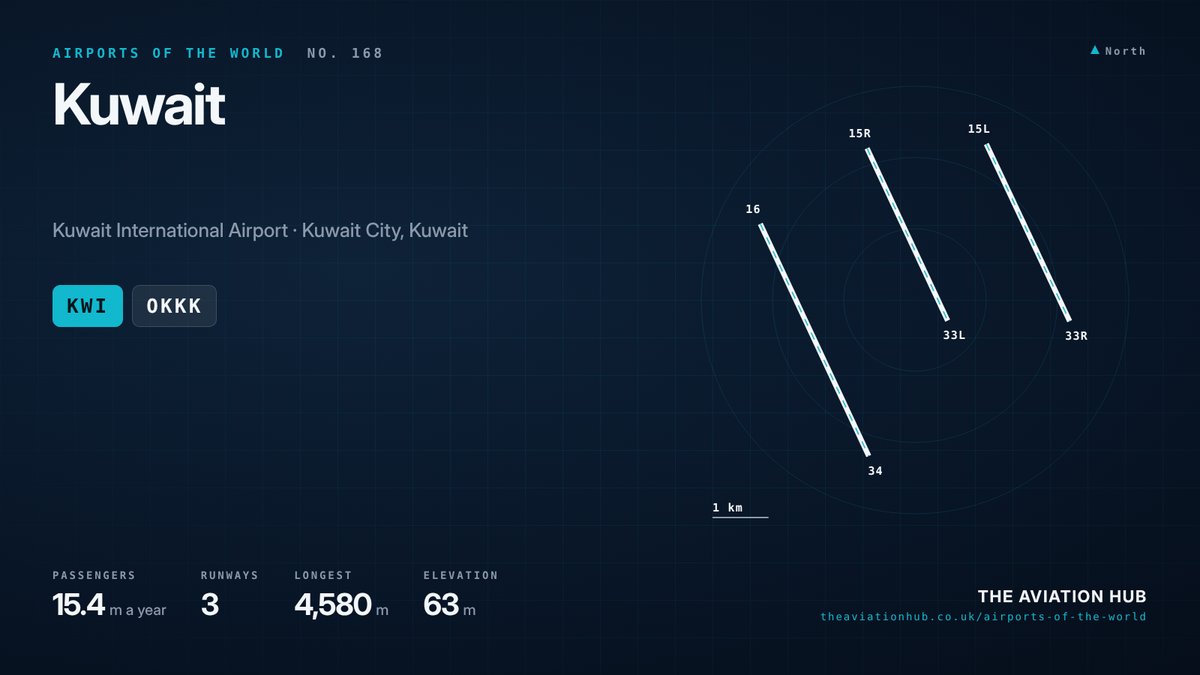
The codes are KWI and OKKK. The airport lies 63 m (206 ft) above sea level on the flat desert south of the city, with the suburbs of Farwaniya and Jleeb Al Shuyoukh pressing against its northern boundary. There are three runways, which is generous for the traffic, and a cluster of separate terminals numbered 1, 4 and 5 while Terminal 2 is finished. Around 15.6 million passengers were recorded in 2023, with traffic since then disrupted by regional conflict.
Kuwait Airways and Jazeera Airways both use Kuwait Airport as their main hub. Abdullah Al Mubarak Air Base occupies part of the site and houses the headquarters of the Kuwait Air Force and its museum. The Directorate General of Civil Aviation, a government body, operates the civil airport. Terminal allocations and flight status are on the airport’s official website.
A Short History of Kuwait’s Airfield
Kuwait’s first landing ground dates from 1927 and 1928. The present site developed after the Second World War as oil wealth arrived and Kuwait Airways, founded in 1954, needed a proper base. The airport grew through the 1960s with the first jets and the country’s independence in 1961.
The landmark terminal, now Terminal 1, opened in 1979 to a design by the Japanese architect Kenzo Tange, a concrete building with a wide span roof that looked futuristic for its time. The 1970s and 1980s also brought a string of hijackings, including Kuwait Airways aircraft taken to Tehran in 1984 and Algiers in 1988.
The Iraqi invasion of August 1990 hit the airport directly. British Airways Flight 149 landed in the opening hours of the invasion and its passengers and crew were taken hostage, and in February 1991 the airfield was the scene of a tank battle as coalition forces retook the city. Rebuilding took most of the 1990s. Terminals 4 and 5 opened in 2018 to relieve the Tange building while Terminal 2 slowly took shape.
Runways at Kuwait Airport
Kuwait Airport has three runways. The newest, 16/34, is an asphalt strip of 4,580 m (15,026 ft) by 60 m on the western side of the field, long enough for any aircraft at any weight in summer heat. The older parallel pair sits to the east. Runway 15L/33R is 3,500 m (11,483 ft) of asphalt and 15R/33L is 3,400 m (11,155 ft) of concrete, both 45 m wide.
The prevailing shamal wind blows from the northwest for much of the year, so departures and arrivals normally use the 33s and 34, with departures climbing out over the suburbs to the northwest and arrivals coming in over the desert to the southeast. Summer temperatures above 45 degrees Celsius are the real operating constraint, because density altitude cuts aircraft performance and the long runways earn their keep. Sandstorms occasionally shut the field for hours.
The runways have also seen conflict. Iranian drone attacks from late February 2026 damaged the airport’s radar, and a strike on Terminal 1 in June, the day after it reopened, killed one person and suspended operations there again.
Terminals and Airlines
Terminal 1, the Tange building, housed almost every foreign airline for four decades, from Emirates, Qatar Airways and Etihad to British Airways, Lufthansa, Turkish Airlines and the Indian, Egyptian and Pakistani carriers that fill the schedule. It was cramped and dated long before the 2026 damage closed it, and its future once Terminal 2 opens is uncertain.
Terminal 4 opened in August 2018 as a dedicated home for Kuwait Airways and its fleet of Airbus A330neo, A320neo and Boeing 777-300ER aircraft, and it has absorbed some foreign flights since Terminal 1 closed. Terminal 5, also from 2018, belongs to Jazeera Airways, which built and operates it as a low cost facility. Terminal 3 is the general aviation building and is closed while Terminal 2 construction continues around it.
Routes and Destinations
The route map at Kuwait Airport reflects the country’s workforce. Cairo, Dubai, Doha, Riyadh, Jeddah, Bahrain and Muscat are the thick regional routes, and the Indian subcontinent dominates the long list beyond them, with Mumbai, Delhi, Kochi, Hyderabad, Chennai, Dhaka, Karachi, Lahore and Kathmandu all served daily or better. Manila carries the Filipino community. Jazeera flies the largest number of destinations with its Airbus A320neo and A321neo fleet.
Kuwait Airways provides the long haul. London Heathrow, Paris, Frankfurt, Munich, Geneva and Rome are the European points, and New York JFK, at around 6,300 miles (10,200 km), is the longest route from the field. Bangkok, Manila and Guangzhou cover Asia. Turkish Airlines and the Gulf majors provide the competition. Traffic peaks around Ramadan, Eid and the summer exodus when temperatures soar. Cargo City, which opened on the western side in 2019, handles freight.
Getting to and from Kuwait Airport
There is no rail link and none under construction. Kuwait Public Transport Company buses connect the airport with the city centre for less than half a dinar (around £1.20), which is the cheapest sensible option, with services running through the day.
Taxis wait outside every terminal, and a metered or fixed fare ride to Kuwait City takes 20 to 30 minutes for roughly 5 to 7 dinars (£12 to £17). Ride hailing apps work from the car parks. The Airport Road and the Sixth Ring Road link the terminals to the city and to Salmiya, Hawalli and the coastal suburbs. Short and long stay parking sits in front of each terminal, and most residents drive or are collected.
Spotting and Photography
Kuwait is a difficult country for aviation photography. The air base shares the airfield, security is tight and pointing a long lens at the apron from outside the fence invites attention. The practical approach is to shoot from inside the terminals, where the airside windows of Terminal 4 give a view of the Kuwait Airways fleet and Terminal 5 looks over the Jazeera stands.
Traffic is a mix of Gulf wide bodies, Indian and Egyptian narrow bodies, Kuwait Airways 777s and A330neos and the odd freighter at Cargo City. Winter light is soft and clear, while summer brings heat haze that ruins long shots by mid morning. Do not photograph the military side, keep cameras away from the perimeter roads and accept that at Kuwait Airport the terminal is the viewing gallery.
Terminal 2 and Beyond
Terminal 2 is the whole future. Designed by Foster and Partners as a vast trefoil under a single roof, it is planned with 28 gates, a 400 bed airside hotel and a design that meets LEED Gold standards. The project has slipped repeatedly through the pandemic and after, and the latest target is an opening in late 2026. When it comes, the scattered terminals of today should consolidate and capacity will rise sharply.
Kuwait Airport is heading into a new era with one modern terminal and three runways, provided the region stays calm enough to use them. Compare it with the other Gulf hubs on the Airports of the World map.
Continue to follow The Aviation Hub for more analysis and insight.
Advertise with us Your brand, in front of an aviation audience Home page and in-article placements, sold directly, one advertiser per slot. From £250 a year. See the rates

