
Murtala Muhammed International Airport is the principal gateway to Nigeria and the base for most of its airlines. Lagos Airport handles several million passengers a year, with traffic peaking at about 7.5 million in 2019. It sits in Ikeja, the capital of Lagos State, on the mainland north of the lagoon. The field links Africa’s most populous country with London, Dubai, Atlanta and the rest of West Africa, and it is in the middle of a long overdue rebuild.
Lagos Airport at a Glance
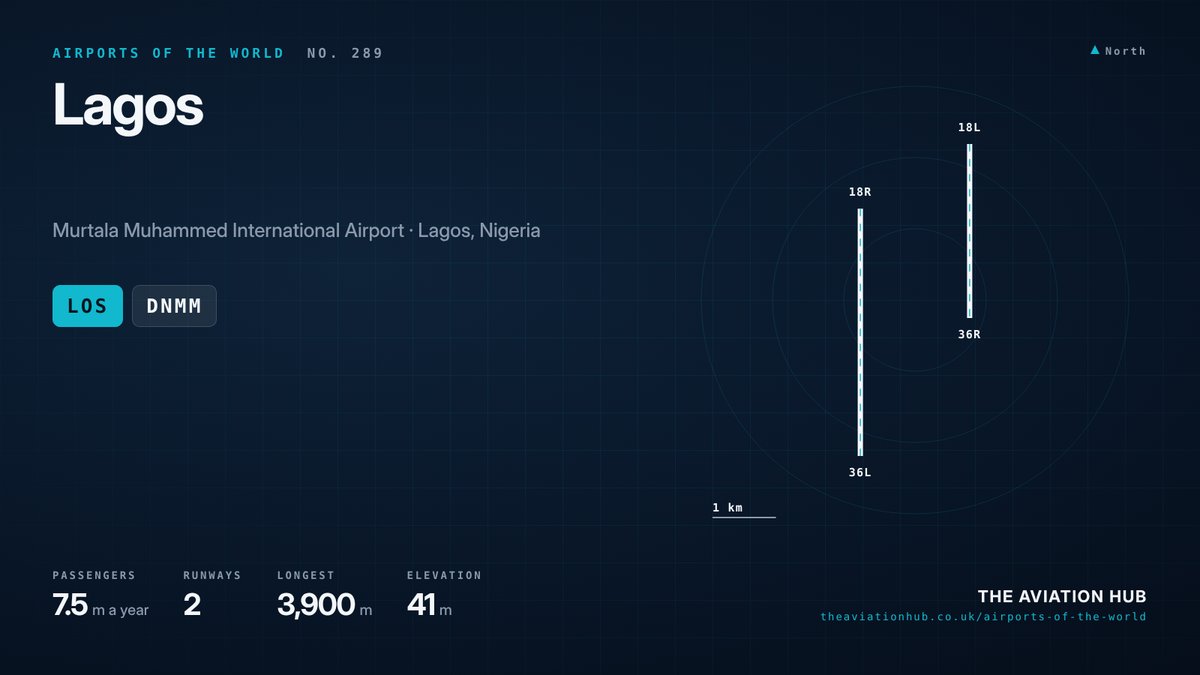
The IATA code is LOS and the ICAO code is DNMM. The airport lies in Ikeja, about 14 miles (22 km) north of Lagos Island by road, at an elevation of 41 metres (135 ft). It has two parallel asphalt runways. The international side has the original 1979 terminal and a new terminal opened in 2022, while domestic flights use two separate terminals about a kilometre away.
Traffic was about 6.5 million passengers in 2022, the latest full year published, and has been recovering towards the 2019 peak. Air Peace, Arik Air, Ibom Air, ValueJet and Aero Contractors all base aircraft here. The Federal Airports Authority of Nigeria, known as FAAN, runs the airport and has its headquarters on site. Travel notices and terminal updates appear on the airport’s official website.
How Lagos Got Its Airport
The airfield at Ikeja was built during the Second World War and opened as Lagos Airport. In 1947 the new West African Airways Corporation made it its main base, and the field grew into the colonial hub for British West Africa. Independence in 1960 brought Nigeria Airways and a steady rise in international service through the oil boom of the 1970s.
In 1976 the airport took the name of General Murtala Muhammed, the head of state assassinated in a failed coup that February. A new international terminal, modelled on Amsterdam Schiphol, opened on 15 March 1979. The privately funded domestic terminal, MMA2, followed on 7 April 2007. A new international terminal, financed largely by a Chinese Exim Bank loan, was commissioned on 22 March 2022.
The airport’s reputation suffered in the 1990s. The United States Federal Aviation Administration posted security warnings in 1992 and suspended direct flights in 1993. The ban was later lifted, and by 2010 Nigeria had won the top FAA safety rating.
Runways at Lagos Airport
Lagos Airport has two parallel asphalt runways. Runway 18R/36L is 3,900 metres (12,794 ft) long and 60 metres wide, and it handles the long haul wide bodies along with much of the domestic traffic. Runway 18L/36R is 2,742 metres (8,997 ft) long and 45 metres wide. Both runways serve the international and domestic terminals.
South westerly winds off the Atlantic dominate for much of the year, so landings toward the south are common. The dry Harmattan from the north brings dust haze between December and February, which can cut visibility sharply. The field has a mixed safety record. Dana Air Flight 0992 crashed into a residential area on approach in June 2012, killing all 153 on board and six people on the ground.
Terminals and Airlines
International flights use the 1979 terminal and the new terminal beside it, which can handle about 14 million passengers a year. FAAN ordered all foreign airlines to move into the new building by October 2023, but many stayed in the old one because the new apron could not take the largest aircraft. A renovation of the old terminal began in August 2025, budgeted at more than ₦700 billion over 22 months.
Domestic flights use the older local terminal, known as MMA1, and the separate MMA2 building. Air Peace, the largest airline in Nigeria, runs a fleet of Boeing 737s, Embraer E195-E2s and Boeing 777s. International carriers include Emirates, Qatar Airways, Ethiopian Airlines, KLM, Air France, British Airways, Virgin Atlantic, Delta and United. All three global alliances are represented.
Routes and Destinations
Abuja is the key domestic route from Lagos Airport, flown many times a day by several airlines. Port Harcourt, Owerri, Enugu, Kano, Benin City and Uyo follow. Regionally, Accra is the key link, with Abidjan, Monrovia, Dakar and Douala also served by Nigerian and foreign carriers.
Long haul traffic is dominated by London. British Airways and Virgin Atlantic fly to Heathrow, and Air Peace began Gatwick flights in 2024. Dubai, Doha, Addis Ababa, Paris and Amsterdam carry heavy connecting flows. The longest routes are Delta’s flights to Atlanta, with a seasonal New York JFK service, and United’s link with Washington Dulles. Etihad plans to return from Abu Dhabi in March 2027.
Getting to and from Lagos Airport
Road is the only practical way to reach Lagos Airport, and traffic is the main hazard. Ikeja hotels are 15 to 20 minutes away. Victoria Island, Ikoyi and Lekki can take anything from 45 minutes to well over two hours, depending on the time of day and the state of the bridges. Leave generous time for departures.
Ride hailing apps such as Uber and Bolt operate in Lagos and are the simplest choice for most visitors. Many hotels and companies arrange their own pickups, which avoids haggling with unlicensed drivers. The Lagos Red Line commuter railway, which began passenger service in 2024, stops at Ikeja, a short drive from the terminals. Parking is available at both the international and domestic sides.
Spotting and Photography
Lagos Airport is not a casual spotting destination. Airside security is tight, and photography near the perimeter can quickly draw questions from police or military personnel. There is no public viewing terrace. Most visiting enthusiasts limit themselves to shots through terminal windows or from the aircraft window on arrival and departure.
Those who persist will see a fascinating mix. Air Peace wide bodies, African carriers from across the continent, Gulf and European long haul jets and a busy business aviation scene all share the apron. Always ask permission before photographing, carry identification, keep cameras discreet and respect every instruction from officials.
What Comes Next
The immediate task is making the terminals work. The renovation of the 1979 building, and the apron upgrades needed to fit wide bodies at the new terminal, should give Lagos Airport room to grow if they are finished on time. Reliability needs attention too. A fire in a terminal server room on 23 February 2026 injured six people and briefly closed the airspace over Lagos.
Longer term, a proposed airport at Lekki Epe could relieve pressure on Ikeja and serve the fast growing east of the city. Lagos Airport remains central to Nigerian aviation, and its future depends on finishing the projects already started. Explore other African hubs on the Airports of the World map.
Continue to follow The Aviation Hub for more analysis and insight.
Advertise with us Your brand, in front of an aviation audience Home page and in-article placements, sold directly, one advertiser per slot. From £250 a year. See the rates

