
Lanzhou Airport Guide: Gansu’s Gateway on the Silk Road
Lanzhou Airport at Zhongchuan sits 71 km from the city it serves, with a vast new Terminal 3 and three runways. History, routes and rail access explained.
 By The Aviation Hub
6 min read
Updated October 20, 2026
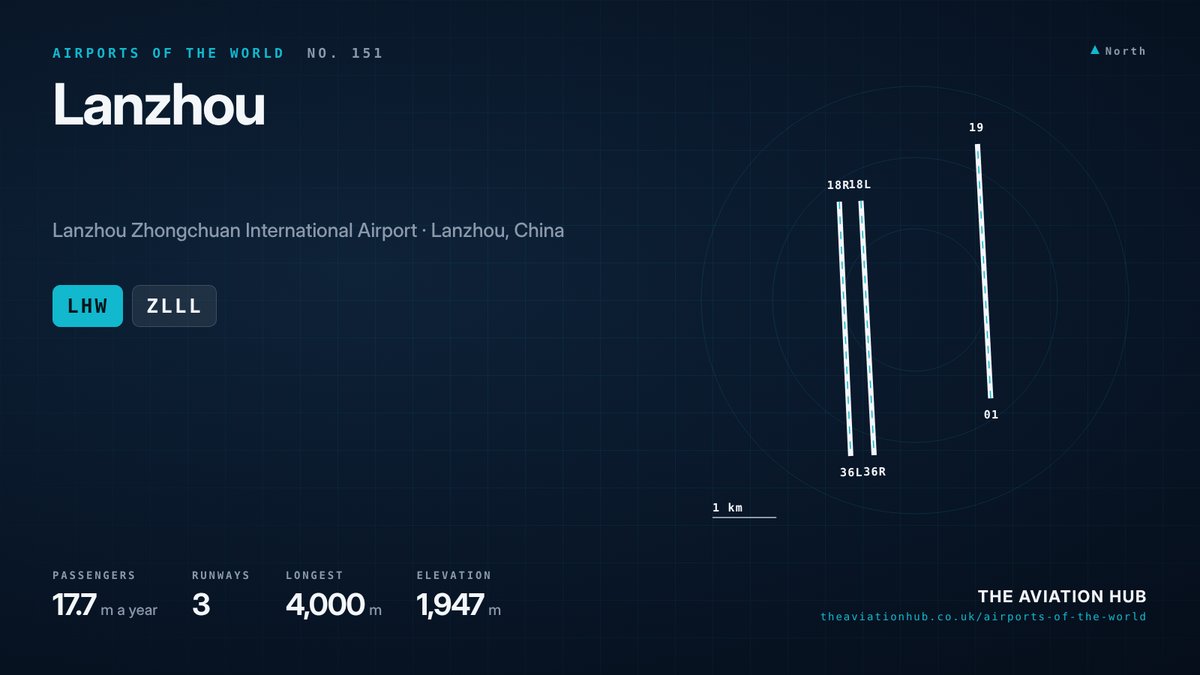
Lanzhou Zhongchuan International Airport serves the capital of Gansu province, the long, thin region that follows the ancient Silk Road through north west China. It sits on a high loess plateau far to the north of the city, at an altitude of almost 2,000 m, and it is one of the farthest airports in China from the city it serves. Lanzhou Airport handled close to 18 million passengers in 2025 and has just emerged from a huge expansion that gave it a 400,000 square metre terminal and two new runways.
Lanzhou Airport at a Glance
The IATA code is LHW and the ICAO code is ZLLL. The airport lies about 44 miles (71 km) north west of downtown Lanzhou in Yongdeng county, at an elevation of 1,947 m (6,388 ft). There are now three runways and a single operating passenger terminal, the enormous Terminal 3 opened in March 2025, with the older Terminals 1 and 2 taken out of scheduled service. A dedicated intercity railway links the site to the city.
Lanzhou Airport handled roughly 17.7 million passengers in 2025, around 126,000 aircraft movements and some 86,000 tonnes of cargo, which placed it 29th among Chinese airports. China Eastern, Hainan Airlines and Spring Airlines treat it as a focus city, and China Southern, Air China, Sichuan Airlines and Xiamen Air are regular operators. The Gansu Provincial Civil Aviation Airport Group, a state owned company, runs the field. Transport and flight details are on the airport’s official website.
How Lanzhou’s Airport Came to Be
Lanzhou’s original airport, Gongxingdun, sat barely 2 km from the city centre in the narrow Yellow River valley. The authorities judged it too hemmed in by mountains and buildings to develop. The search for a replacement led far out of the valley to flat land near the town of Zhongchuan, where construction began in 1968. The first flight, an Ilyushin Il-14, landed on 26 July 1970, and the new field opened with five domestic routes.
Growth was slow for decades, reflecting Gansu’s position as one of China’s poorer provinces. Terminal 1 opened in 2001 as traffic began to climb with the country’s economic boom. Terminal 2, a wing shaped building of about 61,000 square metres, followed in 2015, the same year the airport intercity railway opened and transformed access from the city.
Phase 3 was on a different scale entirely. Approved in 2019 at a cost of about CNY 31.7 billion (roughly £3.4 billion), it required the demolition of Zhongchuan town itself and several villages across 10.7 square kilometres, with residents relocated. The result, Terminal 3, opened on 20 March 2025 with 87 gates across four piers and replaced both older buildings. Terminal 2 closed for renovation, and Terminal 1’s landside facilities were shut.
Runways at Lanzhou Airport
Lanzhou Airport has three runways, two of them added in the Phase 3 works. Runway 01/19 is 4,000 m (13,123 ft) long and 45 m wide. The close parallel pair, 18L/36R and 18R/36L, are also 4,000 m (13,123 ft) long and 45 m wide. The slight difference in designation between the runways reflects their alignments relative to magnetic north.
Length matters here more than almost anywhere in China. At 1,947 m above sea level, the thin air cuts engine thrust and lift, so a Boeing 737 or Airbus A320neo needs considerably more pavement than at a coastal airport, and the margins shrink further in summer heat. Three long runways give the airfield capacity far beyond its current traffic. The plateau is flat, dry and prone to spring dust storms, which can cut visibility sharply.
Terminals and Airlines
Terminal 3 is the whole show at Lanzhou Airport now. Its 87 gates spread across four piers, and the building uses a digital twin of the airfield and advanced 5G coverage for its operations. China Eastern is a leading airline here, with a locally based fleet of Airbus A320 family aircraft feeding its hubs at Shanghai, Xi’an and Kunming. Hainan Airlines runs Boeing 737-800 and 737 MAX 8 services to Beijing, Haikou and Shenzhen, and Spring Airlines provides low cost competition on the trunk routes.
China Southern, Air China, Sichuan Airlines, Xiamen Air and Shandong Airlines fill out the domestic roster. International flying is thin, with services to Bangkok, Kuala Lumpur, Singapore, Vientiane, Nagoya and Hong Kong, and freighters to Almaty and Lahore. Alliance wise, China Eastern and Xiamen Air are SkyTeam members, Air China is Star Alliance, and Hainan and Spring sit outside the alliances.
Routes and Destinations
Beijing, Shanghai, Guangzhou, Shenzhen, Chengdu and Xi’an are the busiest routes, flown throughout the day by a mix of A320neo, A321neo and 737 aircraft. Within the north west, Urumqi, Yinchuan, Xining and Dunhuang are important connections, and the Dunhuang route feeds the Mogao Caves tourist trade. Hangzhou, Nanjing, Kunming and Haikou provide the links to China’s east and south.
Summer is the peak as domestic tourists follow the Silk Road through Gansu, with Zhangye’s coloured rock formations and the Jiayuguan fortress drawing crowds. Winter is quieter and cold. The longest regular routes reach Singapore and Kuala Lumpur at around 2,400 miles (3,900 km). Cargo of about 86,000 tonnes a year is modest but includes a growing share of e commerce freight, and the airport hopes to become a logistics hub for Central Asia.
Getting to and from Lanzhou Airport
The intercity railway is the only sensible way to reach Lanzhou Airport. It opened in 2015 and runs from Zhongchuan Airport East station, beside the terminal, to Lanzhou West in about 38 minutes, with connections to Lanzhou railway station and through trains towards Wuwei and Yinchuan. Fares are low, typically around CNY 20 to 30 (about £2 to £3). A pilot scheme means passengers who clear railway security do not need to be rescreened at the airport. A metro station has been reserved for a future line.
By road, three Airport Express coach lines leave from the Ground Transportation Centre, a five minute walk from Terminal 3, each costing CNY 30 (about £3). Line 1 takes about an hour to the city centre near Lanzhou railway station, Line 2 serves Lanzhou West and Line 3 runs to Qingshuiqiao. Taxis are expensive because of the distance, with fares well over CNY 200 (about £22) for a journey of 60 to 90 minutes on the expressway.
Spotting and Photography
Lanzhou is not a place to spot from the fence. Chinese security rules make perimeter photography a bad idea, and the remote plateau location offers no convenient public viewpoints in any case. The compensation is Terminal 3, whose long piers and tall windows give sweeping views across the aprons to all three runways. The ends of the piers put you close to taxiing aircraft and let you look down the parallel runways to the north.
The dry air and high altitude produce intense light and deep blue skies, best in the early morning and late afternoon when the sun is low across the plateau. The fleet mix is domestic, dominated by A320neo family aircraft and 737s, with the occasional wide body on a Beijing or Shanghai peak service. The 2,000 square metre curved screen in the Ground Transportation Centre, designed to evoke the Yellow River falling from the sky, is worth a look. Keep cameras inside the terminal, avoid security staff and do not photograph the military side.
What Comes Next
The expansion is done. Phase 3 delivered a terminal and runway system sized for 38 million passengers or more, which is more than double the current traffic. The task for Lanzhou Airport over the next decade is to fill it, which depends on Gansu’s tourism boom continuing and on building international connections to Central Asia and South East Asia. A reserved metro station hints at a second rail link in time.
The verdict is a provincial airport with infrastructure far ahead of demand, which is the Chinese way, and growth should follow. Compare it with the rest of the country’s network on our Airports of the World map.
Continue to follow The Aviation Hub for more analysis and insight.
Advertise with us Your brand, in front of an aviation audience Home page and in-article placements, sold directly, one advertiser per slot. From £250 a year. See the rates

