
Larnaca Airport Guide: Cyprus’s Main Gateway Explained
Larnaca Airport is the main gateway to Cyprus, built in a hurry in 1975 and now handling close to 10 million passengers. Runway, airlines, routes and access.
 By The Aviation Hub
7 min read
Updated October 20, 2026
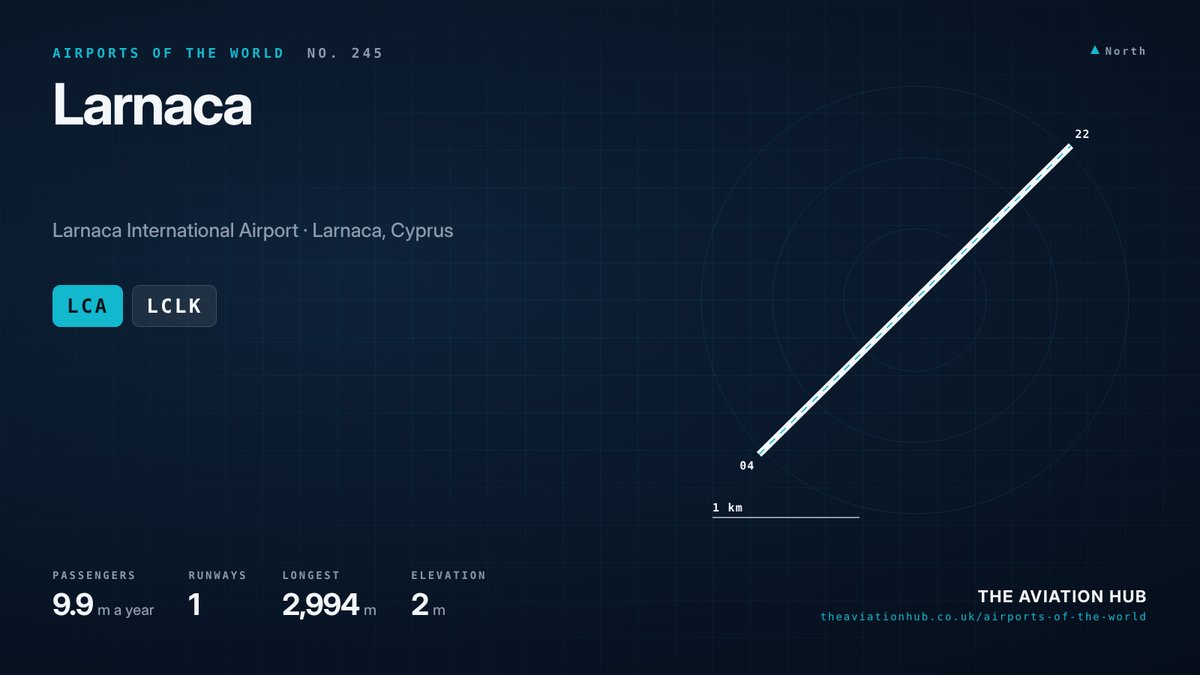
Larnaca International Airport is the principal gateway to Cyprus and the busier of the island’s two civil airports. Larnaca Airport was built in a matter of months after the 1974 invasion closed Nicosia, and it has grown from an emergency stopgap into a terminal handling close to 10 million passengers a year. It lies on the salt lake flats south of Larnaca town, a short walk from the beach. For British holidaymakers, Greek business travellers and the island’s growing Israeli market, this is where Cyprus begins.
Larnaca Airport at a Glance
The airport uses the IATA code LCA and the ICAO code LCLK. It stands about 2.5 miles (4 km) southwest of Larnaca town centre and roughly 30 miles (50 km) from Nicosia, at an elevation of just 2 metres (8 feet) on the shore beside the salt lake. There is one runway and one main passenger terminal, with the old terminal building now used for VIP and private flights.
Passenger traffic reached roughly 9.9 million in 2025, up about 14 per cent on the previous year and well above the pre pandemic peak. Cyprus Airways and Tus Airways are based here, and Aegean Airlines and Wizz Air both treat it as a focus city. The airport is operated by Hermes Airports, the consortium that holds the concession for both Larnaca and Paphos, and current information is on the airport’s official website.
How Larnaca’s Airport Came to Be
The site had been an airfield in the 1930s and later a British military installation, but until 1974 Cyprus flew from Nicosia. The Turkish invasion that July left Nicosia Airport in the buffer zone, where it remains to this day, and the government needed a replacement fast. Work at Larnaca began in late 1974 and the airport opened on 8 February 1975, with a runway initially too short for jets and a terminal that was little more than a shed.
The field grew in step with the island’s tourism boom. The runway was lengthened, the terminal was extended several times and the airport became the hub of Cyprus Airways through the 1980s and 1990s. It also witnessed its share of drama, including a 1978 gunfight on the apron between Egyptian commandos and Cypriot forces that killed 17 commandos, and a 1988 Kuwait Airways hijacking in which hostages were killed.
In 2006 Hermes Airports took over both Cypriot airports under a 25 year concession worth around €650 million. The current terminal opened on 7 November 2009 and the airport was renamed in July 2016 after Glafcos Clerides, president from 1993 to 2003.
Runways at Larnaca Airport
Larnaca Airport has a single asphalt runway, 04/22, measuring 2,994 metres (9,823 feet) in length and 45 metres in width. It runs along the coast from southwest to northeast, with the salt lake on one side and the sea on the other. The length accommodates the Airbus A330 and Boeing 787 that appear on Gulf and charter services, and the airport has handled larger types on diversion.
Arrivals on runway 22 approach from the northeast over Larnaca Bay and the town’s seafront, a route that gives passengers a view of the marina and the Finikoudes promenade. Runway 04 approaches come in from the southwest, with the salt lake to the north. Runway 22 is in use for the great majority of movements, and runway 04 is used only rarely.
With one runway and a dense summer schedule, the airport runs close to its limits on peak Saturdays, when charter and low cost traffic from Britain, Germany and Poland piles in. There is no second runway in the plans, and growth is coming instead from the terminal expansion.
Terminals and Airlines
The 2009 terminal at Larnaca Airport is a long, low building with departures on the upper level and arrivals below, and gates along a single pier. It replaced the original structure, which is now run by Skylink Services as a VIP terminal for heads of state, executive jets and private operators. Lounges are modest, as befits a largely leisure airport.
Cyprus Airways flies Airbus A320 family aircraft to Athens, Tel Aviv and a spread of European cities, and Tus Airways operates a small fleet on short routes. Aegean Airlines has a strong presence with multiple daily Athens services. Wizz Air flies to Poland, Italy, Romania and the Baltics, while easyJet, Jet2, TUI and British Airways carry the British market. Emirates, Qatar Airways and Gulf Air link the island with the Gulf, and Israir, Arkia and Tus Airways serve Tel Aviv.
Routes and Destinations
Athens is the dominant route at Larnaca Airport, with around 1.3 million passengers in 2024, led by Aegean and Cyprus Airways. Tel Aviv came next with roughly 840,000, reflecting the short hop across the water and the close business ties between the two countries. London Heathrow and London Gatwick followed, together carrying more than 700,000 passengers, with Vienna completing the top five.
The United Kingdom, Greece, Israel, Poland and Germany together provided nearly two thirds of all traffic in 2024. The Gulf carriers offer connections onwards to Asia, while Emirates and Qatar Airways give the island one stop access to much of the world. Summer is the peak, with June to September bringing the heaviest loads, though winter traffic has grown as Cyprus markets itself to retirees and remote workers. Cargo is modest at around 35,000 tonnes a year.
Getting to and from Larnaca Airport
Cyprus has no railways, so the choice at Larnaca Airport is road. Taxis wait outside arrivals and charge around €15 to €20 to Larnaca town, €60 to €70 to Nicosia and roughly €70 to €80 to Limassol or Ayia Napa. Journey times are about 10 minutes to Larnaca, 45 minutes to Nicosia and an hour to Limassol along the motorway network.
Shuttle buses run from the airport to Limassol, Nicosia, Ayia Napa, Protaras and Paralimni, with fares of roughly €8 to €10, which makes them the cheapest sensible option for most visitors. Local Larnaca buses serve the town and the Finikoudes seafront for a couple of euros. Car hire desks sit in the arrivals hall, and most holidaymakers heading to the resorts collect a car here.
Parking is split between short stay and long stay areas close to the terminal, with pre booked rates cheaper than paying on the day. A drop off zone sits outside departures, with a short free period before charges begin.
Spotting and Photography
The salt lake and the seafront give good sightlines over Larnaca Airport. For runway 22 arrivals, the beach at Mackenzie on the northeastern edge of the airfield is the classic spot, with aircraft crossing the shoreline at low level directly overhead and a row of cafes to retreat to. Morning light works best here, with the sun behind the camera for aircraft on short final.
Runway 04 arrivals are rare, so most spotting centres on runway 22. A hill near the salt lake looks over the apron, and in winter the lake fills and attracts flamingos, which makes for unusual compositions. The terminal has no viewing deck, but the departures level windows look over the apron.
Mackenzie beach is a public place and spotting there is tolerated. Stay off the perimeter road, avoid the fences and do not photograph the police or military aircraft that occasionally use the field. Cyprus is relaxed, but the airport is also a security sensitive site given its proximity to the Middle East.
What Comes Next
Hermes Airports is expanding the terminal to a capacity of around 12.4 million passengers a year. The works add a new security hall, extra remote stands and a western wing with more gates, and are intended to end the summer crush that has become a feature of recent years. The concession runs into the 2030s, which gives the operator an incentive to invest.
The bigger question is the unused airport at Nicosia, which stays frozen in the buffer zone while the island remains divided. Until that changes, Larnaca Airport will carry the main burden of the island’s growth, and its traffic will keep climbing with tourism and the Israeli and Gulf markets. See how it ranks among Mediterranean gateways on the Airports of the World map.
Continue to follow The Aviation Hub for more analysis and insight.
Advertise with us Your brand, in front of an aviation audience Home page and in-article placements, sold directly, one advertiser per slot. From £250 a year. See the rates

