
Leon Bajio Airport Guide: Mexico’s Industrial Heartland
Leon Bajio Airport serves Guanajuato's car plants, colonial cities and migrant families. See how its long runway, airlines and US routes work.
 By The Aviation Hub
6 min read
Updated October 20, 2026
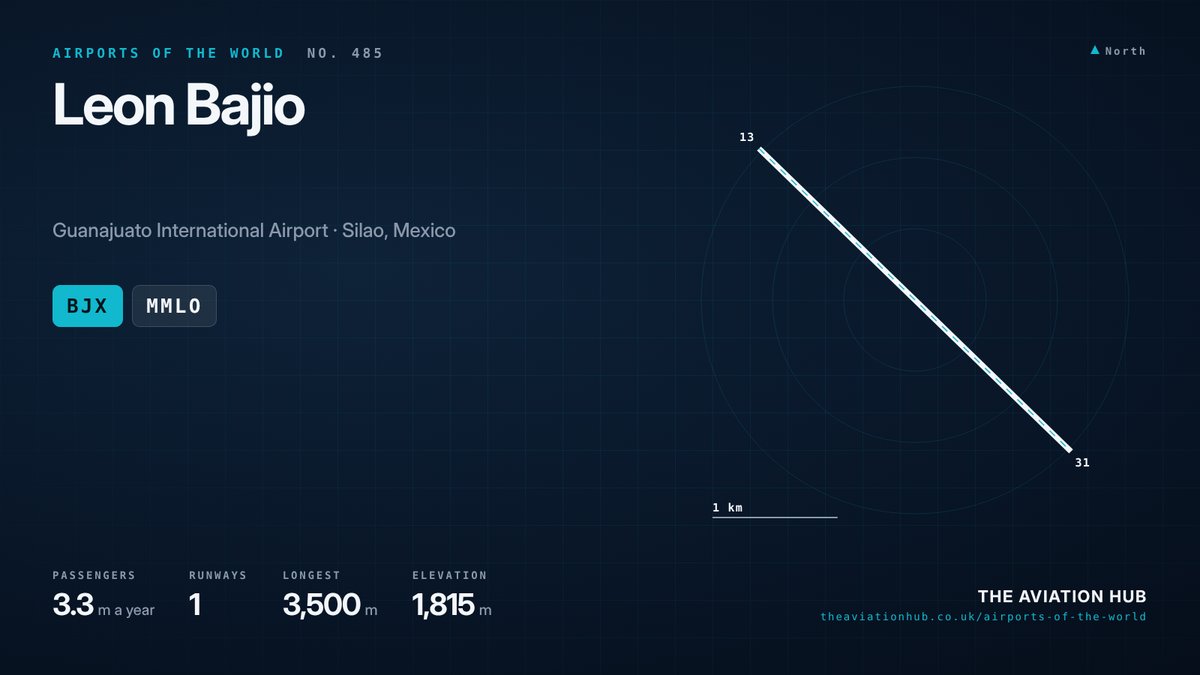
Central Mexico’s Bajio region builds cars, shoes and machinery for half the continent, and most of its air traffic funnels through one runway near Silao. Leon Bajio Airport, officially Guanajuato International Airport, serves the cities of Leon, Guanajuato, Silao and Irapuato. It handles roughly 3.3 million passengers a year. Business travellers from the car plants mix with families flying to relatives in Texas, California and Illinois.
Leon Bajio Airport at a Glance
The codes are BJX and MMLO. The airport stands in the municipality of Silao, about 15 miles (25 km) south east of central Leon and a similar distance west of the state capital, Guanajuato. It sits high on the central plateau at 5,956 ft (1,815 m). There is one runway and one passenger terminal.
Recent traffic has run at around 3.3 million passengers a year. Volaris, which treats the field as a focus city, and Viva, the former Viva Aerobus, carry the largest shares, with Aeromexico, American and United also present. Grupo Aeroportuario del Pacifico, known as GAP, holds the concession and runs Leon Bajio Airport alongside Guadalajara, Tijuana and other western Mexican fields. Flight information is on the airport’s official website.
How the Bajio Got Its Airport
The Bajio is a broad, fertile basin that stretches across Guanajuato and its neighbouring states. Leon grew rich on leather and footwear, while Guanajuato city built its fortune on silver. Air services first used a small field closer to Leon, but the region needed a larger airport between its main cities.
The answer was a site near Silao on the federal highway linking Leon with Irapuato and Mexico City. The official name honours the state, while airlines and passengers use the regional name Del Bajio. Most booking systems show Leon, and the industry shorthand is Leon Bajio Airport.
The turning point came with Mexico’s airport privatisation in the late 1990s, when GAP won the concession. A second wave followed as carmakers arrived. General Motors built its Silao assembly plant almost next door, and Mazda, Honda and Toyota opened plants elsewhere in the state. The Guanajuato Puerto Interior logistics park grew up beside the airport, and traffic has nearly tripled since the mid 2010s.
Runways at Leon Bajio Airport
Runway 13/31 measures 3,500 m (11,483 ft) by 45 m (148 ft) and is surfaced with asphalt. It runs roughly north west to south east across the open plateau.
The length is important. At almost 6,000 ft above sea level, the thin air reduces engine thrust and lift, and spring afternoons can be hot. A long runway lets an Airbus A320neo or Boeing 737 MAX 8 leave for Chicago or Los Angeles despite the altitude. It also gives margin for heavier freighters serving the factories.
Winds on the plateau are generally light. The direction in use varies through the day and season, with afternoon thunderstorms common in the summer rainy season. Plans for a second runway at Leon Bajio Airport have been discussed for years, though no firm timetable has been published.
Terminals and Airlines
A single terminal at Leon Bajio Airport handles all domestic and international flights. The building is compact, and processing times are usually short outside the holiday peaks. Migration and customs facilities process the international arrivals from the United States.
Volaris operates the largest network, flying Airbus A320neo and A321neo jets to domestic cities and to several US airports with large Mexican communities. Viva competes on many of the same domestic routes and also flies to Chicago, Dallas Fort Worth, Houston and San Antonio. Aeromexico and its regional arm Aeromexico Connect link Mexico City and Atlanta, often with Embraer E190 aircraft.
The US airlines focus on their hubs. American flies to Dallas Fort Worth and United Express to Houston Intercontinental, feeding business travellers into their networks. There are no alliance lounges of note.
Routes and Destinations
Tijuana was the busiest domestic route in 2025, with about 304,000 passengers, followed by Monterrey, Cancun and Mexico City. Tijuana’s strength reflects family and labour ties with the border region. Cancun and other beach destinations carry growing leisure traffic.
The international market is almost entirely the United States. Dallas Fort Worth, Houston and Chicago are the core routes, with Volaris adding Oakland, Los Angeles, Fresno, Sacramento and other points in California. Flair adds a seasonal Vancouver link from October 2026. Demand peaks around Christmas, Easter and the summer holidays, when migrants travel home.
Cargo matters at Leon Bajio Airport because of the car industry. Urgent parts arrive by air when supply chains stretch, and the adjacent logistics park is designed to connect road, rail and air. A dedicated cargo terminal has been proposed to capture more of this business.
Getting to and from Leon Bajio Airport
There is no rail link. The airport sits on Federal Highway 45D, the toll road between Leon and Irapuato, so road access is quick. Central Leon is around 25 to 30 minutes away, Guanajuato city about 30 to 40 minutes, and Irapuato roughly 40 minutes.
Authorised airport taxis sell fixed fare tickets from booths in the arrivals hall, priced by destination zone. Rental car desks are in the terminal, and hotels and tour operators offer pre booked transfers to Guanajuato and San Miguel de Allende. The colonial town of San Miguel is about 90 minutes away.
For a solo traveller, a fixed fare taxi is the simplest sensible option. Groups heading to San Miguel usually save by sharing a pre booked van. Parking lies directly in front of the terminal.
Spotting and Photography
Leon Bajio Airport is not a classic spotting venue, but it rewards a visit. The single runway means every movement passes the terminal, and the clear plateau light is excellent for most of the year. Volaris and Viva jets in their bright liveries dominate the ramp.
The gate area windows give the best views for passengers. Outside, the surrounding land is largely industrial and agricultural, and the perimeter is fenced. Mornings are usually clearer than afternoons in the rainy season, when storms build over the hills.
Be discreet with long lenses near the fence and the industrial parks, and follow any instruction from airport security or the National Guard. Mexico’s airports take perimeter security seriously.
What Comes Next
GAP’s development plans focus on terminal capacity, aprons and passenger processing. The concession operator has been expanding the building as traffic grows. A cargo terminal and a second runway are the longer term ambitions.
Nearshoring is the big driver. As manufacturers move production from Asia to Mexico, the Bajio stands to gain more factories, more business travel and more freight. The verdict is clear growth, provided terminal works keep pace with demand. See the wider region on the Airports of the World map.
Continue to follow The Aviation Hub for more analysis and insight.
Advertise with us Your brand, in front of an aviation audience Home page and in-article placements, sold directly, one advertiser per slot. From £250 a year. See the rates

