
Lihue Airport Guide: Kauai’s Open Air Garden Gateway
Lihue Airport is the main way onto Kauai, with outdoor check in, two runways and flights to Honolulu and the mainland. Here is how it all works.
 By The Aviation Hub
5 min read
Updated October 20, 2026
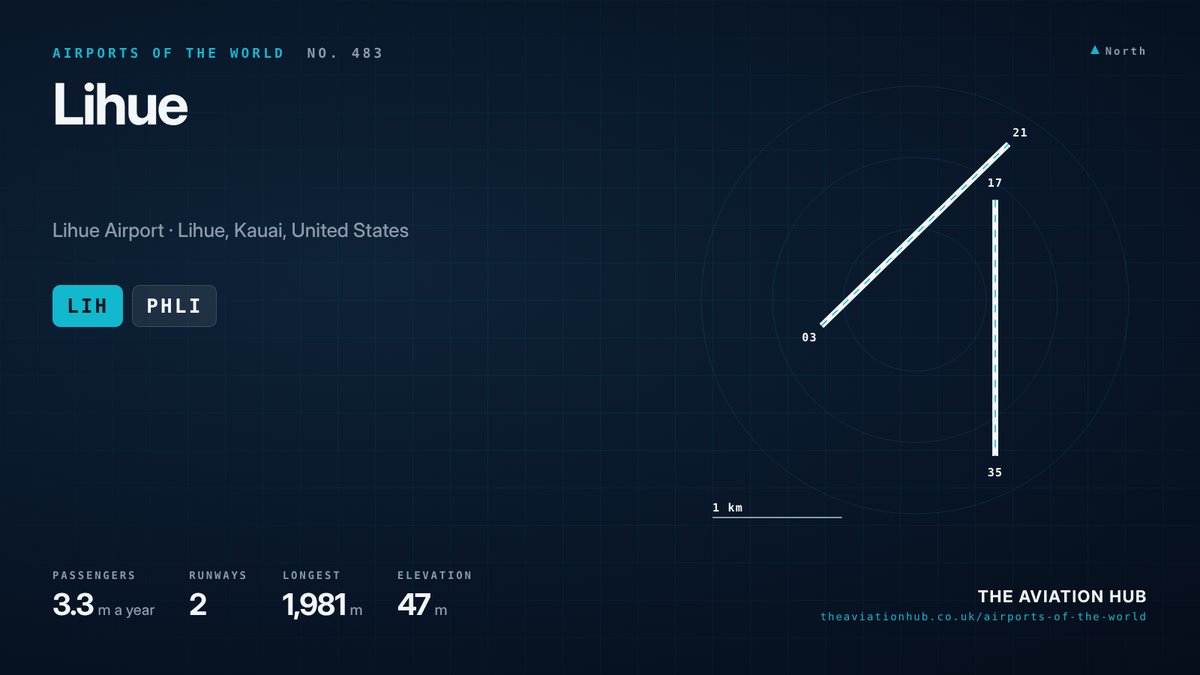
Almost every visitor to Kauai, the Garden Isle, arrives through one terminal on the island’s south east coast. Lihue Airport sits beside the town of Lihue, the county seat, and handles more than three million passengers a year. Inter island hops to Honolulu run all day, and narrow body jets cross the Pacific to the American west coast and Canada. Check in happens outdoors under the trade winds, which sets the tone for the island.
Lihue Airport at a Glance
The codes are LIH and PHLI. The field lies about 2 miles (3 km) east of central Lihue, right on the coast, at an elevation of 153 ft (47 m). There are two runways of equal length and a single passenger terminal. Traffic reached about 3.75 million passengers in 2024.
The State of Hawaii Department of Transportation owns and runs Lihue Airport as part of its statewide airport system. No airline uses it as a hub. Hawaiian Airlines carries the largest share, with Southwest, United, Alaska, Delta, American and WestJet also serving the island. Gate assignments and flight status are on the airport’s official website.
How Kauai’s Airport Came to Be
Kauai’s early air services used small fields on the west side of the island, including Burns Field near Port Allen. As demand grew after the Second World War, a new airport was built close to Lihue, the island’s commercial centre and main harbour at Nawiliwili. It opened around 1950.
The name simply follows the town. In Hawaiian, Lihue is usually translated as “cold chill”. The airport grew in step with tourism, gaining a second runway and a larger terminal as jets replaced propeller aircraft on the inter island routes.
Hurricane Iniki tested the airport in September 1992, when it devastated much of Kauai. Lihue became the island’s lifeline for relief flights while roads and power were restored. Tourism took years to recover, but the airport has since settled into steady growth.
Runways at Lihue Airport
Runway 03/21 and runway 17/35 each measure 1,981 m (6,500 ft) by 46 m (150 ft), and both are asphalt. Their layout gives crews a choice of directions in shifting winds. A helipad serves the island’s busy helicopter tour industry.
Northeasterly trade winds blow for much of the year, so runway 03/21 carries most of the airline flying, usually in the northeasterly direction. Runway 17/35 handles traffic when winds shift, as they do during Kona weather from the south.
At 6,500 ft, the runways are adequate for a Boeing 737-800 or Airbus A321neo to the west coast, but they rule out heavy wide bodies on long sectors. Work began in July 2024 to shift runway 03/21 to the west so that it finally meets federal runway safety area standards. The project also upgrades taxiways and installs LED signs, with completion due in December 2026.
Terminals and Airlines
The terminal at Lihue Airport is low rise and largely unwalled. Check in counters face the kerb in the open air, and gardens fill the courtyards between the gate areas. The design suits the climate, though rain squalls can make the walk to the gates damp.
Hawaiian Airlines, now part of Alaska Air Group, uses gates 3 to 6 for its Boeing 717 inter island flights and its mainland services. American usually takes gate 3 with Airbus A321s. United uses gates 9 and 10, mainly with Boeing 737-800s and 737-900ERs and occasionally a 757-200. Delta, Alaska, Southwest and WestJet share gates 7 and 8.
Hawaiian runs a Premier Lounge for first class passengers. Elsewhere the offer is simple, with a few cafes and shops airside.
Routes and Destinations
Honolulu is by far the busiest route, with Hawaiian and Southwest offering frequent inter island flights through the day. Kahului on Maui and Kona on the Big Island are the other neighbour island links. The hop to Honolulu takes around 35 minutes in the air.
Mainland routes reach the major cities of western North America. United flies to San Francisco, Los Angeles and Denver, while Alaska serves Seattle and other west coast cities. Delta links Los Angeles and Seattle with the A321neo, and American connects Los Angeles and Phoenix. WestJet brings Canadians in on a seasonal route from Vancouver.
Demand peaks in the northern winter and again in summer school holidays. Mail and small cargo move by feeder aircraft from Honolulu, and the island’s tour helicopters add a steady stream of movements on fine days.
Getting to and from Lihue Airport
There is no rail on Kauai, and most visitors pick up a hire car. Rental counters and lots sit just across from the terminal, and the drive to central Lihue takes around five minutes. Kapaa on the east side is about 20 minutes north, Poipu around 25 minutes south, and Princeville on the north shore roughly an hour.
The Kauai Bus routes 100 and 200 connect Lihue Airport with downtown Lihue for a small flat fare, which is the cheapest option. Luggage limits apply, so it suits light packers. Taxis and rideshare wait at the kerb, and many resorts run shuttles.
Traffic on the Kuhio Highway through Kapaa can be heavy at peak times. Allow extra time for an evening departure if staying on the north or east shore.
Spotting and Photography
The open air terminal makes casual spotting easy, with views of the apron from the gate lounges and garden walkways. Lihue Airport also has a cinematic past. Scenes from Blue Hawaii, Six Days Seven Nights and The Descendants were shot here, and a deleted Lilo and Stitch sequence had the characters hijack a Boeing 747 from the field.
Outside, the coastline around Ahukini Landing, beside the field, puts aircraft over the water against the ocean. Morning light suits the eastern side, and the green mountains inland make a strong backdrop in the afternoon. Helicopter tours depart throughout the day.
Stay on public land, keep clear of fences and do not stop on airport roads. Respect private property and cultural sites along the shore.
What Comes Next
The runway project will leave Lihue Airport with a relocated main runway and a standard safety area from 2027. Beyond that, the state is focused on upgrading the terminal while keeping its open air character. The bigger question is how many visitors Kauai wants, since the island has debated limits on tourism growth.
The verdict is steady, measured growth tied closely to island politics and airline capacity from the mainland. See how it compares with other Hawaiian fields on the Airports of the World map.
Continue to follow The Aviation Hub for more analysis and insight.
Advertise with us Your brand, in front of an aviation audience Home page and in-article placements, sold directly, one advertiser per slot. From £250 a year. See the rates

