
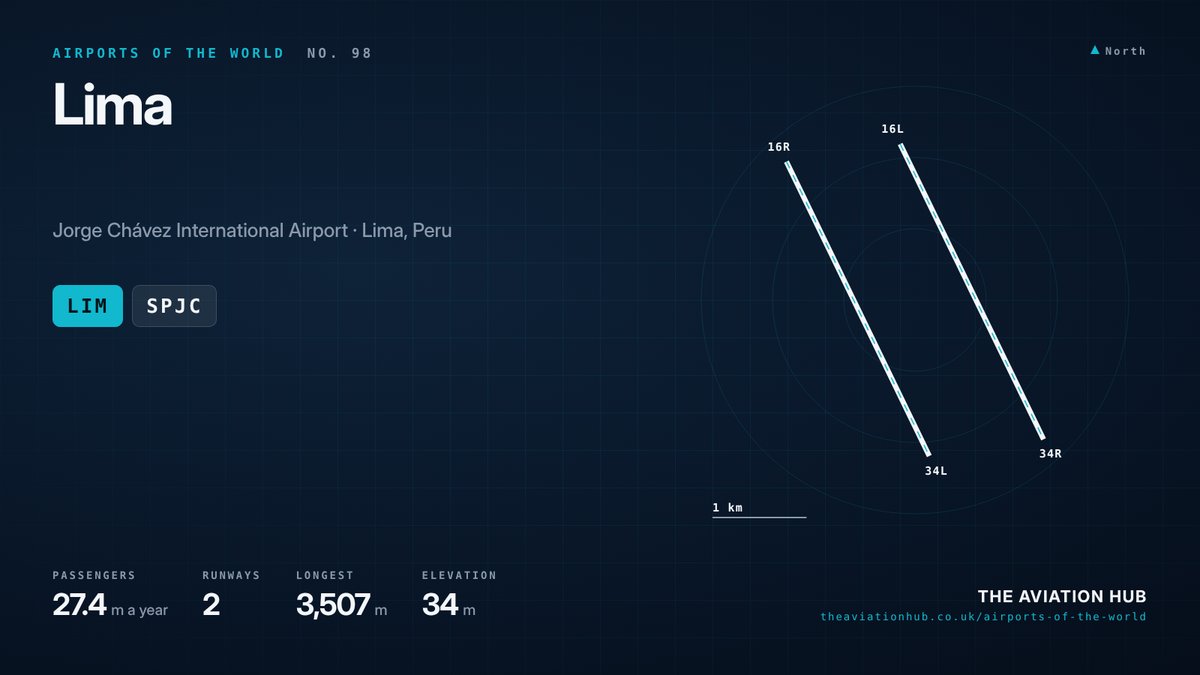
Jorge Chavez International Airport is the gateway to Peru and the hub of the Pacific coast of South America. It stands in Callao, the port city that adjoins the capital, about 7 miles (11 km) north west of central Lima. Lima Airport handled around 27.4 million passengers in 2025 and serves as the hub of LATAM Peru, Sky Airline Peru and JetSmart Peru. A second runway in 2023 and a brand new terminal in June 2025 have transformed a field that had been bursting at the seams for a decade.
Lima Airport at a Glance
The codes are LIM and SPJC. The field sits at 113 ft (34 m) above sea level on the flat coastal strip beside the Pacific, roughly 7 miles (11 km) from the historic centre and about 11 miles (17 km) from the Miraflores hotel district. The sea fog known as the garua hangs over the site for much of the winter.
Lima Airport has two parallel runways and, since June 2025, a single new passenger terminal. The 2025 total was 27,420,159 passengers according to the state air navigation agency CORPAC, which also controls the airspace. LATAM Peru is the dominant carrier, with Sky Airline Peru, JetSmart Peru, Star Peru and ATSA Airlines also based here and the Colombian freight carrier Aerosucre using it as a focus city. Lima Airport Partners, a consortium led by Fraport of Germany, has held the concession since 2001. Flight information is on the airport’s official website.
A Short History of Jorge Chavez
Lima’s first international airport was Limatambo in the San Isidro district, which by the 1950s had been swallowed by housing. The government built a replacement on open land in Callao, and President Manuel Prado opened it as Lima International Airport on 29 October 1960. In June 1965 it was renamed after Jorge Chavez Dartnell, the Peruvian aviator who made the first flight across the Alps in 1910 and died in the crash at the end of it.
The decades that followed brought tragedy as well as growth. Varig Flight 810 crashed near the airport in 1962, killing all 97 on board, and in 1996 Aeroperu Flight 603 went into the sea after masking tape left over the static ports during cleaning made its instruments useless. The 1990s also saw car bombs and a shooting at an American Airlines aircraft during Peru’s internal conflict.
Fraport’s arrival in 2001 brought a terminal refurbishment and a long wait for land. The state finally handed over the expansion site in 2018, and the second runway and a new control tower entered service on 3 April 2023. The new terminal opened on 1 June 2025, two months later than planned after certification delays, with Aerolineas Argentinas operating the first passenger flight.
Runways at Lima Airport
Runway 16L/34R is the original strip, 3,507 m (11,506 ft) long and 45 m (148 ft) wide. Runway 16R/34L, the 2023 addition to the west, is 3,480 m (11,417 ft) long and also 45 m (148 ft) wide. Both carry instrument approaches and both are long enough for the Boeing 787-9 and Airbus A350-900 services to Europe.
Winds off the Pacific are remarkably constant, blowing from the south for most of the year, so the 16s see the overwhelming majority of movements. Arrivals on the 16s come in from the north over the northern suburbs of Callao, while the port of Callao lies south of the field. The second runway added much needed capacity.
The field has had its share of runway drama. An Aero Continente Boeing 737 belly landed with its gear up in 2003 and everyone survived, and in November 2022 a LATAM Airbus A320neo struck a fire engine that had driven onto the runway during take off, killing two firefighters. Low cloud and fog in the winter months from June to September cause regular delays.
Terminals and Airlines
The new terminal at Lima Airport is a single large building with a central processor and piers, built to handle 40 million passengers a year. All scheduled carriers moved across in June 2025, with domestic and international flights still under one roof. LATAM Peru, the market leader, has the lion’s share of the gates, and the low cost pair of Sky and JetSmart occupy much of the rest of the domestic operation.
The international line up spans Avianca, Copa, Aeromexico, American, United, Delta, Air Canada, Air Transat, Air France, KLM, Iberia, Air Europa and Plus Ultra. LATAM’s long haul fleet connects Lima with Madrid, and the European carriers serve their home hubs. The Sumaq VIP lounge in the old terminal was twice named lounge of the year by Priority Pass, and the new building has fresh lounge space for LATAM and independent operators.
The old terminal sits empty for now. Plans include a medical centre, offices, logistics and private aviation, and the government has also studied reopening it to add capacity if demand runs ahead of forecasts.
Routes and Destinations
Domestic flying is heavy because Peru’s geography makes road travel slow. Cusco, the gateway to Machu Picchu, is the busiest route in the country, with dozens of daily flights, and Arequipa, Piura, Iquitos, Trujillo and Tarapoto are also busy. LATAM, Sky and JetSmart all fight hard on these trunk routes with Airbus A320 family aircraft.
Santiago, Bogota, Buenos Aires, Miami, Madrid, Mexico City, Panama City and Sao Paulo lead the international list. Amsterdam, at around 6,550 miles (10,500 km), is the longest regular route, served by KLM, with Paris and Barcelona close behind. Madrid is served by LATAM, Iberia, Air Europa and Plus Ultra. Cargo matters too, with asparagus, blueberries and fresh fish heading north to Miami on freighters and in bellies. Traffic peaks in the southern summer holidays of January and February and again in July.
Getting to and from Lima Airport
There is no rail link and the road situation is the airport’s weakest point. The new terminal opened with only two temporary access bridges from the Santa Rosa avenue side, and no public transport reaches the new building directly. Line 2 of the Lima Metro is under construction, and Line 4, due around 2028, will stop near the old terminal rather than the new one.
Airport Express Lima is the official coach and runs to Miraflores in 45 minutes to an hour for a modest fare. It is the cheapest sensible option for visitors. Registered taxis from the official desks inside the terminal cost around 60 to 80 soles (£12 to £17) to Miraflores, and ride hailing apps work from designated pick up points. Allow at least an hour by road at peak times, as Callao traffic is notorious.
Parking is available in front of the new terminal, and a Wyndham Grand hotel opened directly opposite in June 2025.
Spotting and Photography
Lima Airport is a rewarding stop for anyone interested in South American fleets. The LATAM, Sky and JetSmart narrow bodies are joined by the wide bodies of Air France, KLM, Iberia and Air Europa, Peruvian Air Force transports and the freighters of Aerosucre and Atlas Air. The new terminal’s glass piers face the aprons and runways, and airside views are the safest way to watch.
Outside the fence, the roads of northern Callao under the 16 approach catch arrivals low over the rooftops. Afternoon haze and the winter garua limit visibility, so the clear summer months from December to April are best.
Callao has a reputation for street crime, and the neighbourhoods around the perimeter are not places to linger with a camera. Go with a local contact, keep equipment out of sight between shots, and stay away from the fence and the police posts. Airport security will stop anyone photographing the perimeter at length.
What Comes Next
The 2025 terminal and 2023 runway were sized for 40 million passengers by 2030, so Lima Airport has capacity to spare for the first time in a generation. The missing pieces are landside. Permanent access roads, a proper link to the Metro and the fate of the old terminal all need decisions, and the government and the concession holder have argued publicly over who pays.
Peru’s economy and the strength of LATAM’s regional network will set the pace. The field is now a credible connecting hub between North and South America rather than a bottleneck.
Lima Airport has finally caught up with the city it serves. Compare it with the other South American hubs on the Airports of the World map.
Continue to follow The Aviation Hub for more analysis and insight.
Advertise with us Your brand, in front of an aviation audience Home page and in-article placements, sold directly, one advertiser per slot. From £250 a year. See the rates

