
London City Airport Guide: The Docklands Runway Explained
London City Airport sits in the Royal Docks, six miles from the City. Steep approach, runway limits, airlines, DLR access, spotting and growth plans.
 By The Aviation Hub
5 min read
Updated October 20, 2026
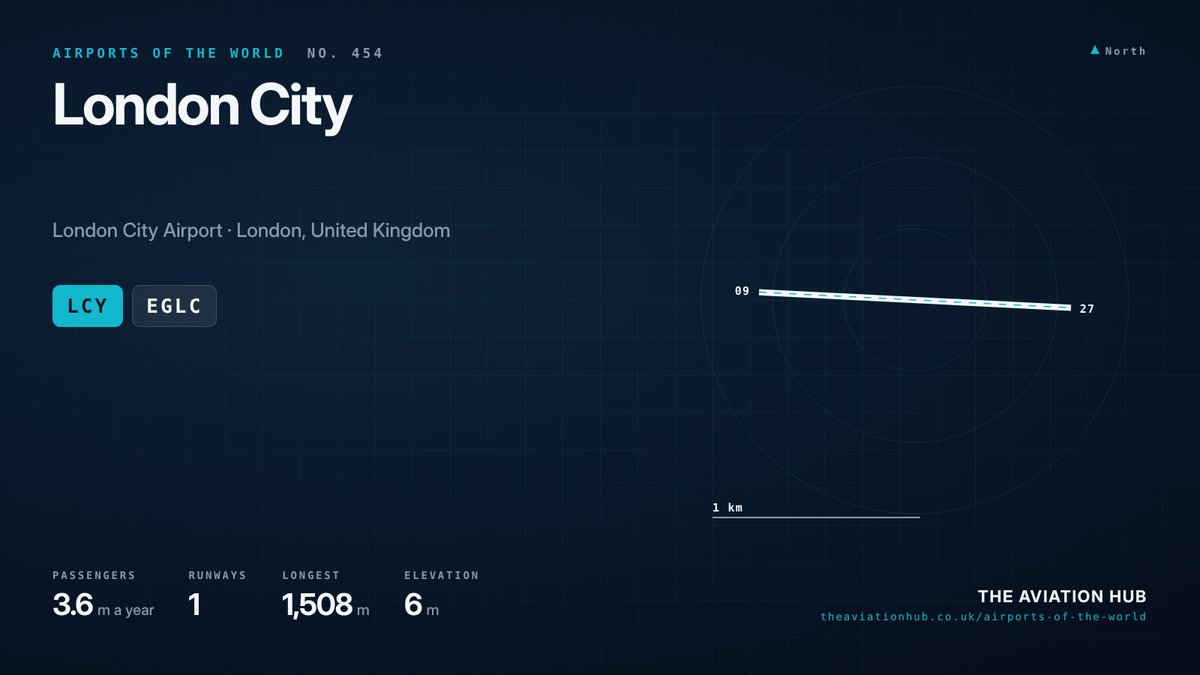
London City Airport occupies a strip of quayside between two flooded docks in Newham, east London, about six miles from the Bank of England. It is the capital’s business airport, built so that bankers and executives can reach Europe with minimal fuss. Around 3.6 million passengers used it in 2024. Its short runway, steep approach and tight rules on hours and aircraft make it unlike any other London airport.
London City Airport at a Glance
The IATA code is LCY and the ICAO code is EGLC. The airport lies in the Royal Docks, roughly 6 miles (10 km) east of the City of London and 3 miles (5 km) from Canary Wharf. It sits 19 feet (6 m) above sea level, with one runway and a single two storey terminal. London City Airport handled 3,569,871 passengers in 2024, still below the pre pandemic high of about 5.1 million in 2019.
BA CityFlyer has its operating base here. London City Airport Limited owns and runs the field, and Macquarie Asset Management bought a controlling interest in 2025. Live flight information and access details are on the airport’s official website.
How Docklands Got Its Airport
By the early 1980s the Royal Docks had closed and east London was looking for new uses for its derelict waterfront. In 1981 Reg Ward, chief executive of the London Docklands Development Corporation, proposed a short takeoff and landing airport on the quay between the Royal Albert and King George V docks. Mowlem developed it in 1986 and 1987.
The first commercial services began on 26 October 1987, flown by de Havilland Canada Dash 7 turboprops, and Queen Elizabeth II formally opened the airport that November. In 1992 the glide path was reduced to 5.5 degrees, allowing quiet regional jets such as the BAe 146 to operate. Traffic took off as Canary Wharf grew into a financial centre.
Ownership has changed several times. In 2016 a Canadian led consortium of AIMCo, OMERS, Ontario Teachers’ and Wren House bought the airport for about £2 billion. Macquarie took a 25 per cent stake in June 2025 and a further 50 per cent that October.
Runways at London City Airport
The single runway, 09/27, measures 1,508 metres (4,948 feet) long and 30 metres wide. Water lies on both sides. The approach glide path is 5.5 degrees, compared with about 3 degrees at most European airports, so aircraft and crews need special certification. Only multi engine, fixed wing aircraft up to the size of the Embraer E195-E2, Airbus A220 and A318 are permitted, and the airport applied in 2025 to add the Airbus A320neo.
A parallel taxiway and eight extra stands opened in November 2020, ending lengthy backtracking along the runway. In January 2021 London City Airport became the first major airport controlled from a remote digital tower, at the NATS centre in Swanwick, Hampshire, about 80 miles away. On 13 February 2009 a BA CityFlyer Avro RJ100 suffered a nose gear collapse on landing, without serious injuries.
Terminals and Airlines
The single terminal has 15 gates, all on open stands, so every passenger walks to the aircraft. That, together with short security queues, gives the airport its famously quick journey from kerb to gate.
BA CityFlyer flies Embraer E190s to Edinburgh, Glasgow, Amsterdam, Dublin and a long list of European and leisure destinations. KLM links Amsterdam, Swiss serves Zurich with the A220, ITA Airways flies to Milan Linate and Luxair connects Luxembourg. Loganair, Aurigny and Air Dolomiti add regional links. British Airways once flew an all business class A318 to New York JFK, refuelling at Shannon, until 2020.
Routes and Destinations
Amsterdam was the busiest route in 2024, with 563,953 passengers. Edinburgh followed with 334,893, Zurich with 331,913, Dublin with 266,658 and Milan Linate with 260,840. These are classic business routes, linking the City and Canary Wharf with other financial and corporate centres.
Weekday mornings and evenings are the peak. Leisure flying has grown, with summer routes to Mediterranean islands and winter flights to ski resorts. Cargo is negligible. London City Airport runs to a strict timetable: 06:30 to 22:30 on weekdays, 06:30 to 13:00 on Saturdays and 12:30 to 22:30 on Sundays, leaving a quiet day long break each weekend.
Getting to and from London City Airport
The Docklands Light Railway has its own station beside the terminal. Trains run to Bank in the City in around 20 to 25 minutes, with links to Canary Wharf, Stratford International and Woolwich Arsenal. A change at Canning Town gives the Jubilee line. Paying by contactless card on the DLR is the cheapest sensible option.
The Elizabeth line passes about 300 metres south of the terminal but does not stop, and TfL does not support adding a station. By road, the airport is reached via the A1020 and A112. Short and long stay car parks sit beside the terminal, and a taxi rank serves arrivals. London buses call at the airport, and Thames Clippers boats stop at nearby Royal Wharf.
Spotting and Photography
London City Airport is a favourite with London spotters. The north side of Royal Albert Dock gives an unobstructed view across the water to the runway, with summer evenings offering the best light as the sun moves round to the north west. Runway 09 arrivals pass the towers of Canary Wharf, a classic London shot, while runway 27 arrivals come in over Beckton and Gallions Reach.
The steep approaches make for unusual angles, and the variety ranges from E190s and A220s to Dash 8s, ATR turboprops and business jets. Stay on public paths, never climb on railings by the dock edge and respect any instructions from security staff. Remember the weekend closure before travelling out for photos.
What Comes Next
The £344 million City Airport Development Programme, approved on 27 July 2016, delivered the new taxiway and stands, but work on the terminal extension was paused in 2020. Plans to raise the passenger cap from 6.5 million to 9 million, with more flights between 06:00 and 09:00, have been approved. A bid to allow Saturday afternoon flights was rejected by Newham Council on 10 July 2023, and neighbours remain watchful.
New generation aircraft are central to growth, and approval for the A320neo would open longer routes. Unexpected disruption remains possible, as when a Second World War bomb was found in King George V Dock in February 2018. The verdict: London City Airport will keep growing within tight limits, powered by its new owner and quieter jets. Compare it with the capital’s other gateways on the Airports of the World map.
Continue to follow The Aviation Hub for more analysis and insight.
Advertise with us Your brand, in front of an aviation audience Home page and in-article placements, sold directly, one advertiser per slot. From £250 a year. See the rates

