
Long Beach Airport Guide: Slots, Southwest and Streamline Style
Long Beach Airport mixes a historic terminal, strict noise rules and a Southwest led schedule. Read about its runways, routes, transport and spotting.
 By The Aviation Hub
6 min read
Updated October 20, 2026
Southern California has bigger airports, but none with quite the character of Long Beach. Long Beach Airport, also known as Daugherty Field, combines a listed 1940s terminal with one of the strictest noise ordinances in the United States. It handled about 3.8 million passengers in 2025. Southwest Airlines dominates the schedule, while business jets, flight schools and a deep manufacturing heritage give the field far more variety than its airline numbers suggest.
Long Beach Airport at a Glance
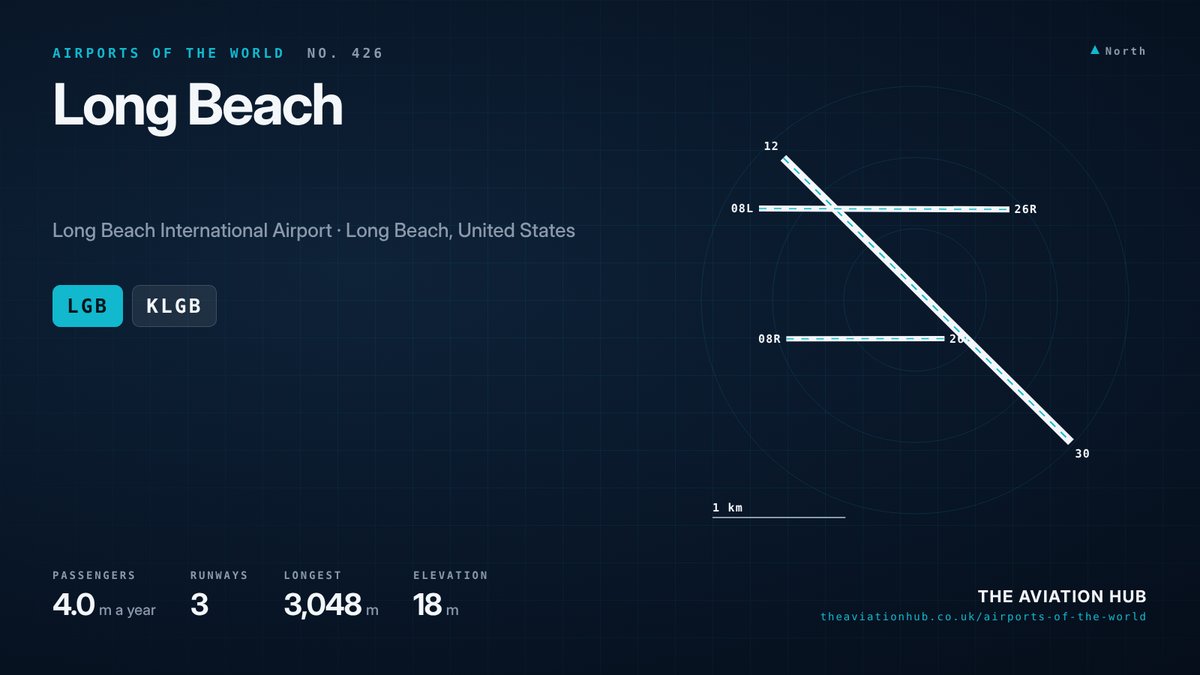
The IATA code is LGB and the ICAO code is KLGB. Long Beach Airport lies about 3 miles (5 km) northeast of downtown Long Beach, roughly 20 miles (32 km) south of downtown Los Angeles. The field sits 60 feet (18 metres) above sea level. It has three runways and a single passenger terminal.
Traffic reached about 3.8 million passengers in 2025, down 8 per cent on 2024. Southwest carried roughly 88 per cent of passengers between May 2025 and April 2026. Delta Connection, Hawaiian and Alaska provide the rest. The City of Long Beach owns and operates the airport, and parking, flight and terminal details are on the airport’s official website.
How Long Beach’s Airport Came to Be
Aviation arrived early. In 1911 Calbraith Perry Rodgers finished the first transcontinental flight on the sand at Long Beach. Local aviator Earl Daugherty opened a flight school nearby in 1919, and in 1923 the city council created a municipal airport. The field still carries his name. Douglas “Wrong Way” Corrigan flew regularly from Daugherty Field before his famous 1938 flight to Ireland.
The Navy opened a reserve air base in 1928, and the Second World War transformed the site. Douglas Aircraft built a huge factory beside the runways, producing transports and bombers. The plant later built airliners such as the DC-8, DC-9 and MD-80, and military C-17 airlifters until production ended in 2015.
The Streamline Moderne terminal dates from the early 1940s and is now a historic landmark. A $136 million modernisation finished in December 2012 added a new concourse behind it. Airline flying at Long Beach Airport has been tightly limited since 1981, after residents fought for noise controls.
Runways at Long Beach Airport
The main runway, 12/30, measures 3,048 metres (10,000 feet) long and 61 metres (200 feet) wide, in asphalt. It handles all airline flights and most business jets.
Two parallel runways serve lighter traffic. Runway 08L/26R is 1,887 metres (6,192 feet) long and 46 metres (150 feet) wide. Runway 08R/26L is 1,194 metres (3,918 feet) long and 30 metres (100 feet) wide. Both are asphalt.
Onshore Pacific breezes usually favour runway 30, with departures climbing out to the northwest. Runway 12 takes over during Santa Ana wind events and some winter storms. The two short parallels carry busy flight school and light aircraft traffic. Two further runways, 16L/34R and 16R/34L, closed and were removed in July 2016.
The noise ordinance shapes everything. Airlines operate under a cap on daily commercial flights, set at around 58 as of 2023, and late night departures face penalties. Those slots are valuable, which explains the scramble when carriers leave.
Terminals and Airlines
The historic terminal handles check in and arrivals, while the 2012 concourse holds the gates. It has an open air feel, with outdoor seating areas that suit the mild climate. A $125 million second phase, approved in February 2020, adds a new ticketing building, a seismic retrofit of the old terminal, new baggage claim and relocated car hire. Six projects in that phase were complete by 2025.
JetBlue once dominated Long Beach Airport but closed its base in October 2020 and moved to Los Angeles International. Southwest took most of the freed slots and now flies the bulk of departures with Boeing 737 jets. Delta Connection links the city with Salt Lake City, and Hawaiian serves the islands. Alaska returned with twice daily Seattle flights on 8 September 2026.
Routes and Destinations
Las Vegas is the busiest route, with around 241,000 passengers between May 2025 and April 2026. Sacramento follows at roughly 207,000, then Phoenix at about 176,000. Oakland and Salt Lake City complete the top five, each above 140,000 passengers.
Southwest’s network covers California, the Mountain West and Texas, with links as far as Chicago Midway and Nashville. Hawaiian flies to Honolulu and Kahului on Maui, the longest routes from the field at more than 2,400 miles (3,900 km). Leisure travel peaks around holidays, and Disneyland visitors make up a share of passengers. Long Beach is the second closest airport to the park, after John Wayne in Orange County. FedEx and UPS fly cargo, though freight plays a small part.
Getting to and from Long Beach Airport
Lakewood Boulevard, part of State Route 19, links the terminal with the Interstate 405 freeway. Driving from downtown Long Beach takes around 15 minutes, while central Los Angeles is 40 minutes away or more in traffic. Short and long stay parking sit close to the terminal, and ride hailing pickups are well organised.
Long Beach Transit routes 102, 104, 111 and 176 serve the airport. Route 111 connects with Downtown Long Beach Station for the Metro A Line to downtown Los Angeles. Route 104 reaches Willow Street Station on the same line. That bus and train combination is the cheapest sensible option for reaching Los Angeles, though it takes well over an hour. Route 405 runs weekday service to UCLA.
Spotting and Photography
Long Beach Airport is a favourite with Southern California spotters, thanks to the mix of airliners, business jets and light aircraft. Public streets around the perimeter give good views of runway 30 arrivals, and the area around the former Douglas plant offers sightlines towards the parallels. The outdoor areas of the concourse also give passengers views of the apron.
Morning light suits the northeast side, while afternoons favour positions to the south. Gulfstream runs a service centre here, so corporate jets add constant interest. Military visitors and vintage aircraft appear on occasion.
Behave sensibly. Stay on public land, keep away from fences, never block traffic and follow instructions from airport police.
What Comes Next
The Phase II terminal work will finish the modernisation and secure the historic terminal against earthquakes. Long Beach Airport will not grow much beyond its slot cap, and the city has shown no appetite to relax the noise rules. Growth will come from larger aircraft and fuller flights rather than more departures.
Long Beach also hosts events at the 2028 Olympic Games, which should bring a short burst of demand. Alaska’s return adds competition on the Seattle route. Compare the field with other Los Angeles area airports on our Airports of the World map. The verdict: Long Beach Airport is a capped but popular alternative to Los Angeles International, with history in every hangar and a schedule that depends heavily on Southwest.
Continue to follow The Aviation Hub for more analysis and insight.
Advertise with us Your brand, in front of an aviation audience Home page and in-article placements, sold directly, one advertiser per slot. From £250 a year. See the rates

