Los Cabos International Airport serves the resort corridor at the southern tip of the Baja California peninsula in Mexico, where the desert meets the Sea of Cortez. Los Cabos Airport handles around seven and a half million passengers a year, the great majority of them holidaymakers from the United States and Canada, and it ranks among the busiest airports in the country. The field lies about 6 miles (10 km) north of San Jose del Cabo and roughly 22 miles (35 km) in a straight line from Cabo San Lucas. Few Mexican airports depend so heavily on a single market.
Los Cabos Airport at a Glance
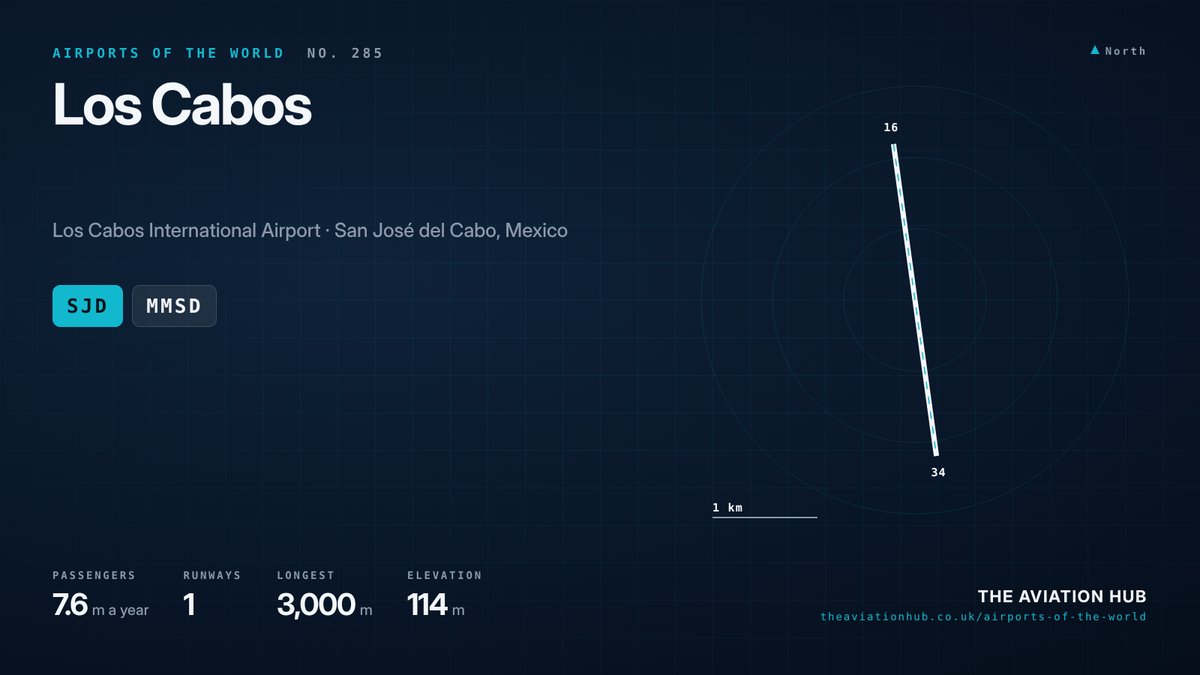
The IATA code is SJD and the ICAO code is MMSD. The airport sits on the desert plain north of San Jose del Cabo at an elevation of 114 metres (374 ft), with the mountains of the Sierra de la Laguna rising behind it. The town itself is about 6 miles (10 km) south, and the hotel strip that runs west along the coast to Cabo San Lucas stretches another 20 miles (32 km) beyond that.
One runway and two passenger terminals handle the traffic. Passenger numbers in 2025 were roughly 7.5 million, barely changed from 2024 after years of rapid growth. No airline bases a hub here, but Viva treats the airport as a focus city and the big United States and Canadian carriers all run extensive schedules into it. The operator is Grupo Aeroportuario del Pacifico, the Guadalajara based company that runs a dozen airports across western Mexico. Terminal maps and airline lists are available on the airport’s official website.
How Los Cabos’s Airport Came to Be
Los Cabos was a remote fishing settlement until the 1970s, reached by boat, by light aircraft or by the long road down the peninsula. The Mexican government chose it, alongside Cancun and Ixtapa, as one of a handful of planned resort developments, and an airport was central to the scheme. The field opened in 1977 with a provisional terminal under a tent like roof, and for its first years it handled a trickle of flights from the mainland and from California.
Growth followed the hotels. As the resort gained a reputation among American golfers and sport fishermen, airlines added routes, and the tented terminal gave way to permanent buildings. Privatisation in 1998 put the airport under Grupo Aeroportuario del Pacifico, which rebuilt Terminal 1 between 2008 and 2011 and added Terminal 3 beside Terminal 2 to cope with international growth. Hurricane Odile struck in September 2014, badly damaging the terminals and closing the airport for 18 days. Flights resumed on 3 October 2014, and further upgrades followed over the next decade.
Runways at Los Cabos Airport
Los Cabos Airport has a single asphalt runway, 16/34, which is 3,000 metres (9,843 ft) long and 45 metres wide. It runs roughly north to south across the desert floor. The length comfortably handles Boeing 737 and Airbus A320 family aircraft and supports wide body flights to Europe. The commercial apron has room for around 22 narrow body aircraft, with stands rated for wide bodies when needed.
Operations are straightforward most of the year, with the mountains of the Sierra de la Laguna well to the west. The peak of the hurricane season, from August to October, is the exception. Odile in 2014 remains the benchmark for damage. The single runway is the main capacity constraint at peak hours, when arrivals from the United States bunch together in the early afternoon.
Terminals and Airlines
Terminal 1 at Los Cabos Airport is a single storey building serving domestic flights, with eight ground level gates and a VIP lounge on a mezzanine. It is the home of the Mexican carriers. Aeromexico, Volaris and Viva fly from here to Mexico City, Guadalajara, Tijuana, Monterrey and other mainland cities. Volaris and Viva are low cost airlines and between them they carry most domestic passengers.
Terminal 2 handles international flights and is far larger. The two storey building has customs and immigration on the lower level and 19 departure gates above, nine of them with jet bridges. It absorbed the old Terminal 3 between 2018 and 2020. American Airlines, Delta, United, Alaska Airlines, Southwest, JetBlue, Frontier and Sun Country all fly in from the United States, with Air Canada, WestJet, Flair, Porter and Air Transat from Canada. Copa links Panama City. The alliance spread covers oneworld, SkyTeam and Star Alliance. A VIP lounge sits past security. Condor’s Frankfurt flights and Iberojet’s Madrid flights also use Terminal 2.
Routes and Destinations
Los Angeles is the busiest international route from Los Cabos Airport, with around 300,000 passengers a year, followed by Dallas Fort Worth and Phoenix. Denver, San Francisco, Houston, Seattle, Chicago and Atlanta are all served daily, and the schedule from Canada swells in winter with flights from Vancouver, Calgary, Toronto and Montreal. Mexico City is the busiest domestic route at around 420,000 passengers, with Guadalajara and Tijuana next.
The pattern is sharply seasonal. December to April is the peak, when snowbirds from the northern United States and Canada fill the resorts, and the summer months are quieter and hotter. Europe is served by Iberojet from Madrid, a summer route since 2023, and by Condor from Frankfurt twice a week in winter. Frankfurt is the longest route at around 6,130 miles (9,870 km). TUI Airways tried a London Gatwick service in 2019 and 2020, and a brief Shanghai link ran in 2011. More than 50 destinations appear on the map across a year. Cargo is small and mostly belly freight.
Getting to and from Los Cabos Airport
There is no rail and only limited public transport, so almost everyone leaves by road. The Transpeninsular Highway and a connecting toll road built in the early 2000s link the terminals to San Jose del Cabo in around 15 minutes and to Cabo San Lucas in 40 to 50 minutes. Authorised airport taxis and pre booked shuttles work from desks and ranks outside both terminals. A private transfer to Cabo San Lucas costs in the region of MXN 1,500 to 2,000 (roughly £60 to £80), while shared shuttles are far cheaper.
Ride hailing apps operate in the area but their pick up rights at the airport have been contested, so check the current position before relying on one. Local buses run along the highway between the resort towns for a small fare, but check how close they stop to the terminals before relying on one. Car hire is big business here, with all the major firms present, though timeshare sales desks are a well known nuisance in the arrivals halls and are best ignored. Parking sits in front of each terminal.
Spotting and Photography
The desert around the airport is open and the light is excellent, which makes Los Cabos Airport a rewarding stop for spotters. Arrivals on runway 16 come in from the north, and public roads around the field give views of aircraft on approach. The terminal windows in Terminal 2 overlook the apron and the runway beyond.
The wind decides whether runway 16 or 34 is in use, so check the forecast before choosing a spot. Winter brings the most variety, with Boeing 737 MAX 8s and Airbus A321neos from the United States, WestJet 737s from Canada and Condor wide bodies from Frankfurt. Private jets are a feature in their own right, with Gulfstreams and Globals lining the general aviation ramp. Stay on public roads, keep away from the fence and remember that the heat is dangerous for anyone standing around at midday.
What Comes Next
Los Cabos Airport is close to its practical capacity at peak hours, and the operator has been adding jet bridges and apron space in stages, most recently in 2022. The long term question is whether the single runway can keep up with winter demand. Water, power and road access in the desert are constraints in their own right.
New routes keep coming regardless. Volaris, Air Transat and Porter all added flights for the 2026 to 2027 winter season, and the Canadian market in particular has room to grow. Los Cabos Airport has become one of the key leisure gateways of North America, and the flat 2025 figures look more like a pause than a ceiling. Explore the rest of Mexico’s airports on the Airports of the World map.
Continue to follow The Aviation Hub for more analysis and insight.
Advertise with us Your brand, in front of an aviation audience Home page and in-article placements, sold directly, one advertiser per slot. From £250 a year. See the rates