
Louisville Airport Guide: Worldport, Runways and Routes
Louisville Airport combines a busy passenger terminal with the UPS Worldport cargo hub. Explore its history, runways, airlines, routes and future plans.
 By The Aviation Hub
5 min read
Updated October 20, 2026
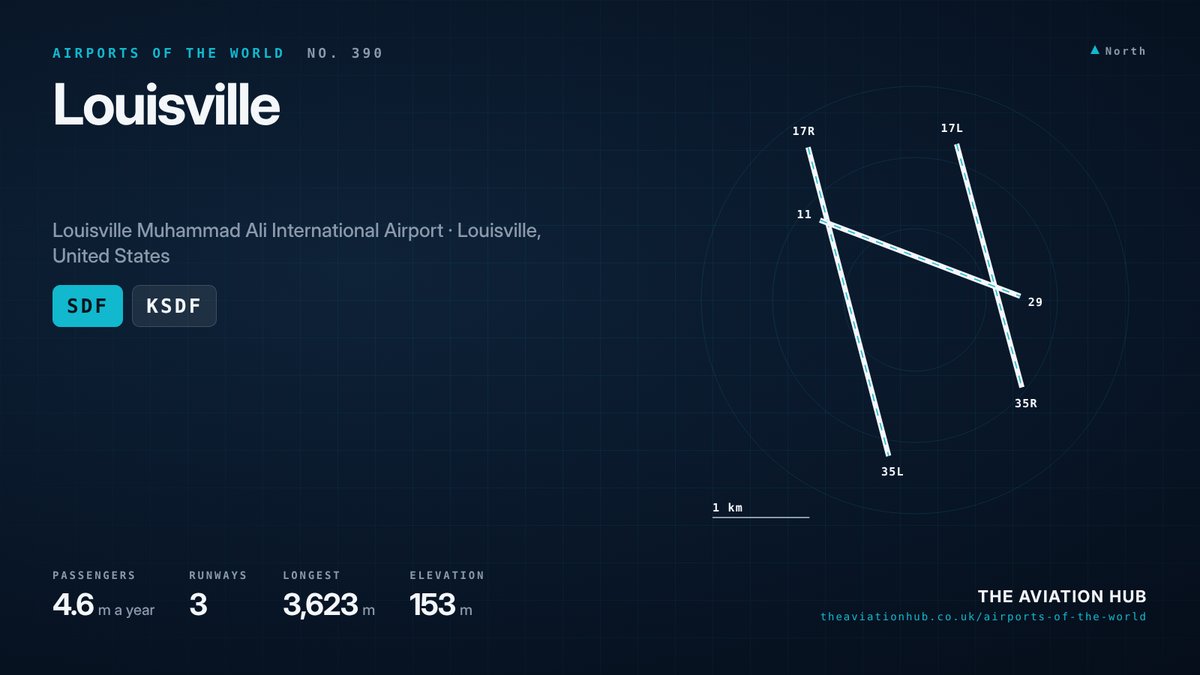
Most airports of this size are defined by their passengers. Louisville Airport is defined by its parcels. Officially Louisville Muhammad Ali International Airport, it serves Kentucky’s largest city and around 4.6 million passengers a year, but it is best known as the home of UPS Worldport, the global air hub of the parcel giant. Through the night, wave after wave of freighters lands from across the United States and the world, turning a mid sized city airport into one of the busiest cargo fields anywhere.
Louisville Airport at a Glance
The IATA code is SDF and the ICAO code is KSDF. The airport lies about 6 miles (9 km) south of downtown Louisville, at an elevation of 153 m (501 ft). It has three runways and one passenger terminal with two concourses. Louisville Airport handled 4,594,949 passengers in 2025, down from more than 4.8 million in 2024. Cargo dwarfs those figures, with around 7.5 billion lb moving through in 2025. UPS runs its main hub here, and the Kentucky Air National Guard’s 123rd Airlift Wing flies C-130 Hercules from the site. The Louisville Regional Airport Authority is the operator.
How Louisville’s Airport Came to Be
The great Ohio River flood of 1937 shaped the airport’s location. In 1941 the Army Corps of Engineers built a new field south of the city, on land that had stayed dry. It opened to the public in 1947, when commercial flights moved from the older Bowman Field. Bowman, which dates from the 1920s, still serves light aircraft and business flying on the east side of the city.
The airport was named Standiford Field after Dr Elisha David Standiford, a local businessman and politician. That name survives in the SDF code. It became Louisville International Airport in 1995, and on 16 January 2019 the airport authority voted to add the name of Muhammad Ali, the city’s most famous son.
UPS transformed Louisville Airport after opening its air hub here in the early 1980s. Worldport grew in stages, and a second expansion costing around one billion dollars was completed in April 2010. Tragedy has struck twice. In 1953 Resort Airlines Flight 1081 crashed on landing, killing 25 people. On 4 November 2025 a UPS McDonnell Douglas MD-11 freighter crashed just after take off from Runway 17R, causing a large fire and killing 15 people, including all three crew.
Runways at Louisville Airport
Three concrete runways serve the field. The parallels are 17R/35L, at 3,623 m (11,887 ft), and 17L/35R, at 2,615 m (8,578 ft). Runway 17R/35L was extended in 2007, giving heavy long haul freighters more room. The crosswind runway, 11/29, measures 2,210 m (7,251 ft).
At Louisville Airport the parallel layout allows simultaneous arrivals during the overnight peak, when UPS aircraft land in tight sequence. Flow direction depends on the wind. Noise is a long running issue for neighbourhoods under the approach paths, and runway use is managed to spread the impact where possible. The parallel layout took shape during a major expansion in the 1990s, which required the buyout of nearby neighbourhoods.
Terminals and Airlines
All passengers use the Jerry E. Abramson Terminal, named after a former mayor. It has 24 gates across two concourses, joined by a central rotunda with a single security checkpoint. The layout is compact and easy to navigate.
Southwest is the largest passenger airline at Louisville Airport, flying point to point across the country. Delta, American and United connect the city with their hubs, while Allegiant and other low cost carriers serve leisure markets. There are no regularly scheduled international passenger flights, despite the international title, although the airport is a port of entry and handles many international cargo flights.
Routes and Destinations
Hub links dominate. Atlanta, Charlotte, Chicago, Dallas Fort Worth and Denver provide onward connections, and Southwest adds nonstop service to cities such as Baltimore, Chicago Midway, Las Vegas and Orlando. Florida routes swell in winter, when leisure carriers add capacity to the sun.
The Kentucky Derby brings the biggest passenger spike of the year. On the first weekend of May, Louisville Airport fills with business jets and charters, and ramp space is at a premium. Cargo is a different world. UPS aircraft connect Worldport with every major US market and with gateways in Europe, Asia and Latin America, directly or via Anchorage, including Cologne Bonn, Hong Kong and Shanghai.
Getting to and from Louisville Airport
There is no rail link. The cheapest option from Louisville Airport is the TARC local bus, which connects the terminal with downtown Louisville for a small fare. Journey times are longer than by car but the service is reliable.
Interstate 65 runs along the eastern edge of the airport, and the Watterson Expressway, Interstate 264, passes just to the north. Downtown is usually 10 to 15 minutes away by taxi or ride hailing. The Kentucky Exposition Center sits next door, and Churchill Downs is a short drive northwest. Rental car counters sit in the terminal, garage and surface parking are available beside it, and current rates are on the airport’s official website.
Spotting and Photography
Louisville is a cargo spotter’s dream. The main UPS wave arrives late in the evening and departs before dawn, so a night visit with a fast lens reveals Boeing 747-8F, 767-300F and Airbus A300 freighters in numbers. Daytime brings airline traffic and a smaller UPS schedule.
Roads around the perimeter of Louisville Airport give views of the parallels, with the southern end useful when aircraft land on Runway 35. The Air National Guard C-130s add variety. Stay on public land, do not stop on airport access roads or the interstate, and follow any instruction from police or airport staff.
What Comes Next
The SDF Next programme involves more than one billion dollars of planned improvements to the terminal, baggage claim, security, lighting and rental car facilities. Work was under way by 2024 and will continue in phases.
UPS remains central to the airport’s future, as fleet changes and network shifts at Worldport ripple through the entire field. On the passenger side, the challenge for Louisville Airport is to win back growth after the dip in 2025 and to attract more nonstop routes. Expect Louisville to stay one of the most important cargo airports in the world. Explore more on the Airports of the World map.
Continue to follow The Aviation Hub for more analysis and insight.
Advertise with us Your brand, in front of an aviation audience Home page and in-article placements, sold directly, one advertiser per slot. From £250 a year. See the rates

