
Luxembourg Airport Guide: Findel’s Cargo and Luxair Hub
Luxembourg Airport at Findel is home to Luxair and Cargolux, with a 4,000 m runway and free trams to the city. Read about its history, routes and spotting.
 By The Aviation Hub
6 min read
Updated October 20, 2026
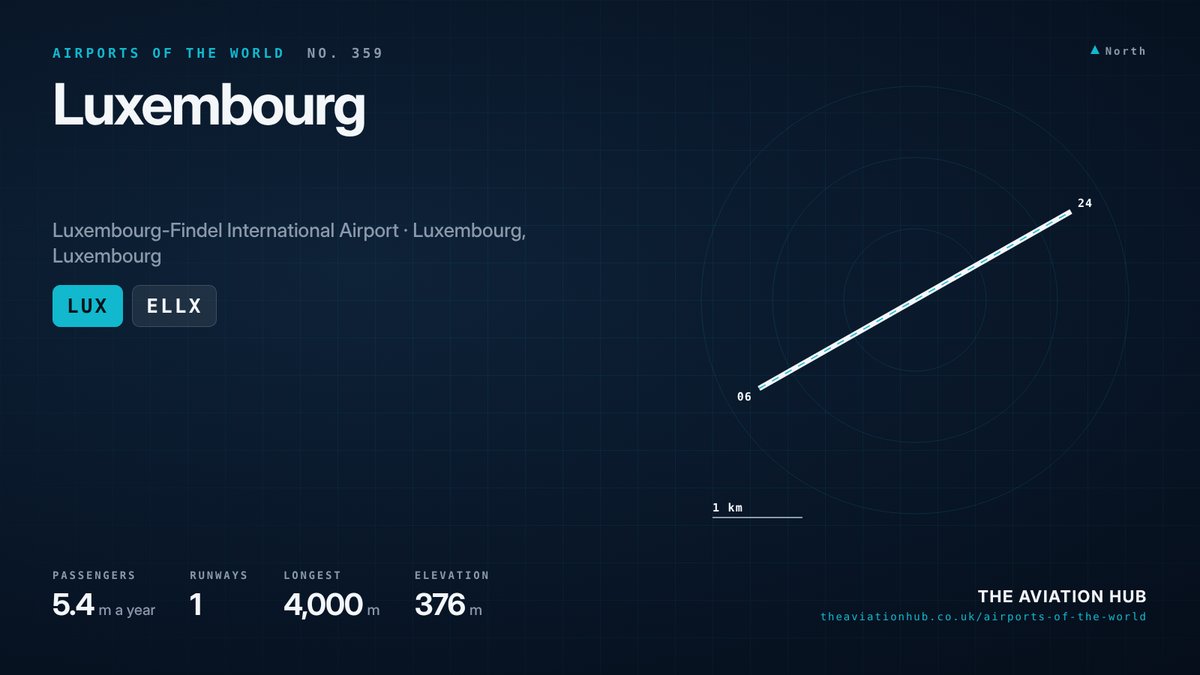
Luxembourg Airport is the only airport in the Grand Duchy with a paved runway, set on the Findel plateau just east of the capital. It handled about 5.2 million passengers in 2024, a remarkable figure for a country of fewer than 700,000 people. Cargo is the real story. Thanks to Cargolux, the field ranks among Europe’s five busiest freight airports, and its long runway sees a constant flow of Boeing 747 freighters.
Luxembourg Airport at a Glance
The airport carries the IATA code LUX and the ICAO code ELLX. It lies about 4 miles (6 km) east of Luxembourg City centre at an elevation of 376 m (1,234 ft). A single asphalt runway, 06/24, handled about 92,000 movements in 2024, and passengers use Terminals A and B.
Luxembourg Airport handled roughly 5.15 million passengers in 2024 and about 905,000 tonnes of cargo. The national airline Luxair and the freight carrier Cargolux both have their headquarters on site, and Luxair carries the largest share of passengers. A publicly owned airport company manages the terminals and commercial operations. Flight information and transport options are on the airport’s official website.
How Luxembourg’s Airport Came to Be
The airport began in the 1930s as Sandweiler Airport, a small grass field with a 1,000 m runway. During the Second World War it was used first by the Luftwaffe and then by United States Army units, and it returned to Luxembourg’s control in August 1945. Its later name, Findel, comes from the area on which it stands.
The postwar decades turned it into an international airport. The runway was lengthened step by step to today’s 4,000 m, and Cargolux, founded in 1970, grew into one of the world’s leading all cargo airlines. Terminal B opened in 2004, and the main Terminal A was inaugurated in May 2008, replacing the old building.
A plan to link the airport by underground rail was approved in 2003, and a rail tunnel was built in 2008. The scheme was shelved in 2009 because of budget constraints, and the tunnel has remained unused. In March 2020 the airport closed to passenger flights for a week during the pandemic.
Runways at Luxembourg Airport
Runway 06/24 is 4,000 m (13,123 ft) long and 45 m wide, with an asphalt surface. Its great length suits fully loaded Boeing 747-8 freighters bound for Asia and the Americas, and it gives passenger jets generous margins on a plateau that is often wet or icy.
South westerly winds prevail at Luxembourg Airport, so runway 24 is the usual direction, with arrivals approaching from the north east over Niederanven. Fog and low cloud are common on the high ground, and the instrument landing systems see heavy use. On 6 November 2002 Luxair Flight 9642, a Fokker 50, crashed near Niederanven on approach in poor visibility, killing 20 people. There is no parallel runway, so maintenance has to be planned around night closures and quiet periods.
Terminals and Airlines
Terminal A, opened in 2008, is the main passenger building at Luxembourg Airport and handles most flights. Terminal B reopened in 2017 for aircraft with up to 110 seats. It has boarding gates but no check in desks or arrivals hall. Since 2021, announcements and signs have used only French and English, a decision that drew criticism for leaving out Luxembourgish and German.
Luxair dominates, flying Embraer E195-E2s, Boeing 737s and De Havilland Canada Dash 8 turboprops across Europe and to holiday destinations. Lufthansa, KLM, British Airways, Swiss and Turkish Airlines connect their hubs, giving access to all three alliances. TAP Air Portugal and low cost carriers including easyJet add further competition. Cargolux operates from its own large maintenance and cargo complex.
Routes and Destinations
London, Frankfurt, Munich, Amsterdam and Paris are the core business routes, serving the financial sector and the European institutions based in the city. Portugal is the biggest market of all. A large Portuguese community in Luxembourg made Porto and Lisbon the two busiest routes in 2024, with Luxair, TAP and low cost carriers all competing.
Summer brings flights to Spain, Greece, Italy and Turkey, while the Canary Islands, Egypt and Cape Verde provide winter sun. Long haul passenger flights have been rare. A Luxair Newark service in 1999 lasted only seven months. China Southern now flies to Guangzhou and Zhengzhou, Etihad flies to Abu Dhabi from 21 October 2026 and United plans to fly to Newark from April 2027. Cargo is where Luxembourg Airport goes truly global, with Cargolux freighters linking Asia, the Middle East, Africa and the Americas.
Getting to and from Luxembourg Airport
All public transport in Luxembourg has been free since 2020, which makes the bus or tram the cheapest sensible option by a long way. Since March 2025 tram line 1 has reached the airport through Kirchberg, linking it with the European quarter, the city centre and the main railway station. Bus routes 6, 16 and 29 also serve the city, and regional bus 302 runs to Trier in Germany.
By road, Luxembourg Airport sits beside junction 9 of the A1 motorway, which links the capital with the German border. A taxi to the city centre takes 15 to 20 minutes, though fares are high by European standards. Short and long stay car parks surround Terminal A, and car hire desks sit in the arrivals hall.
Spotting and Photography
Luxembourg Airport is a favourite with freighter fans. Public roads and paths around the perimeter give good views of the runway, and the southern side near Sandweiler keeps the sun behind you for much of the day. With runway 24 most often in use, the approach from the north east is popular for arrival shots.
The Cargolux fleet is the main draw, from 747-400Fs to 747-8Fs, along with visiting freighters from Asia and the Middle East. Luxair’s E2s and turboprops add colour. Fog can linger on the plateau in the morning, so afternoons are often more reliable. Keep to public land, avoid blocking farm tracks and stay away from the high security cargo zone, where valuables such as art and jewellery are handled.
What Comes Next
Growth at Findel is shaped as much by freight as by passengers. Cargolux continues to modernise its fleet, and the cargo centre has been expanded with specialist facilities for pharmaceuticals and high value goods. The tram extension has transformed passenger access, and Terminal A still has room to absorb steady growth.
The single runway is the long term constraint, together with noise concerns in nearby villages. For now, Luxembourg Airport is heading for steady growth, anchored by Luxair, a wealthy catchment and one of Europe’s great cargo operations. See how it compares with other European airports on our Airports of the World map.
Continue to follow The Aviation Hub for more analysis and insight.
Advertise with us Your brand, in front of an aviation audience Home page and in-article placements, sold directly, one advertiser per slot. From £250 a year. See the rates

