
Lyon Saint Exupéry occupies open farmland about 12 miles (20 km) east of Lyon, in the commune of Colombier Saugnieu. It serves France’s third largest city and the wider Auvergne Rhone Alpes region, and in winter it doubles as a gateway to the Alpine ski resorts. Lyon Airport handled about 10.7 million passengers in 2025, up 2.4 per cent on the year before. A high speed rail station on site, a 4,000 metre runway and a strong low cost base set it apart from most French regional fields.
Lyon Airport at a Glance
The IATA code is LYS and the ICAO code is LFLL. The field lies 821 feet (250 m) above sea level, close to the A43 and A432 motorways. It has two parallel runways and one terminal in use, Terminal 1, after Terminal 2 closed for modernisation in April 2026. Traffic reached 10,709,883 passengers in 2025, alongside about 54,000 tonnes of cargo.
easyJet is the largest airline at Lyon Airport and bases a fleet of Airbus A320 family jets here. Air France has treated Lyon as a focus city since 1997, alongside its low cost sister Transavia France and the regional operator Twin Jet. The operator is Aéroports de Lyon, controlled since 2016 by a consortium led by Vinci Airports. Timetables, parking and terminal news are on the airport’s official website.
How Lyon’s Airport Came to Be
For decades Lyon relied on Bron, an aerodrome on the eastern edge of the city that dated from before the First World War. By the 1960s housing had closed in around it and there was no room to grow. The state chose a new site near the village of Satolas, far enough out for long runways and decades of expansion.
President Valéry Giscard d’Estaing inaugurated Lyon Satolas Airport on 12 April 1975, and passengers followed a week later. Bron survived as a general aviation field, a role it still fills. In 1994 a TGV station opened beside the terminal on the new high speed line. Its soaring steel canopy by Santiago Calatrava quickly became the emblem of the whole site.
In 2000, the centenary of his birth, the airport took the name of Antoine de Saint Exupéry, the Lyon born aviator and author of The Little Prince. Air France had begun building a focus operation in 1997, and low cost carriers arrived in force during the 2000s, using a basic Terminal 3. The biggest change at Lyon Airport came in June 2018, when a large extension to Terminal 1 opened and roughly doubled terminal space.
Runways at Lyon Airport
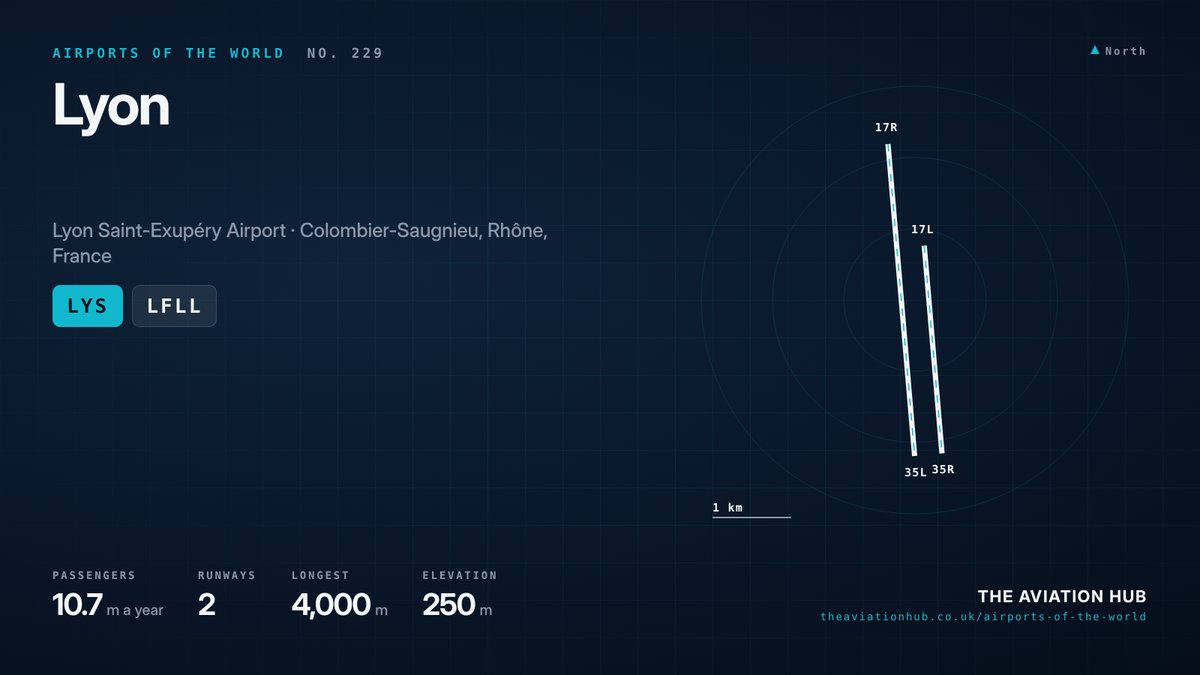
Lyon Airport has two parallel asphalt runways aligned roughly north to south. Runway 17R/35L is 4,000 metres (13,124 feet) long and 45 metres wide, long enough for any airliner in service. Runway 17L/35R is 2,670 metres (8,760 feet) long and also 45 metres wide. It comfortably handles the Airbus A320 and Boeing 737 traffic that makes up most of the schedule.
The longer runway is normally used for departures and the shorter one for arrivals. That split gives the airport far more runway capacity than its traffic needs. The north south alignment follows the Rhone corridor, where the wind tends to blow from the north or the south. Departures to the east climb towards the Alps, and on clear days passengers can often pick out Mont Blanc.
Terminals and Airlines
Terminal 1 now handles every passenger flight at Lyon Airport. Its older two storey section belongs to the original building, while the 2018 extension added a large hall for check in, security and shops. A tunnel leads to a satellite with the D gates, used mainly by easyJet and Transavia. That satellite once served Terminal 3, which was demolished to make room for the extension.
Terminal 2 mirrors the older part of Terminal 1. It reopened in April 2024 after a two year renovation and took Volotea, Norwegian, Air Arabia and ASL Airlines France. It closed again on 1 April 2026 for further work, with no reopening date announced, and its airlines moved back into Terminal 1.
The airline mix is broad for a regional field. Air France and KLM carry the SkyTeam flag, with their low cost sister Transavia alongside. Lufthansa and Turkish Airlines lead the Star Alliance presence, and Emirates operates its own long haul service. Air Algérie, Tunisair and Royal Air Maroc add a strong North African presence.
Routes and Destinations
Paris Charles de Gaulle is the anchor route from Lyon Airport, flown by Air France mainly as a feeder into its long haul network. Rail has taken almost all point to point traffic to the capital. Since 2023 French law has banned flights between Lyon and Orly, because the TGV covers the journey in about two hours. Amsterdam, Frankfurt, Munich and Istanbul provide the other key hub links.
North Africa is a large market, reflecting the region’s Algerian, Tunisian and Moroccan communities, with frequent flights to Algiers, Tunis and Casablanca. easyJet and Transavia supply a long list of leisure routes to Spain, Portugal, Italy, Greece and Egypt. Long haul flying is thin but steady. Emirates serves Dubai, while Air Canada and Air Transat fly to Montreal, roughly 3,700 miles (5,900 km) away.
Winter brings a distinct second season. Flights from the UK, Scandinavia and the Netherlands carry skiers bound for the Alps, many of whom step straight onto transfer coaches. Cargo is modest, at around 54,000 tonnes a year.
Getting to and from Lyon Airport
Rail is the strongest card. The Rhônexpress tram runs from the terminal to Lyon Part Dieu in about 30 minutes, calling at Vaulx en Velin La Soie for the metro. It is quick but pricey by French standards, with a single fare of around 17 euros (about £15).
The TGV station next door offers direct high speed trains to Paris, Marseille and other cities, which makes Lyon Airport a genuine rail gateway for the south east. TCL city buses 47 and 48 have served the airport since January 2020. They are the cheapest option, though the trip into central Lyon is far slower than the tram. Coaches link Grenoble, Saint Etienne, Chambéry and the ski resorts.
By road, the A43 and A432 reach central Lyon in around 30 minutes outside the rush hour. Taxis wait outside Terminal 1, and fares to the city centre usually run well above 50 euros. Around 16,000 parking spaces are spread across four car parks, and the cheaper outlying lots are best booked online in advance.
Spotting and Photography
Spotting at Lyon Airport is relaxed by French standards. The farmland around the perimeter offers views of both runways from public lanes, especially near the northern and southern thresholds. Because the runways run north to south, the eastern side has the sun behind you in the morning and the western side in the afternoon.
The Calatrava station, with its canopy shaped like a bird in flight, is worth photographing in its own right. Traffic is dominated by easyJet and Transavia, with welcome variety from Emirates, Turkish Airlines, Royal Air Maroc, Air Algérie and the Canadian transatlantic flights in summer. Winter weekends add ski flights from northern Europe.
French police and gendarmes take perimeter behaviour seriously. Stay on public roads, never climb fences or banks beside the airfield, keep clear of farm entrances and carry identification in case you are asked for it.
What Comes Next
The 2018 extension of Terminal 1 gave the airport room to grow, and the closure of Terminal 2 is for modernisation rather than retreat. With two parallel runways and a 4,000 metre strip, the airfield itself is not the constraint.
Politics is. Plans for further growth have drawn opposition from environmental campaigners and local politicians, and the ban on short domestic flights shows how quickly rail can take traffic away. Lyon Airport looks set for steady rather than spectacular growth, built on low cost leisure flying, North Africa and hub feeders. See how it fits into the French network on the Airports of the World map.
Continue to follow The Aviation Hub for more analysis and insight.
Advertise with us Your brand, in front of an aviation audience Home page and in-article placements, sold directly, one advertiser per slot. From £250 a year. See the rates

