Macau International Airport occupies a strip of reclaimed land on the eastern shore of Taipa, a few miles from the casinos of the Cotai Strip. Macau Airport opened in 1995 and handles around 7.6 million passengers a year, a modest figure by Chinese standards but a vital one for the territory. Air Macau is based here, and the airport serves as a bridge between mainland China, Taiwan and Southeast Asia. Its runway, built on an artificial island and joined to the terminal by causeways, is one of the more striking sights in Asian aviation.
Macau Airport at a Glance
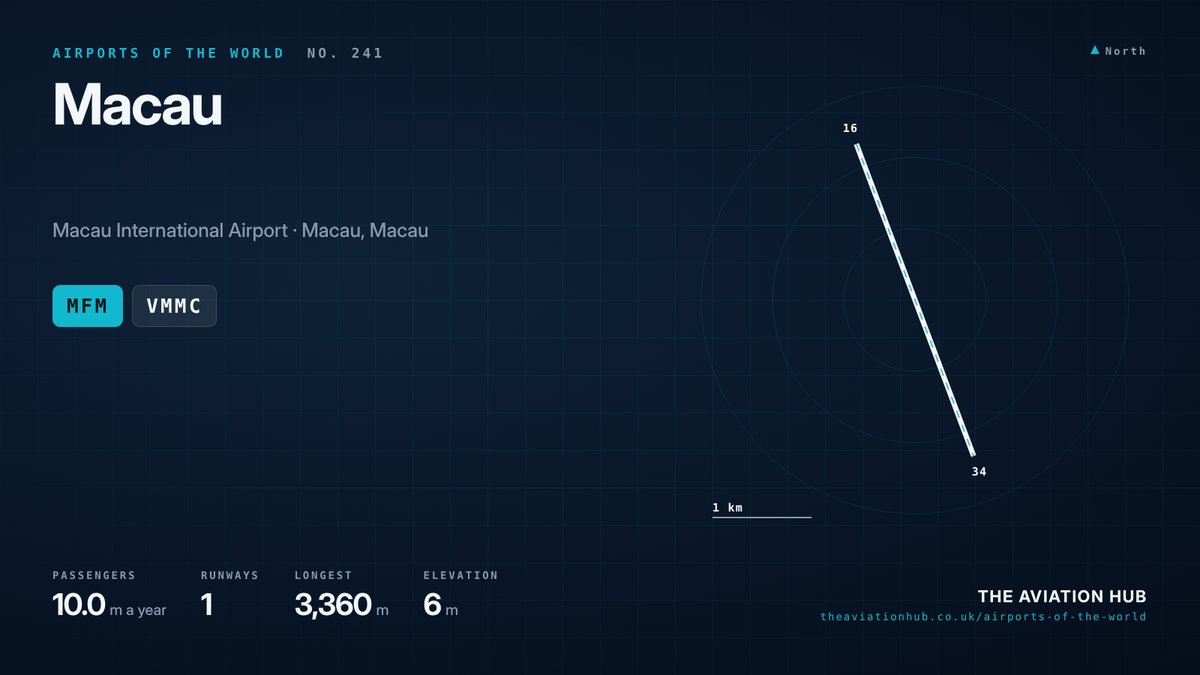
The airport carries the IATA code MFM and the ICAO code VMMC. It lies on Taipa, roughly 4 miles (6 km) southeast of the historic centre of Macau, and the field sits just 6 metres (20 feet) above sea level. There is one runway and one passenger terminal, with a separate business aviation centre for the executive jets that the casino trade attracts.
Traffic peaked at around 9.6 million passengers in 2019 before the pandemic cut it to a few hundred thousand. Recovery has been steady, with roughly 7.6 million passengers in 2024 and a similar figure in 2025. Air Macau is the home carrier. The airport is run by CAM, the Macau International Airport Company, and flight details are published on the airport’s official website.
How Macau’s Airport Came to Be
For most of the twentieth century Macau had no runway at all. Travellers took a ferry to Hong Kong and flew from Kai Tak. The Portuguese administration decided in the 1980s that an enclave about to return to Chinese rule needed its own airport, and work began on reclaiming land off Taipa.
The project cost about US$1 billion. The runway was built on a separate artificial island, and two causeways carry taxiways across the water to the terminal. Commercial service began on 9 November 1995, and President Mario Soares of Portugal performed the formal inauguration a month later.
The early years were difficult. TAP Air Portugal flew Lisbon to Macau from 1996 but could not make the route pay and withdrew in 1998. The airport found its role instead as a link between Taiwan and the mainland at a time when direct cross strait flights were banned, and later as a base for low cost carriers feeding the Cotai resorts.
Runways at Macau Airport
Macau Airport has a single runway, 16/34, measuring 3,360 metres (11,024 feet) in length and 45 metres wide. The strip sits on its own reclaimed island in the Pearl River estuary, which gives arriving aircraft an approach over open water from either direction. The runway is long enough for wide body aircraft.
Runway 16 brings aircraft in from the north over the estuary, while runway 34 approaches from the south over the sea beyond Coloane. Runway 34 is the usual direction for both arrivals and departures, although some airlines prefer runway 16 for southbound departures. With a single runway there are no parallel or crosswind operations.
The low elevation and exposed position make the airport vulnerable to typhoons. Strong storms can halt flights, and Typhoon Hato in 2017 caused serious disruption across the territory.
Terminals and Airlines
All scheduled flights at Macau Airport use the single passenger terminal on the Taipa shore. The building was designed for around 6 million passengers a year but handled more than 7 million by 2017, and extensions have added gates and check in capacity. Departures are on the upper level and arrivals below.
Air Macau is the dominant carrier and operates a fleet of Airbus A320 family jets, including the A321neo, on routes across China, Taiwan, Japan, Korea and Southeast Asia. Mainland carriers including Air China, China Eastern and XiamenAir fly in from major cities. EVA Air and Starlux serve Taipei, and low cost airlines such as AirAsia, Cebu Pacific, Jeju Air and Scoot feed the leisure market. A business aviation centre handles the private jets that arrive for the casinos.
Routes and Destinations
Taipei is one of the busiest routes, served by Air Macau, EVA Air and Starlux with multiple daily flights. Macau has long served as a transfer point for Taiwanese travellers heading to the mainland, and the route kept that traffic even after direct cross strait flights began in 2008. Mainland destinations include Beijing, Shanghai, Chengdu, Hangzhou and Nanjing.
Beyond China the network reaches Bangkok, Singapore, Kuala Lumpur, Manila, Hanoi, Seoul Incheon, Busan and Tokyo Narita. Low cost carriers dominate the Southeast Asian routes. Seasonal patterns follow the Chinese holiday calendar, with Golden Week in October and the Lunar New Year bringing surges of mainland visitors to Macau Airport.
Getting to and from Macau Airport
The Macau Light Rapid Transit has a station outside the terminal on the Taipa Line. Trains run to the Taipa Ferry Terminal in one direction and to Barra on the Macau peninsula in the other, reaching Cotai in about five minutes. Fares are low, and the line is the cheapest sensible option for anyone heading to the casinos or Taipa village.
Bus routes AP1, MT1, MT4, N2, 26, 36, 51A and 51B link the airport with the peninsula, Taipa, Cotai and Coloane. Most Cotai hotels run free shuttle buses from the airport for guests. Taxis wait outside arrivals for the short ride to central Macau.
Cross border coaches run from the airport to Zhuhai, Guangzhou and Dongguan. A dedicated shuttle also connects to the ferry terminals for passengers transferring to Hong Kong or the mainland without passing through Macau immigration. A multi storey car park stands beside the terminal.
Spotting and Photography
Macau is an unusual spotting location because the runway sits out in the water. The light rail’s Airport station on Avenida Wai Long overlooks the apron and taxiways, and the footbridge beside the Taipa Ferry Terminal gives a close view of aircraft taxiing to and from the causeways.
For runway 34 traffic, the road by Our Lady of Sorrows Church at Ká Hó on Coloane looks towards the southern end of the runway. Because spotters on Taipa look east towards the runway, the light is best from around noon until sunset, and morning shots face into the sun.
There is no dedicated viewing deck. Security staff watch the perimeter closely, so spotters should stay on public footpaths, avoid photographing security installations and respect any signs that prohibit cameras. Macau Airport is small, and a polite, low key approach pays off.
What Comes Next
The expansion master plan calls for more than 129 hectares of land reclamation between the runway and the apron, with new taxiways and a larger apron. The most visible early sections broke ground in 2020, the main reclamation works began in late 2024, and the programme is expected to run to around 2030. The first phase should lift capacity from 10 million to 13 million passengers a year.
Macau Airport also faces competition from across the water. Zhuhai Jinwan Airport lies a short drive away on the mainland, and the Hong Kong Zhuhai Macau Bridge makes it easy for residents to fly from Chek Lap Kok instead. The airport’s strength is convenience for the Taiwan and Southeast Asia markets, and its future rests on keeping low cost carriers and the casino trade engaged. For context on how it compares with its neighbours, see the Airports of the World map.
Continue to follow The Aviation Hub for more analysis and insight.
Advertise with us Your brand, in front of an aviation audience Home page and in-article placements, sold directly, one advertiser per slot. From £250 a year. See the rates