
Madison Airport Guide: Truax Field, Runways and Routes
Madison Airport, officially Dane County Regional at Truax Field, mixes airline hubs with Air Guard F-35s. Read how its runways and routes work.
 By The Aviation Hub
5 min read
Updated October 20, 2026
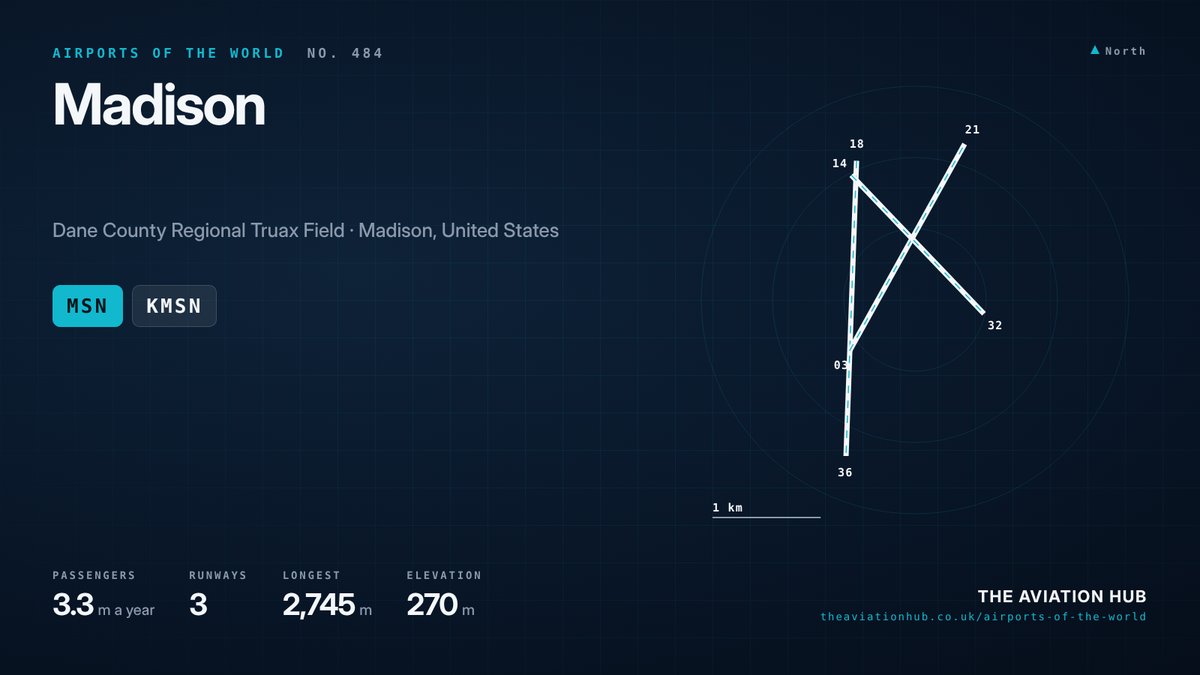
Wisconsin’s state capital is served by a compact, busy field on its north east edge. Madison Airport, officially Dane County Regional Airport at Truax Field, handles around 2.5 million passengers a year and ranks second in the state behind Milwaukee. It links the city, the state government and the University of Wisconsin to the big airline hubs. It also hosts a front line Air National Guard fighter wing flying the F-35.
Madison Airport at a Glance
The codes are MSN and KMSN. The airport lies about 7 miles (11 km) north east of downtown Madison and the Capitol, at an elevation of 887 ft (270 m). There are three concrete runways and a single terminal with 16 gates on one concourse. The site covers around 3,500 acres (1,416 ha).
Traffic in the year to July 2026 came to roughly 2.5 million passengers on more than 17,000 scheduled flights. No airline has a hub here. American, United and Delta lead, with their regional partners SkyWest and Republic carrying a big share. Dane County owns and operates Madison Airport, and flight information sits on the airport’s official website.
How Madison’s Airport Came to Be
The City of Madison bought 290 acres in 1927 for $35,380. The land had been a cabbage patch supplying a local sauerkraut factory. A Works Progress Administration grant in 1936 paid for four runways and a hangar, and the airport opened in September 1937.
War changed everything. The Army Air Corps took over in June 1942 and named the base Truax Field after Lieutenant Thomas “Bud” Truax, a Madison native killed in a training accident in November 1941. The base closed as an active airfield in November 1945 and returned to civil control, but the military never fully left.
A new terminal opened in December 1966 at a cost of $2.36 million. A $12 million project in 1986 almost tripled its size and added jet bridges. A $68 million expansion in 2006 doubled the building again in a prairie style influenced by Frank Lloyd Wright, who was born in Wisconsin. The $85 million South Terminal extension opened in June 2023.
Runways at Madison Airport
Runway 18/36 is the primary runway at 2,745 m (9,006 ft). Runway 03/21 measures 2,195 m (7,200 ft), and runway 14/32 is 1,782 m (5,846 ft). All three are concrete and 46 m (150 ft) wide, and they form a triangle that gives a usable option in almost any wind.
The north south runway handles most airline and military flying. Winter northwesterlies and summer southerlies tend to line up reasonably well with it. The crosswind runways come into play in strong westerly or easterly winds, which are common across the open Wisconsin farmland.
Madison Airport is a joint civil and military field. The Wisconsin Air National Guard’s 115th Fighter Wing operates the Lockheed Martin F-35A Lightning II, and the Army National Guard flies Sikorsky UH-60M Black Hawk helicopters. Fighter departures are a regular and loud feature of the day.
Terminals and Airlines
All airlines share the single terminal. American leads with around a fifth of passengers, flying mainline jets to Charlotte, Dallas Fort Worth and Phoenix plus American Eagle regional jets to East Coast cities. United serves Chicago O’Hare and Denver, while Delta connects Atlanta, Detroit and Minneapolis.
Delta Connection and United Express add Embraer E175 and Bombardier CRJ flights to Boston, Newark, New York LaGuardia and Washington National. Low cost and leisure carriers fill out the board. Frontier flies to Denver, Breeze links Florida and other leisure points, and Sun Country runs seasonal Phoenix and Fort Myers flights.
Airside there are two restaurants, a coffee shop and three markets. Wisconsin Aviation runs the fixed base operation for private and business aircraft.
Routes and Destinations
Chicago O’Hare is the busiest route by a wide margin, with around 286,000 passengers a year on American and United. Denver follows at around 147,000, then Dallas Fort Worth at 124,000 and Minneapolis at 122,000. Atlanta, Charlotte and Detroit each carry close to 100,000.
These figures show what Madison Airport really is: a feeder into the national hub system. Most travellers connect onwards rather than stopping at the first city. Point to point leisure flying is growing, though, led by Breeze to Tampa, with Fort Myers added from 21 October 2026, and by seasonal sun routes in winter.
The longest scheduled flights reach Phoenix and, in season, Los Angeles on Breeze. Cargo is modest at around 25 million lb a year. In February 2025 the airport said it would seek international designation, which would allow customs processing and direct international flights.
Getting to and from Madison Airport
There is no rail link. Metro Transit route D2 runs every 30 minutes between the terminal and downtown, calling at Capitol Square, State Street and the University of Wisconsin campus. It is the cheapest option by far, at a standard city bus fare.
By car, the airport sits close to US Highway 51 and Interstates 39 and 90. Downtown is about 15 minutes away outside peak hours. Taxis and rideshare wait outside baggage claim, and many local hotels run free courtesy shuttles. Rental car counters face baggage claim.
A large parking structure next to the terminal handles short and long stays, with cheaper surface lots further out. Allow extra time in winter, when snow can slow every journey.
Spotting and Photography
The mix of airline jets and military fighters makes Madison Airport more interesting than its size suggests. The terminal’s large windows look across the ramp towards the main runway, and regional jets dominate the apron in the morning bank.
Outside, public roads around the perimeter offer views of aircraft on approach to runway 36 and runway 18. The F-35 schedule varies, so weekday daytime is the best bet for the fighters. Low winter sun gives sharp light, and summer evenings are long.
The Guard base is a military installation. Do not photograph Guard facilities, stay on public land and keep clear of fences. Local police and base security respond quickly.
What Comes Next
The South Terminal extension is not finished. Three more gates are in development, and a terminal modernisation programme has brought new jet bridges. An 8 MW solar array on airport land is planned to supply clean power.
International designation is the big prize. A customs facility would let Madison Airport attract flights to Canada, Mexico and the Caribbean without relying on Chicago. The verdict is steady growth, a modern terminal and a more independent role in the Midwest network. Compare it with nearby fields on the Airports of the World map.
Continue to follow The Aviation Hub for more analysis and insight.
Advertise with us Your brand, in front of an aviation audience Home page and in-article placements, sold directly, one advertiser per slot. From £250 a year. See the rates

