
Manchester Airport lies at Ringway, about 7 miles (11 km) southwest of Manchester city centre on the border with Cheshire. It is the third busiest airport in the United Kingdom and the busiest outside London, serving a catchment of more than 20 million people across the north of England. Two parallel runways, two terminals reshaped by a £1.3 billion rebuild and a long haul network that no other regional airport in Britain can match make it the country’s northern gateway. Around 32 million passengers used it in 2025.
Manchester Airport at a Glance
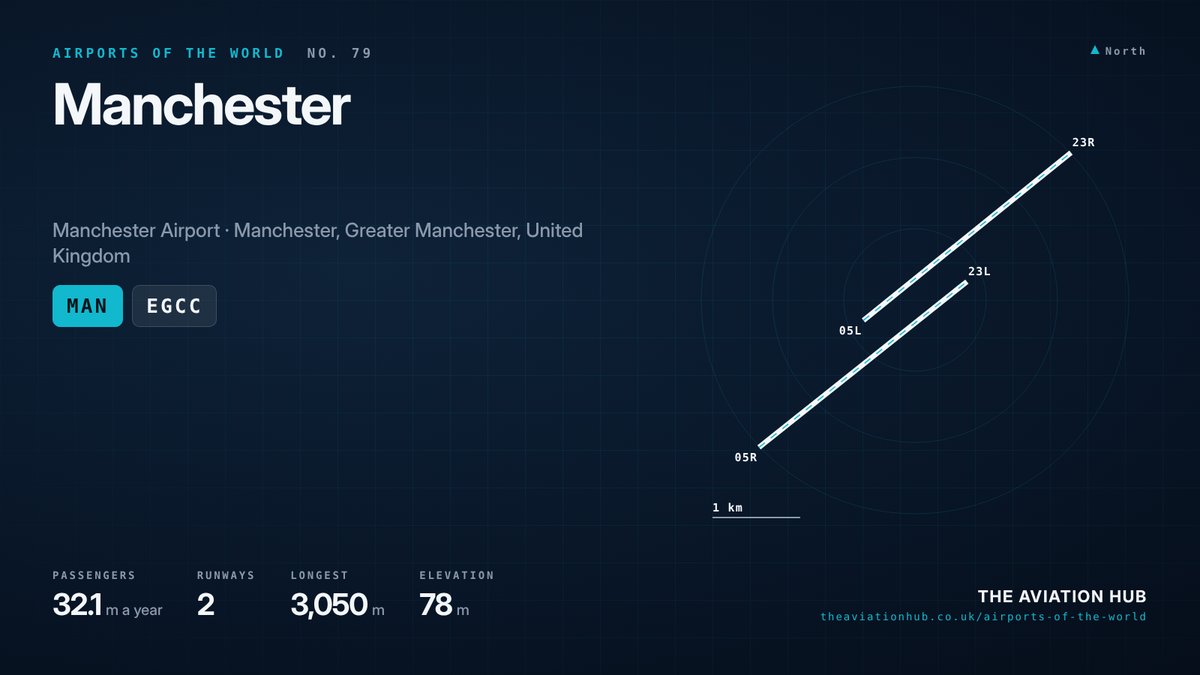
The codes are MAN and EGCC. The field stands 78 m (257 ft) above sea level and covers about 560 hectares between the M56 motorway and the village of Styal. It has two parallel runways and, since the closure of Terminal 1 in November 2025, two passenger terminals, with Terminal 2 handling most flights. Manchester Airports Group, owned by the ten Greater Manchester councils and the Australian investor IFM, operates it alongside Stansted and East Midlands.
Manchester Airport handled about 32.1 million passengers in 2025, up 4.1 per cent and well above its 2019 peak of 29.4 million. Jet2.com, easyJet, TUI Airways and Ryanair have large bases, Virgin Atlantic runs a long haul hub and around 199 destinations are served. Freight through the World Freight Terminal came to about 96,000 tonnes. Live flight information and parking are on the airport’s official website.
How Manchester’s Airport Came to Be
Manchester Corporation began building an airport at Ringway in November 1935 to replace the grass field at Barton. Ringway Airport opened officially on 25 June 1938, and KLM flew the first scheduled service to Amsterdam two days later. During the Second World War, RAF Ringway trained tens of thousands of parachutists and served as a centre for aircraft production and testing.
Civil flying resumed in 1946. Terminal 1, opened by Prince Philip in 1962, was advanced for its time and set the airport on a path towards transatlantic routes. The name became Manchester International Airport in 1975. Terminal A, now Terminal 3, opened in 1989 and Terminal 2 followed in 1993, giving the field three passenger buildings by the mid 1990s.
The second runway opened on 5 February 2001 after a bitter planning fight over habitat loss in the Bollin valley and noise over Knutsford. The 2017 Transformation Programme then set out to enlarge Terminal 2 and close Terminal 1, which happened on 19 November 2025. The darkest day came on 22 August 1985, when British Airtours Flight 28M caught fire during an aborted take off and 55 people died, a disaster that reshaped cabin safety rules worldwide.
Runways at Manchester Airport
Manchester Airport has two parallel runways aligned northeast to southwest. Runway 05L/23R is the original strip, 3,048 m (10,000 ft) long and 45 m wide with an asphalt surface. Runway 05R/23L, the 2001 runway, is 3,050 m (10,007 ft) and concrete. They lie 390 m apart and are staggered, too close for independent parallel approaches, so the usual pattern is landings on one and departures on the other.
The prevailing wind is westerly, so aircraft land from the northeast on 23R and depart towards the southwest on 23L about 80 per cent of the time. When the wind swings east the field reverses to 05. Only 05L/23R is used at night between 22:00 and 06:00, and the second runway is in practice opened only for peak periods, since movements of around 203,000 a year fit comfortably on one strip for much of the day.
The runways handle every type up to the Airbus A380, which Emirates has used on the Dubai route. A night noise quota limits movements in the small hours.
Terminals and Airlines
Terminal 2 is the centre of everything. Its Pier 1 opened in April 2019, an extension followed in 2021 and the refurbished original building with a new security hall reopened in May 2025, with Pier 2 completing the project at the end of that year. Jet2, easyJet, TUI and Virgin Atlantic are based there, and the long haul carriers Emirates, Qatar Airways, Etihad, Singapore Airlines, Cathay Pacific, Hainan Airlines, Ethiopian and Biman all use it along with Lufthansa, KLM, Air France and Turkish Airlines.
Terminal 3 is the Ryanair base and also hosts British Airways, Aer Lingus, Loganair and the domestic and Irish shuttles. In March 2026 the entrance and security area of the old Terminal 1 were rebranded as part of Terminal 3, and a wider refurbishment will follow. The Skylink walkway joins Terminals 2 and 3 to the railway station, and a private terminal near the Runway Visitor Park reopened in November 2024.
Routes and Destinations
Dubai is the busiest route from Manchester Airport with around 1.19 million passengers in 2025, flown by Emirates three times a day. Dublin follows at 1.15 million and Amsterdam at 1.09 million, then Tenerife South and Alicante, both above 920,000. Paris Charles de Gaulle, Doha and the leisure heavyweights Palma, Antalya and Malaga fill the rest of the top ten.
London Heathrow is the main domestic route at about 606,000 passengers, with Belfast International at 551,000, Belfast City, the Isle of Man and Jersey behind. Long haul is unusually rich for a regional field. Virgin Atlantic flies Airbus A330neos and A350-1000s to New York JFK, Orlando, Atlanta, Las Vegas and Barbados, Air Canada and Air Transat serve Toronto, and Singapore Airlines, Cathay Pacific and Hainan link Asia. Singapore at about 6,800 miles (10,900 km) is the longest service.
Traffic peaks sharply in July and August. The World Freight Terminal, opened in 1986, handles pharmaceuticals and aerospace parts.
Getting to and from Manchester Airport
The Station, between Terminals 2 and 3, is one of the best connected airport stations in the UK. Northern, TransPennine Express and Transport for Wales run more than 300 trains a day, reaching Manchester Piccadilly in 15 to 20 minutes and continuing to Leeds, York, Newcastle, Liverpool, Preston, Glasgow, Edinburgh and North Wales. Metrolink trams run to the city centre in about an hour and are the cheapest sensible option, with fares under £5.
The M56 has a dedicated spur at junction 5 to Manchester Airport, and the A555 relief road opened in 2018 links towards Stockport and the A6. A taxi to the city centre takes 20 to 30 minutes and costs around £25 to 30. Drop off at the terminals is charged, with a free drop off site served by shuttle. National Express and Flixbus coaches serve northern England and the Midlands, and the 43 bus runs to the city around the clock.
Spotting and Photography
The Runway Visitor Park on the western side of the airfield, with views of both runways, is the best public viewing facility at any UK airport. Opened in 1992 as the Aviation Viewing Park, it offers raised mounds beside the taxiway, a cafe and a collection of preserved aircraft that includes Concorde G-BOAC, a Trident, a Nimrod and the prototype Avro RJX. Around 300,000 people visit each year.
Light conditions change through the day, so check the sun’s position before choosing a mound. For the second runway, the footpaths around Styal and the Bollin valley give views of departures from 23L. Highlights are the Emirates and Qatar 777s, the Virgin A350s and the summer wide body charters. Keep off the perimeter fence, do not block the lanes around Styal and expect the airport police to check on anyone standing near the thresholds.
What Comes Next
With Pier 2 complete, the Transformation Programme finishes with the Terminal 3 refurbishment, after which Terminal 2 will handle about 80 per cent of passengers. Airport City Manchester, the office and logistics development around the field, continues to grow, and the World Logistics Hub aims to lift cargo. Long haul additions from India, China and North America are the airport’s priority, and Virgin Atlantic has made the field its second home.
There is no need for a third runway, and long term plans look ahead to around 55 million passengers a year. Manchester Airport is already well past its pre pandemic peak and set to stay the undisputed hub of the north. Compare it with the London airports on the Airports of the World map.
Continue to follow The Aviation Hub for more analysis and insight.
Advertise with us Your brand, in front of an aviation audience Home page and in-article placements, sold directly, one advertiser per slot. From £250 a year. See the rates

