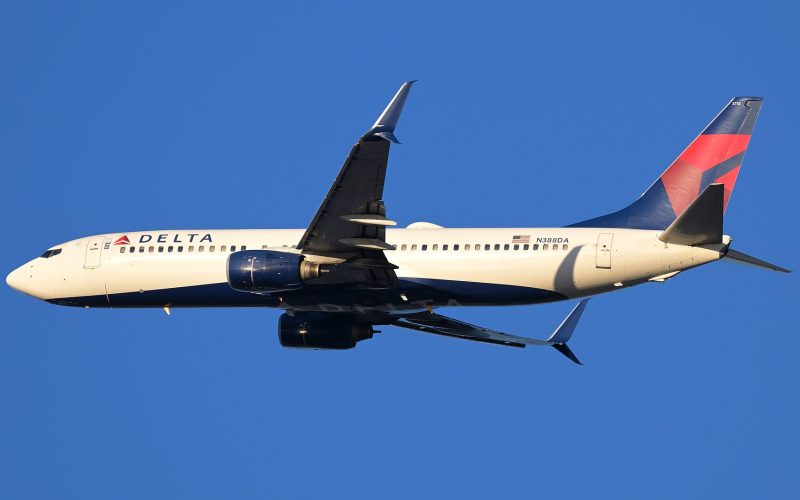
A Ryanair Boeing 737-800 landed at Manchester Airport with just 363kg of fuel in its tanks after three windshear warnings, a refused diversion and a Mayday call.
The UK Air Accidents Investigation Branch (AAIB) has now published its report into the serious incident.
It makes uncomfortable reading for everyone involved, including Manchester Airport itself.
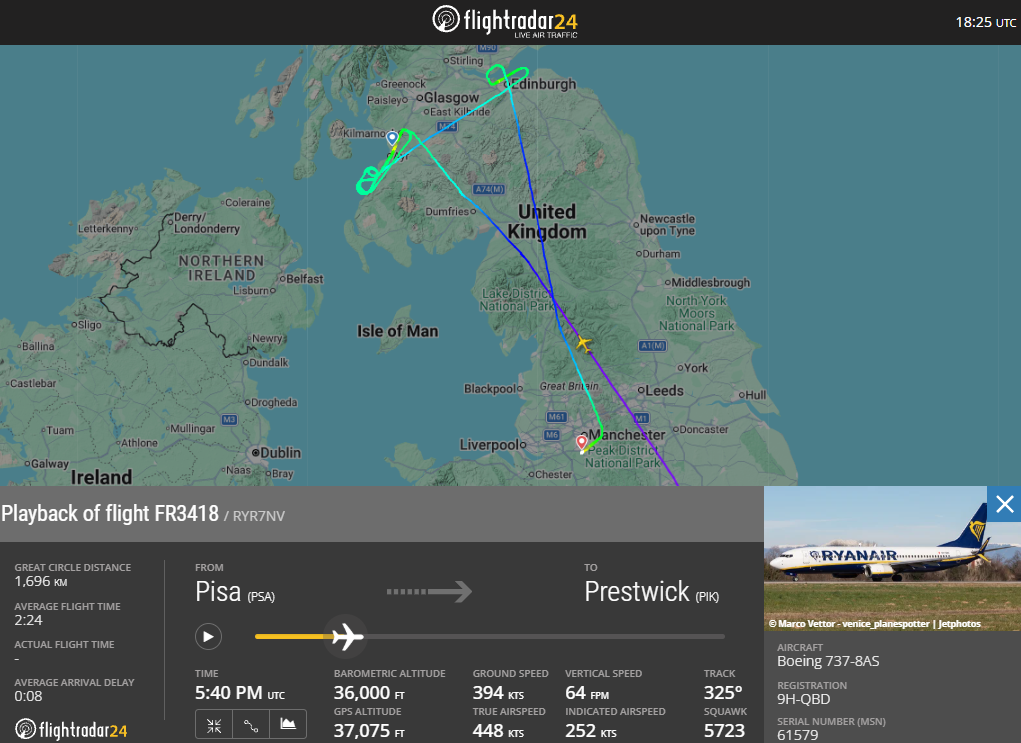
The Malta registered jet, 9H-QBD, was flying from Pisa to Glasgow Prestwick on 3 October 2025 with 171 passengers and six crew.
Storm Amy was sweeping across Scotland that evening.
What followed was a 1 hour 45 minute ordeal that ended with the aircraft touching down far below its protected final reserve fuel.
A Storm Warning the Crew Took Seriously
The crew did not ignore the forecast.
The day before, the operator issued a storm pack containing four safety bulletins. On the morning of the flight, a further email urged conservative fuel planning.
The pilots planned individually at home, then compared notes at Pisa. They swapped the company alternate of Glasgow for Manchester, which offered kinder winds.
The commander also loaded 1,322kg of discretionary fuel, roughly 1 hour 12 minutes of extra flying. Total fuel reached 11,500kg.
Use up and down arrow keys to resize the meta box pane.
However, there was a catch.
Crosswinds ruled out the longer Runway 30 at Prestwick, so the crew had to plan for the shorter Runway 20.
That capped the landing weight, which in turn limited how much extra fuel they could carry.
Two Windshear Escapes at Prestwick
The flight left Pisa over an hour late, at 1528 UTC. On the first approach to Prestwick, the surface wind was 240° at 29kt gusting 45kt.
At around 264ft, the windshear warning sounded and the commander flew the escape manoeuvre.
The crew then held at Turnberry and watched another company 737 approach. That aircraft reported losing 25kt of airspeed at 500ft on short final.
Even so, it landed, so the crew tried again. Before doing so, they told ATC plainly: “in case of missed approach again, we go straightforward to manchester.”
The second approach triggered another windshear warning at just 50ft.
Company rules prohibit a third approach after two windshear aborts. Manchester was the obvious answer.
Why Manchester Said No
Moments later, ATC told the pilots that Manchester was unable to accept them.
Nobody explained why.
The AAIB found that the refusal should never have happened.
The Manchester diversion policy states that the airport accepts diverts whenever ground capacity exists.
Airfield Operations, not the handling agent, makes that call.
The Excess Parking Plan was not even in force, and the airport had already accepted 19 Storm Amy diversions that day.
Yet at 1834 UTC, Airfield Control told ATC the handling agent could not accept the aircraft.
The handling agent insists its policy was to accept this operator’s diversions.
With no record of the conversation, investigators could not establish how the decision was made.
They put it down to a breakdown in communication within Manchester Airport.
A Detour to Edinburgh
With Manchester off the table and Glasgow reporting windshear on final, the crew requested Edinburgh.
That request took another five minutes to approve.
During those minutes, the pilots discussed declaring a Mayday, which would have guaranteed acceptance at Manchester.
They decided their fuel state did not meet the operations manual criteria.
The operator later argued that genuine doubt over a safe landing at Edinburgh could have justified an emergency anyway.
At Edinburgh, the wind was 240° at 34kt gusting 46kt. Passing 745ft, the third windshear warning of the evening sounded.
Another escape manoeuvre followed, and fuel on board fell to 2,164kg.
Mayday and the Return to Manchester
The pilots now faced a grim choice.
Another approach at Edinburgh would protect final reserve fuel if it worked.
If it failed, however, they would have no fuel left to divert and might have to fly through a windshear warning to land.
With 2,100kg on board, they needed 2,800kg to reach Manchester and still hold their reserve.
The crew estimated arriving with 500 to 700kg.
Once programmed, the Flight Management Computer predicted just 300kg.
At 1912 UTC, the commander declared “mayday mayday mayday fuel” and requested an immediate diversion to Manchester. He reminded ATC: “it was denied before.”
Low Fuel Alerts on the Way South
The climb to FL230 and the cruise south brought fresh warnings.
Both main tank low fuel quantity alerts illuminated, and the crew corrected a 100kg imbalance.
They did not action the Low Fuel Quantity checklist, reasoning that the cause was obvious.
Crucially, nobody considered Newcastle, which was closer and reporting a 22kt wind. Edinburgh, now behind them, was also nearer than Manchester.
The AAIB suggests that choosing Manchester as their preferred alternate from the outset may have shaped the crew’s thinking.
The 737 landed on Runway 23R at 1952 UTC with 363kg remaining. By engine shutdown on stand, the flight data recorder showed 240kg.
At go around power, the engines had burned roughly 120kg per minute.
Another missed approach at Manchester was almost certainly off the table.
What the Report Means for Manchester and Beyond

Final reserve fuel exists for exactly this kind of evening.
On this flight it stood at 1,101kg, or 30 minutes of flying.
The operator’s manual allows crews to use it when the unforeseen strikes, but first asks them to seek a landing option that preserves it.
The AAIB accepts that the commander judged Manchester the safest choice, even though it guaranteed a landing below reserve.
The EGPWS manufacturer confirmed that all three windshear warnings were genuine. The system worked exactly as designed.
The clearest failing sits on the ground.
Had Manchester accepted the first diversion request, the jet would likely have arrived with fuel to spare.
Since the incident, Manchester Airport has restated that Airfield Control alone decides on diversions.
Handling agents are notified but play no part in the decision.
There are wider lessons too.
A nominated alternate on a flight plan guarantees nothing, because alternate airports never receive the plan.
Crews also need clear triggers for declaring an emergency early, rather than waiting until the numbers force their hand.
Ultimately, 177 people landed safely at Manchester.
The margin, though, was far thinner than anyone in aviation should accept.
Read the full report on the AAIB website, and explore more serious incident analysis in our Emergency and Accident Hub.
Advertise with us Your brand, in front of an aviation audience Home page and in-article placements, sold directly, one advertiser per slot. From £250 a year. See the rates