
Maui Kahului Airport Guide: The Valley Isle’s Front Door
Maui Kahului Airport handles around seven million passengers a year. Codes, runways, airlines, mainland routes, transport and spotting tips explained.
 By The Aviation Hub
6 min read
Updated October 20, 2026
Almost every visitor to Maui arrives through one building on the island’s flat central isthmus. Maui Kahului Airport handles around seven million passengers a year and is the gateway to an island that lives on tourism. It sits on the north shore beside the town of Kahului, between the West Maui Mountains and the slopes of Haleakala. Inter island hops and long overwater flights to the mainland share a compact terminal and a runway shorter than most transpacific gateways.
Maui Kahului Airport at a Glance
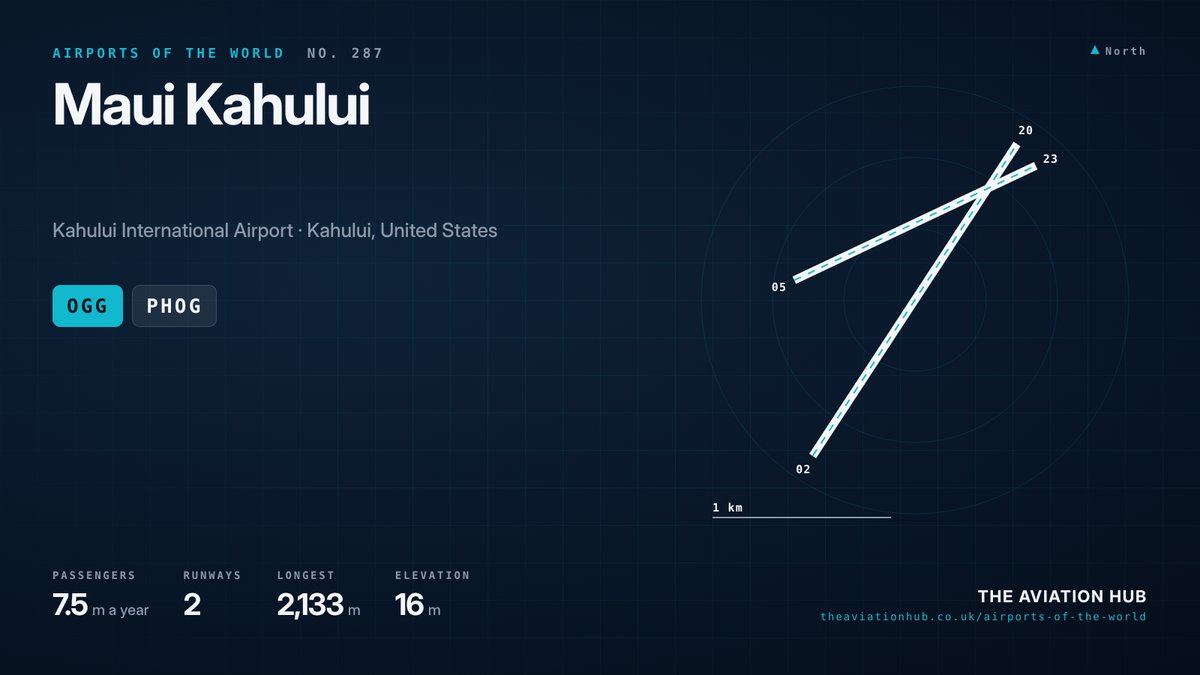
The IATA code is OGG and the ICAO code is PHOG. The airport lies about 3 miles (5 km) east of central Kahului, at an elevation of 16 metres (54 ft). It has two asphalt runways, a helipad and a single passenger terminal split into north and south areas. The Hawaii Department of Transportation owns and runs it as part of the state airport system.
Traffic in 2025 was roughly 7.1 million passengers, with around 118,000 aircraft movements. Hawaiian Airlines and Alaska Airlines, now both part of Alaska Air Group, carry more than half of all passengers, and Hawaiian treats the field as a hub, while Mokulele Airlines flies commuter services from here across the islands. Gate details, parking rates and shuttle information are on the airport’s official website.
From Navy Field to Island Gateway
The site began as Naval Air Station Kahului. Construction started in 1942 on about 1,341 acres of sugar cane fields, and the base supported Navy aviation through the Pacific war. Airline flights had used a smaller field at Puunene, a few miles inland. After the war the Navy handed jurisdiction to the Territory of Hawaii by December 1947, and Congress approved the transfer of ownership in June 1952. Full civil operations began that year.
The OGG code is a tribute rather than an abbreviation. It honours Bertram J. “Jimmy” Hogg, a Kauai born pilot who flew for the forerunner of Hawaiian Airlines, from Sikorsky S-38 amphibians through to the DC-3 and DC-9. Jets and tourism transformed the field from the 1960s onwards. The ticket lobby and baggage halls were enlarged in 2005, and a new access road opened in 2016.
Runways at Maui Kahului Airport
Maui Kahului Airport has two asphalt runways, both 46 metres wide. Runway 02/20 is 2,133 metres (6,998 ft) long and handles almost all airline traffic. Runway 2 has a Category I instrument landing system. The north easterly trade winds blow for most of the year, so runway 2 is in use far more often than runway 20, with departures climbing out over the ocean.
The crosswind runway, 05/23, is 1,518 metres (4,980 ft) long and serves commuter aircraft and general aviation. The modest length of the main runway matters. Mainland flights in narrow bodies such as the Boeing 737 MAX and Airbus A321neo can face payload limits on hot days, and longer routes need careful planning. The 2016 master plan proposed extending runway 2 and adding a parallel runway in the long term.
The airport’s place in aviation history was sealed on 28 April 1988, when Aloha Airlines Flight 243, a Boeing 737-200, landed here after losing a large section of its upper fuselage. One flight attendant was lost. The crew communicated by hand signals because of the noise.
Terminals and Airlines
One terminal serves all passengers at Maui Kahului Airport. The north area holds gates 17 to 39 and the south area gates 1 to 16, with 16 jet bridges in total. Inter island flights use a cluster of odd numbered gates in the middle, while overseas services use gates at both ends. A project worth about $62 million, finished around January 2025, merged two hold rooms into an air conditioned waiting area of 17,000 square feet.
Hawaiian runs the widest network, with Airbus A321neo and Boeing 717 jets and a Premier Club lounge opposite gate 17. Alaska Airlines, Southwest, United, American and Delta fly to the mainland. WestJet and Air Canada serve Canada. Mokulele connects smaller island airports with Cessna Caravans from its own area of the field.
Routes and Destinations
Honolulu is by far the busiest route, with close to one million passengers in the year to May 2026. Los Angeles and Seattle come next, at roughly 360,000 and 290,000. San Francisco, San Diego, Oakland, San Jose, Phoenix, Portland and Las Vegas fill out a dense West Coast network. Kona, Lihue and Hilo receive inter island services.
Canada is the international market. Vancouver carried about 157,000 passengers, followed by Calgary and Edmonton, with most of those flights peaking in winter. The longest route is Delta’s seasonal Atlanta service, at about 4,420 miles (7,120 km), with Chicago, Dallas Fort Worth, Denver and Minneapolis also on the map. Demand peaks from December to March and again in the summer holidays.
Getting to and from Maui Kahului Airport
Most visitors drive. A consolidated rental car facility opened in 2019 at a cost of about $340 million, and a tram links it to the terminal. Kahului and Wailuku are 10 minutes away. Kihei and Wailea take around 30 to 40 minutes, and Lahaina and Kaanapali on the west coast about an hour in normal traffic.
Shared shuttles and ride hailing apps pick up outside baggage claim, and taxis wait at the kerb. The Maui Bus is the cheapest option, with routes 35 and 40 connecting the airport area to Kahului, Paia, Haiku and Upcountry for a couple of dollars. Luggage limits on the buses are strict, so it suits light travellers. Parking at Maui Kahului Airport is close to the terminal and fills at busy times.
Spotting and Photography
Kanaha Beach Park, on the shore just north of the runways, is the classic spot. With trade winds blowing, departures from runway 2 climb out over the beach and the reef, framed by surf and the West Maui Mountains. The park is also a kitesurfing centre, and kite heights near the approach are restricted for safety. Kanaha Pond wildlife sanctuary lies between the airport and town.
Check the sun position before choosing a spot, since the light changes sides through the day. At Maui Kahului Airport, Hawaiian 717s and A321neos and mainland 737s make up most airline movements. Respect the fences, park only in marked spaces and keep drones well away, since the whole area sits inside controlled airspace.
What Comes Next
The 2016 master plan remains the guide to the future, with a longer main runway and eventually a parallel one. Neither is imminent, and both would face scrutiny on an island sensitive to noise, water and land use. Terminal improvements at Maui Kahului Airport continue in smaller steps, and the integration of Hawaiian into Alaska Air Group will reshape the mainland schedule.
The airport served as a lifeline in August 2023, when the Lahaina wildfire sent thousands of visitors through the terminal on extra flights. Maui Kahului Airport will stay busy for as long as tourism drives the island economy, but growth is likely to stay measured. Compare it with other Pacific island fields on the Airports of the World map.
Continue to follow The Aviation Hub for more analysis and insight.
Advertise with us Your brand, in front of an aviation audience Home page and in-article placements, sold directly, one advertiser per slot. From £250 a year. See the rates

