
Mauritius Airport Guide: Island Hub of the Indian Ocean
Mauritius Airport is the hub of Air Mauritius and the island's main gateway. Our guide covers its runway, terminal, routes, access and history.
 By The Aviation Hub
5 min read
Updated October 20, 2026
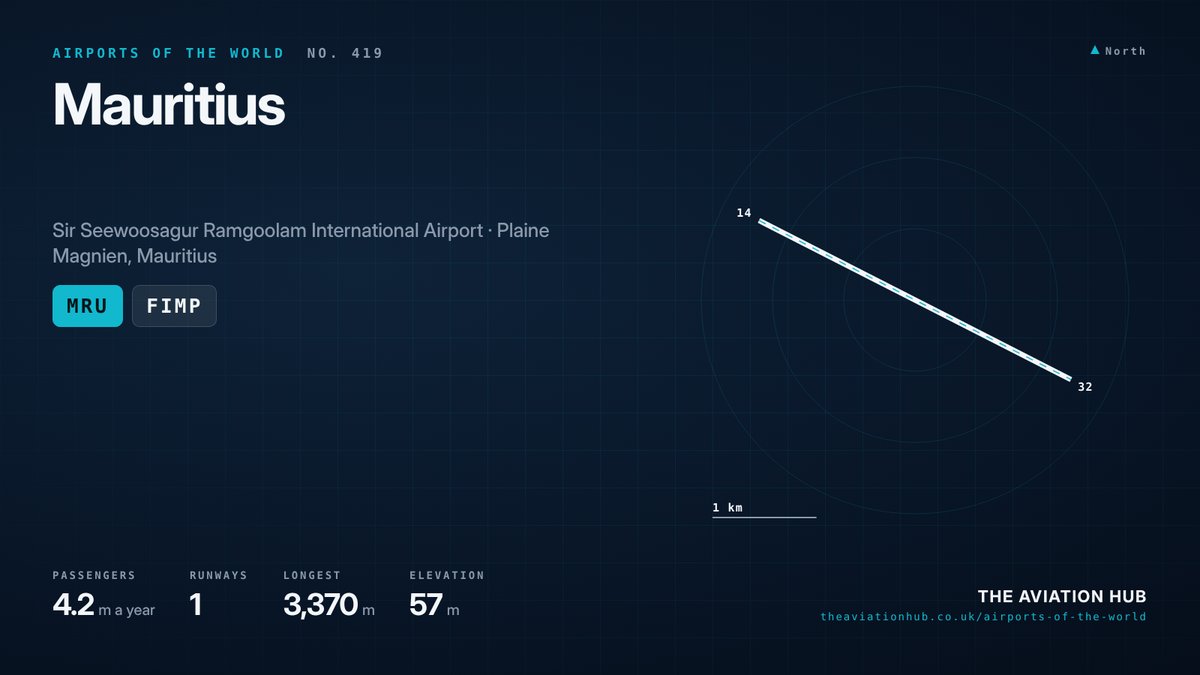
Sir Seewoosagur Ramgoolam International Airport sits near the southeast coast of Mauritius, a few minutes from the turquoise lagoon of Blue Bay. Mauritius Airport is the island nation’s main international gateway and the hub of Air Mauritius. It handled close to 3.9 million passengers in 2019, and tourism remains the engine of its traffic. Long haul jets from Europe, Asia, Africa and the Gulf all converge on its single runway.
Mauritius Airport at a Glance
The IATA code is MRU and the ICAO code is FIMP. The airport lies at Plaine Magnien, about 30 miles (48 km) southeast of the capital Port Louis, at an elevation of 57 metres (186 feet). It has one runway and a passenger terminal opened in 2013, linked to the older building. Mauritius Airport recorded about 3.88 million passengers in 2019, the last full year before the pandemic in published figures.
Air Mauritius, the national carrier, uses the field as its hub. Airports of Mauritius Co. Ltd, majority owned by the government, operates the airport, while Airport Terminal Operations Ltd runs the new terminal. Flight times and passenger information are on the airport’s official website.
How the Island’s Airport Came to Be
The airport began as a wartime project. In 1942, when Mauritius was a British Crown colony, construction started on a Royal Naval Air Station at Plaisance, near the old port town of Mahebourg. At the end of the war the base passed to the Royal Air Force, and civilian flights began soon afterwards.
For decades the field was known as Plaisance Airport. It was later renamed after Sir Seewoosagur Ramgoolam, who led Mauritius to independence in 1968 and became its first Prime Minister. Air Mauritius grew alongside it, and on 10 September 1972 the airline flew its first service to the island of Rodrigues, using a de Havilland Canada Twin Otter.
A two storey terminal with jet bridges, able to serve four aircraft at once, opened in 1986. Tourism boomed, and that building became cramped. A new terminal costing around US$306 million opened in September 2013, and the older building was refurbished from 2014. Together they give Mauritius Airport a modern face for its visitors.
Runways at Mauritius Airport
A single runway, 14/32, handles all traffic. It measures 3,370 metres (11,056 feet) long and 45 metres wide, with an asphalt surface. That length allows wide body jets such as the Airbus A350, Boeing 777 and Airbus A380 to operate long sectors to Europe and Asia.
Southeast trade winds blow for much of the year, so Runway 14 is usually in use for both arrivals and departures. Arrivals on 14 come in over the sugar cane fields inland, while departures climb out over the coast and the lagoon near Blue Bay. Tropical cyclones are the main weather risk between November and April, and severe storms can close Mauritius Airport for a day or more. The single runway leaves no backup, so maintenance work is carefully scheduled.
Terminals and Airlines
The 2013 terminal covers about 57,000 square metres and was designed for around 4 million passengers a year. Its design is inspired by the traveller’s palm, and the building uses solar power, rainwater recovery and insulated facades. Five gates have jet bridges, and one of them can handle the Airbus A380.
Air Mauritius flies Airbus A350-900 and A330neo jets on long haul routes and ATR 72 turboprops on shorter hops such as Rodrigues. Emirates brings the A380 from Dubai. Air France, Condor, Edelweiss, Austrian, Turkish Airlines and Kenya Airways are among the foreign carriers. Air Austral links the island with neighbouring Reunion, and Ethiopian Airlines added seasonal Addis Ababa flights in July 2026.
Routes and Destinations
Europe is the largest long haul market. Air Mauritius flies to Paris and London Gatwick, while Air France, Condor, Edelweiss and Austrian serve Paris, Frankfurt, Zurich and Vienna. Reunion, around 140 miles (230 km) to the west, is a key regional link, with frequent flights by both Air Mauritius and Air Austral. Johannesburg, Cape Town, Antananarivo and Nairobi anchor the African network.
Asia and Australia matter too. Air Mauritius serves Mumbai, Delhi, Chennai, Kuala Lumpur and Perth, reflecting the island’s strong ties with India. Dubai and Istanbul provide one stop links to almost anywhere. The longest routes, to Paris and London, take around 11 to 12 hours. Tourist demand peaks during the European winter and around French school holidays at Mauritius Airport. Honeymooners, divers and golfers make up a large share of visitors, and many stay in all inclusive resorts along the coast.
Getting to and from Mauritius Airport
Road is the only option. The M1 motorway links the airport with Port Louis, a drive of around 45 minutes to an hour depending on traffic. Mahebourg and Blue Bay are around 10 minutes away, while resorts on the north coast, such as Grand Baie, can take well over an hour.
Most visitors use pre booked hotel transfers or taxis, which wait outside arrivals. Car hire is widely available, and Mauritius drives on the left. Public buses pass along the main road near the airport, the cheapest sensible option for budget travellers with light bags, though services are slow. Parking at Mauritius Airport sits directly in front of the terminal.
Spotting and Photography
The coastal setting makes for striking images. With Runway 14 in use, departures climb out over the lagoon near Blue Bay, giving a tropical backdrop of palms and turquoise water. On the rarer days when Runway 32 is active, arrivals come in low over the sea. Public roads around the perimeter offer views, though sugar cane fields can block sightlines.
Expect Air Mauritius A350s, Emirates A380s, Air France 777s and Air Austral jets, plus ATR turboprops for Rodrigues. Bright tropical light is strongest at midday, so early morning and late afternoon work best. Stay on public land, keep away from fences and follow any instruction from police or airport staff at Mauritius Airport.
What Comes Next
The 2013 terminal was designed for around 4 million passengers a year, and traffic is approaching that figure. Further expansion will be needed if tourism keeps growing, along with more aircraft stands. Air Mauritius has rebuilt its network after a difficult pandemic restructuring, and new carriers continue to arrive.
The government’s tourism strategy targets higher spending visitors rather than mass volume, which suits the airport’s long haul profile. Expect steady growth, more Asian and African links and pressure for new capacity later this decade. Compare it with other island gateways on our Airports of the World map.
Continue to follow The Aviation Hub for more analysis and insight.
Advertise with us Your brand, in front of an aviation audience Home page and in-article placements, sold directly, one advertiser per slot. From £250 a year. See the rates

