
Medellin Airport, formally Jose Maria Cordova International Airport, lies in the municipality of Rionegro about 12 miles (20 km) southeast of the city centre on the cool plateau of the Oriente Antioqueno. It is the second busiest airport in Colombia and the international gateway for the Aburra valley, handling around 14 million passengers a year. The field sits far above the city it serves, which gives it a long runway, frequent morning fog and one of the more scenic drives to a terminal anywhere in South America.
Medellin Airport at a Glance
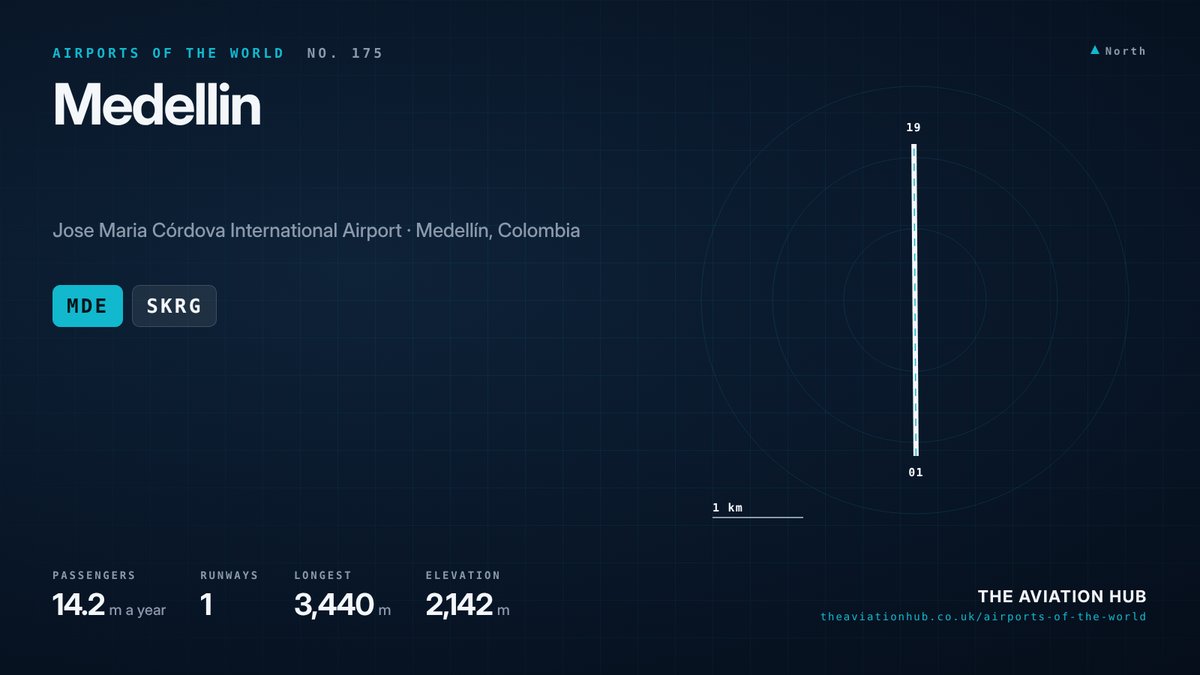
The codes are MDE and SKRG, the ICAO code reflecting Rionegro rather than Medellin. The airport stands 2,142 m (7,028 ft) above sea level on the San Nicolas plateau, more than 600 m higher than the city in the valley below. It has one runway, a single passenger terminal with 17 gates and a cargo complex. Traffic reached roughly 14.2 million passengers in the latest full year, up from about 11.8 million in 2023 as the field recovered from the collapse of Viva Air.
Avianca is the largest airline and Avianca Cargo keeps its main base here. LATAM Colombia, Wingo and JetSmart fly the bulk of the remaining domestic flights, with Copa, American, United, JetBlue, Aeromexico and Air Europa the main foreign carriers. Airplan, a company majority owned by the Mexican airport group ASUR, operates Medellin Airport under a long term concession. Flight status and parking details are on the airport’s official website.
How Medellin Moved Its Airport Uphill
Medellin’s original airport, Olaya Herrera, sits in the middle of the city with mountains on both sides and no room to grow. By the 1970s it could not handle jets safely at full weight, so planners looked for a flat site. They chose the San Nicolas valley near Rionegro over an alternative near Barbosa, and the new airport opened on 29 August 1985. It takes its name from General Jose Maria Cordova, a hero of the independence wars born in Concepcion in Antioquia, and the spelling Cordoba is still seen.
Olaya Herrera closed from 1986 to 1991 while the new field handled everything, then reopened for domestic and regional flights, a split that persists today. The airport’s early years were marked by tragedy. SAM Colombia Flight 501, a Boeing 727, flew into a mountain on approach in May 1993 with the loss of all 132 on board. Two Antonov An-32 freighters crashed in 1996 and 1998, and a DC-3 was lost in 2004 after diverting from the fog bound field.
An Airbus A380 landed in 2006 for high altitude engine tests, the first visit by the type to South America. A Tradewinds Boeing 747 freighter overran the runway that year without injury. In November 2016 LaMia Flight 2933, carrying the Chapecoense football team, ran out of fuel on approach and crashed near La Union, killing 71. A major terminal expansion completed in December 2017 and the Tunel de Oriente road opened in 2019.
Runways at Medellin Airport
The airport has a single asphalt runway, 01/19, measuring 3,440 m (11,286 ft) by 45 m and running almost due north to south along the plateau. The length is no luxury. At 2,142 m elevation the thin air cuts engine thrust and lift, so a Boeing 787 or Airbus A330 bound for Madrid needs most of the strip on a warm afternoon, and payload limits apply on the longest sectors.
Both directions are used depending on wind, with runway 01 the more common for arrivals, bringing aircraft in over the rolling farmland and country houses of Llanogrande. An ILS, VOR and NDB serve the field, and the ILS matters because fog and low cloud roll over the plateau on many mornings between the rainy seasons. Delays and early diversions to Bogota or Cali are a fact of life, and the airport closed entirely for fog in 2004.
The Colombian Air Force shares the runway from its neighbouring CACOM 5 base, and military transports and helicopters mix with the airliners. Medellin Airport has no night curfew, and the overnight bank of cargo flights and the early departures to Bogota keep it busy around the clock.
Terminals and Airlines
One terminal, a two storey building with a distinctive domed roof, serves all flights at Medellin Airport. It has 17 gates, of which ten are domestic, seven international and four able to switch between the two. Check in is on the upper level and arrivals below, with the international pier at one end. The 2017 expansion lifted the domestic hall from about 41,000 to 50,000 square metres and added eight gates, taking design capacity to around 11 million passengers, a figure already exceeded.
Avianca, the Star Alliance member, dominates the domestic gates with Airbus A320 family aircraft and runs its own lounge. LATAM Colombia, Wingo and JetSmart share the rest of the domestic side. Copa feeds its Panama hub, American flies from Miami, JetBlue serves Fort Lauderdale, United flies to Houston, and Air Europa and Avianca take the Madrid traffic with Boeing 787s. Oneworld is represented by American, SkyTeam by Air Europa and Aeromexico.
Routes and Destinations
Bogota is the busiest route from Medellin Airport by far, with Avianca, LATAM and the low cost carriers flying it more than 30 times a day between them. Cartagena, Cali, Barranquilla, Santa Marta and San Andres fill the domestic top table, and the holiday routes to the Caribbean coast peak over Christmas and Easter. The in town Olaya Herrera airport takes the regional turboprop flights, so almost everything from Rionegro is a jet.
Panama City and Miami are the leading international routes, with Copa and Wingo on the first and American and Avianca on the second. Fort Lauderdale, New York JFK, Madrid, Mexico City, Lima, Santiago and Toronto follow. Madrid, at roughly 5,000 miles (8,000 km), is the longest route and the only scheduled link to Europe. Cargo is significant because Antioquia grows a large share of Colombia’s cut flowers, and Avianca Cargo and other freighters fly Airbus A330-200Fs and Boeing 767Fs to Miami every day.
Getting to and from Medellin Airport
The Tunel de Oriente changed everything in August 2019. The 8 km tunnel through the mountains cut the drive from El Poblado to the terminal from nearly an hour to about 20 to 25 minutes, for a toll of around 20,000 pesos. A taxi from the city centre or Poblado costs roughly 100,000 pesos (£19) including the toll, and licensed airport taxis wait outside arrivals. The older road via Las Palmas winds up the mountainside and remains a fine drive with views over the valley.
Shared minibuses run by Combuses and similar operators leave from outside arrivals for the San Diego shopping centre and the Poblado area for around 20,000 pesos, making them the cheapest sensible option at about 45 minutes. Local buses serve Rionegro town. There is no rail link and no plan for one. The airport has ample parking in open and covered lots beside the terminal.
Spotting and Photography
The plateau setting is the attraction at Medellin Airport. The approach to runway 01 crosses open farmland, hotels and golf courses around Llanogrande, and the lanes south of the threshold give low shots with green hills behind. The roads near the air base and cargo terminal offer views of the apron, though the military presence means discretion is wise. Inside, the terminal windows on the upper level overlook the stands.
Morning light suits runway 01 arrivals once the fog has lifted, usually by mid morning, and the afternoon sun lights the cargo apron. The traffic mixes Airbus A320neos and Boeing 737 MAX 8s with Avianca and Air Europa wide bodies and the daily freighters. Do not photograph the air force base, stay well clear of its fences and respect requests from police, who patrol the perimeter.
What Comes Next
The terminal is already over its design capacity, so further expansion of the building and its stands is the obvious next step for Airplan. The single runway has plenty of slots, but fog and the high elevation limit what can be flown economically to Europe, and talk of a second runway is distant. Medellin Airport is growing fast on tourism and the return of low cost competition after Viva Air’s collapse in 2023.
The field could approach 20 million passengers within the decade, and the terminal, not the runway, will decide how smoothly it gets there. Compare it with Bogota and the rest of the continent on the Airports of the World map.
Continue to follow The Aviation Hub for more analysis and insight.
Advertise with us Your brand, in front of an aviation audience Home page and in-article placements, sold directly, one advertiser per slot. From £250 a year. See the rates

