
The quietest of the big Balearic Islands has an airport that swings between sleepy and frantic with the seasons. Menorca Airport sits just outside Mahon, the island capital, and handled about 4.2 million passengers in 2024. Most of them arrive between April and October, when flights from Spain, Britain and the rest of Europe fill the apron. In winter the terminal falls almost silent, with only a handful of domestic links keeping it ticking over.
Menorca Airport at a Glance
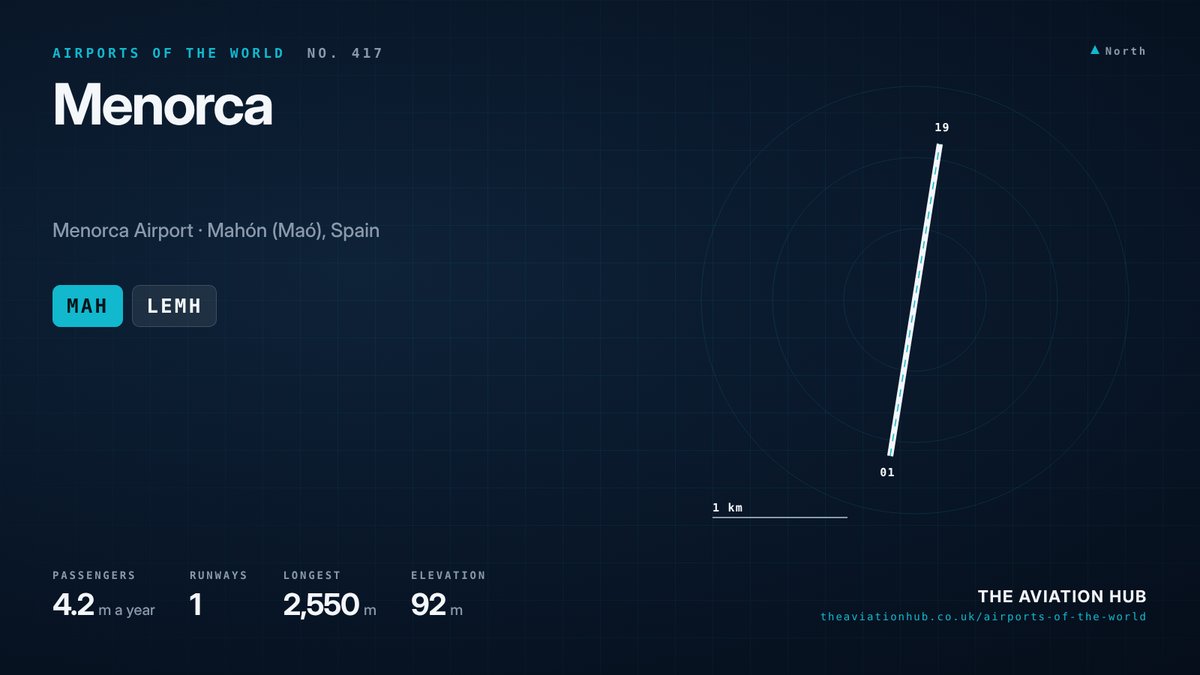
The IATA code is MAH and the ICAO code is LEMH. The airport lies about 3 miles (4.5 km) southwest of Mahon, at an elevation of 92 metres (302 feet). It has one runway and one terminal. Menorca Airport recorded around 4.17 million passengers and nearly 37,000 aircraft movements in 2024, having passed 3 million for the first time in 2016.
Vueling is the largest airline, ahead of Ryanair and Iberia’s regional operation. No airline treats the field as a major hub, and much of the summer traffic comes from seasonal carriers. Aena, the Spanish airport operator, runs the site. Timetables, parking and bus details are on the airport’s official website.
How Menorca’s Airport Came to Be
Commercial flying on the island began at San Luis Aerodrome, built in the late 1930s with an 850 metre runway. The first civilian flight landed in August 1949, an Aviaco service from Barcelona. The runway was extended twice in the late 1950s and early 1960s so that Douglas DC-4 aircraft could use it. In September 1965 the field was renamed Mahon Airport.
Package tourism soon outgrew the old site. Construction of a new airport began in 1967, and it opened on 24 March 1969 with a much longer runway. San Luis survives as a base for light aircraft and a flying club. The current terminal opened in May 1988, and the airport was expanded and refurbished through the 1990s and 2000s.
That work was not without drama. On 14 September 2006 part of the roof of a new terminal section collapsed during construction, probably under heavy rainwater, trapping 20 workers and injuring three. Traffic kept growing regardless. The pandemic cut passenger numbers by almost 70 per cent in 2020, but Menorca Airport recovered strongly and now handles well over 4 million passengers a year.
Runways at Menorca Airport
A single runway, 01/19, handles all traffic. It measures 2,550 metres (8,366 feet) long and 45 metres wide, with an asphalt surface. That length suits the Airbus A320 family and Boeing 737 jets that dominate the schedule, as well as regional turboprops on interisland routes.
The runway runs roughly north to south across the gently rolling countryside of eastern Menorca. Strong northerly winds, known locally as the tramuntana, are a feature of island weather, especially outside summer, and often bring operations onto Runway 01. Peak summer Saturdays bring waves of charter and low cost flights into Menorca Airport within a short window, keeping controllers and ground crews busy.
Terminals and Airlines
All flights use one terminal with 42 check in desks, 16 departure gates and six baggage carousels. Five gates have jet bridges, while the rest use buses or walking boarding. The building is compact, but summer peaks can still bring long queues at security and passport control for flights to the UK.
Vueling carried about a quarter of passengers in 2023, mainly on links to Barcelona. Ryanair accounted for nearly a fifth, and Iberia’s regional arm, operated by Air Nostrum, took around 16 per cent. Volotea adds further Spanish and French routes. UK carriers such as easyJet, Jet2, British Airways and TUI bring large numbers of British holidaymakers in summer, alongside French, German and Italian airlines.
Routes and Destinations
Barcelona is by far the busiest route, with around 933,000 passengers in 2023. Palma de Mallorca followed with about 392,000, and Madrid with roughly 372,000. These three routes run year round and form the backbone of winter flying, when most international services disappear.
London Gatwick was the busiest international route in 2023, with about 249,000 passengers. Manchester followed with around 156,000, and Paris Orly drew roughly 112,000. Birmingham, Bristol and other UK regional airports also feature strongly in summer. The British connection runs deep, since Menorca spent much of the 18th century under British rule. The season peaks in July and August, when Menorca Airport handles its heaviest traffic.
Getting to and from Menorca Airport
Bus route 10 links the airport with Mahon’s central bus station in about 10 minutes, running roughly from 6am until late evening. It is the cheapest sensible option for anyone staying in the capital. Travellers heading elsewhere on the island can change at Mahon’s bus station, though rural timetables are thin outside summer.
Taxis wait outside arrivals and reach Mahon in around 10 minutes. Ciutadella, at the western end of the island, is about 45 minutes away by road along the main island highway. Car hire is popular, as Menorca’s beaches and coves are spread out and many lack public transport. Parking at Menorca Airport sits directly in front of the terminal.
Spotting and Photography
The quiet country roads around the airport give relaxed views of arrivals and departures. Summer Saturdays are the highlight, with waves of easyJet, Jet2, Vueling and Ryanair jets arriving in quick succession. Visiting European charter operators add variety. The old San Luis aerodrome nearby keeps light aircraft activity going.
Mediterranean light is strong and clear, with early morning and late afternoon giving the best results. Stay on public roads, keep away from fences and respect private farmland. Spanish airport security is professional and firm. Menorca is a UNESCO Biosphere Reserve, so stick to marked paths around Menorca Airport and leave the countryside as you find it.
What Comes Next
In April 2024 Aena announced plans to expand several airports, including Menorca, during its 2027 to 2031 investment period. Details are still emerging, but the focus is likely to be on terminal capacity, security and passenger comfort during the summer peak.
The island’s tourism model emphasises quality over volume, and local politicians are wary of overtourism. Growth is likely to be steady rather than spectacular, with longer shoulder seasons a key goal. Expect a well run seasonal gateway that stays busy in summer and calm in winter. Compare it with Palma and Ibiza on our Airports of the World map.
Continue to follow The Aviation Hub for more analysis and insight.
Advertise with us Your brand, in front of an aviation audience Home page and in-article placements, sold directly, one advertiser per slot. From £250 a year. See the rates

