
Merida Airport Guide: Yucatan Gateway to Mayan Mexico
Merida Airport is the gateway to the Yucatan and its Mayan sites. Read about its two runways, airlines, busiest routes, road links and spotting tips.
 By The Aviation Hub
6 min read
Updated October 20, 2026
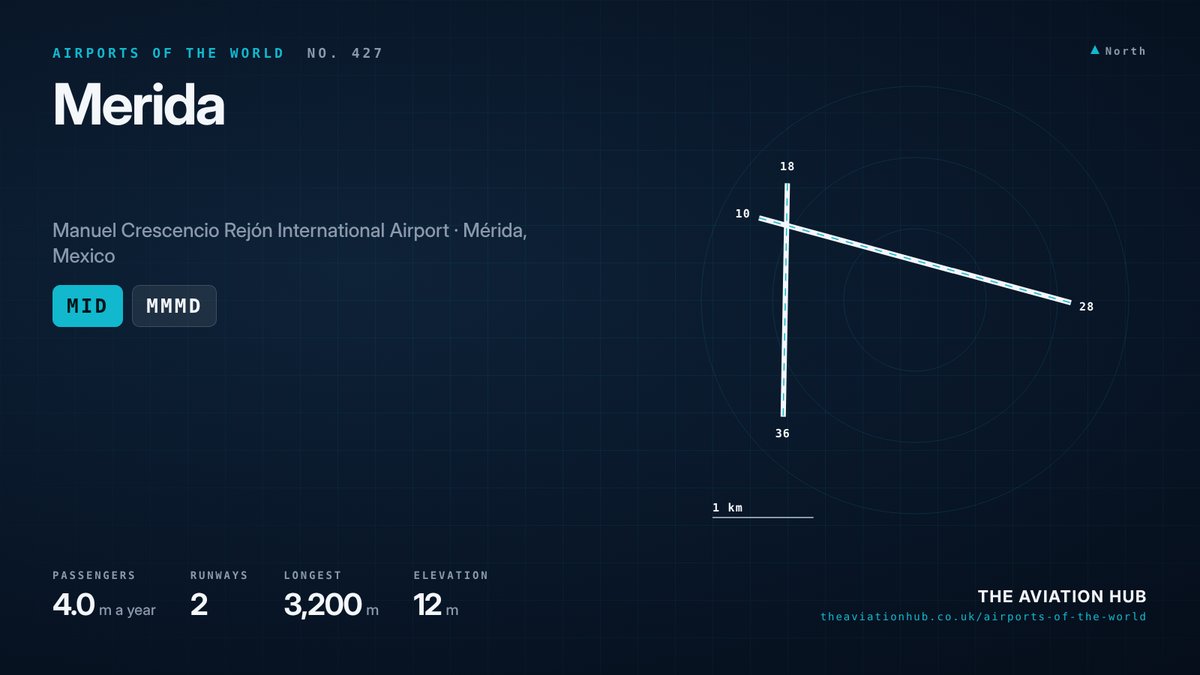
Merida is the capital of Yucatan State and one of Mexico’s fastest growing cities. Colonial streets, Mayan ruins and a steady flow of new residents have pushed its air traffic sharply upwards. Merida Airport, officially Manuel Crescencio Rejón International Airport, now handles close to four million passengers a year on recent figures. It also hosts an air force base and a regional air traffic control centre, which give it a wider role than its size suggests.
Merida Airport at a Glance
The IATA code is MID and the ICAO code is MMMD. Merida Airport sits less than 5 km (3 miles) southwest of the historic centre, inside the city’s ring road. The elevation is 38 feet (12 metres). There are two runways and one passenger terminal, and the field operates around the clock.
Traffic was about 2.1 million passengers in 2017 and has grown strongly since, to roughly four million on recent counts. Aeroméxico, Volaris and Viva carry most passengers, with United, American and seasonal WestJet flights adding international links. Grupo Aeroportuario del Sureste, known as ASUR, operates the field. It ranks ninth in Mexico by passengers. Timetables are on the airport’s official website.
How Merida’s Airport Came to Be
Commercial aviation reached Merida early. Mexicana de Aviación opened the airport in 1929 with a Ford Trimotor service to Mexico City via Campeche and Veracruz, years before good roads arrived. The peninsula was poorly connected to central Mexico by land for decades, so flying mattered more here than in most regions.
The airport takes its name from Manuel Crescencio Rejón, a nineteenth century Yucatecan jurist. He is credited with creating the amparo, a legal protection for citizens that remains central to Mexican law. The field was long known as Merida Rejón Airport before taking its current full title.
Privatisation in the late 1990s placed Merida Airport in the ASUR group. A complete remodelling followed between 1999 and 2001, giving the terminal its present shape. In 2017 the field became the eighth Mexican airport to pass two million annual passengers.
Runways at Merida Airport
The main runway, 10/28, measures 3,200 metres (10,499 feet) long and 46 metres (151 feet) wide. The secondary runway, 18/36, is 2,300 metres (7,546 feet) long and also 46 metres wide. Both are asphalt. The main runway can handle a Boeing 747 or 777, although the Boeing 737-800 and Airbus A320 family do most of the work.
Easterly trade winds mean runway 10 is often in use, with arrivals approaching from the west. Runway 28 takes over when winds swing round. The crossing runway handles crosswind days and some military traffic, so air force jets and transports regularly share the pattern with airliners at Merida Airport.
Weather brings its own pattern. Summer afternoons can produce heavy thunderstorms, and the hurricane season from June to November occasionally closes the field. The Mexican Air Force’s 8th Air Base occupies land on the north side of runway 10/28. The Merida Area Control Centre, one of four in Mexico, manages en route traffic over the southeast.
Terminals and Airlines
A single terminal handles all passengers at Merida Airport. Check in sits in one hall, and arrivals have their own area with car hire desks, a bank and tourist information. A food court and duty free shops serve departing passengers.
Domestic carriers dominate. Aeroméxico and its regional arm Aeroméxico Connect link Merida with Mexico City and beyond. Volaris and Viva offer low cost flights across the country, and Viva treats Merida as a focus city.
United and American connect with their US hubs. WestJet flies seasonally from Toronto and adds Calgary from December 2026, while Air Canada starts seasonal Toronto flights from November 2026. Smaller operators fill gaps, including Mexicana de Aviación, Aerus and TAG Airlines of Guatemala. Alliance coverage is thin, though SkyTeam travellers can connect through Aeroméxico’s Mexico City hub.
Routes and Destinations
Mexico City is by far the busiest route. In 2025 the main Benito Juárez airport carried about 790,000 passengers, with another 269,000 using Felipe Ángeles. Monterrey and Guadalajara followed, with roughly 231,000 and 158,000 passengers. Toluca, Veracruz and Querétaro also feature. At roughly 1,860 miles (3,000 km), Tijuana is one of the longest domestic routes from Merida Airport.
Internationally, Miami and Houston led in 2025, with about 53,000 and 48,000 passengers. Dallas Fort Worth, Orlando, Havana and Toronto followed. Winter brings extra seasonal flights from Canada and the US, timed for sun seekers and those heading for the Mayan sites of Uxmal and Chichen Itza. Cargo volumes are significant for a regional field, with integrators and freight carriers serving the peninsula’s industry.
Getting to and from Merida Airport
Most travellers use authorised airport taxis, which sell fixed fare tickets inside the terminal. The ride to the historic centre takes around 20 to 25 minutes. App based rides operate in the city, though airport pickup rules have shifted over time. City buses serve the surrounding avenues and are the cheapest option for light travellers, but they are slow with luggage.
Car hire is popular, since the Yucatan suits road trips to Mayan sites, cenotes and the coast at Progreso and Celestun. The ring road gives quick access to highways in every direction. The Tren Maya stops at Merida Teya station, on the city’s eastern edge, but it has no direct link to the airport. Parking sits beside the terminal at moderate rates. Cancun lies around 190 miles (305 km) east by toll highway, roughly four hours by car, so some visitors compare fares between the two gateways.
Spotting and Photography
Spotting at Merida Airport needs care because of the air base. Public roads around the perimeter give views of approaches to runway 10, which come in from the west. Light is best from the southern side for most of the day, since the runway runs east to west.
Movements include airliners, regional turboprops, freighters and military aircraft. Winter brings the widest variety, with seasonal flights from Canada and the US.
Mexican military sites are sensitive. Do not photograph the air base, stay on public land, keep away from fences and follow any instruction from police or soldiers.
What Comes Next
Growth has outpaced the terminal’s original design. ASUR’s development programme includes further investment, and new airline routes keep arriving. The Tren Maya could boost tourism across the peninsula, though it may also draw some travellers away from short flights. Merida’s rising population, driven by both Mexicans and foreign residents, should keep demand strong.
See how the field compares with Cancun and other ASUR airports on our Airports of the World map. The verdict: Merida Airport is outgrowing its facilities as fast as the city grows, and further terminal investment looks inevitable within the decade.
Continue to follow The Aviation Hub for more analysis and insight.
Advertise with us Your brand, in front of an aviation audience Home page and in-article placements, sold directly, one advertiser per slot. From £250 a year. See the rates

