
Miami Airport Guide: Gateway to Latin America and the Caribbean
Miami Airport in depth: four runways, American's Latin hub, a huge cargo operation, Metrorail and MIA Mover links and where to watch the aircraft.
 By The Aviation Hub
7 min read
Updated October 20, 2026
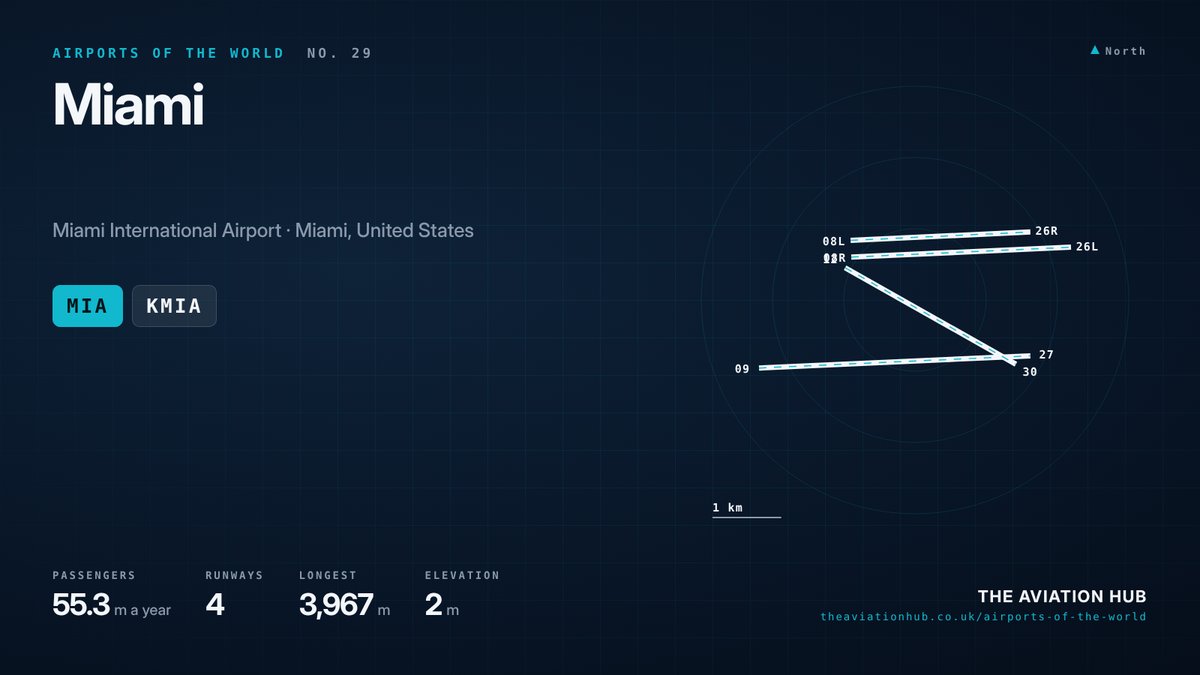
Miami Airport is the principal link between the United States and Latin America, the third largest hub for American Airlines and one of the busiest cargo airports in the world. It sits on a flat tract of former farmland just northwest of downtown, close enough that the skyline fills the windows on final approach. Around 55 million passengers and 3.45 million tons of freight passed through in 2025. Its history runs back to Pan American Airways and the first scheduled international flights from the US mainland.
Miami Airport at a Glance
The IATA code is MIA and the ICAO code is KMIA. The field lies about 6 miles (10 km) west northwest of downtown Miami at an elevation of 2 m (8 ft). Miami Dade County owns it, and the Miami Dade Aviation Department runs it along with the county’s smaller general aviation fields. One large horseshoe shaped terminal with six concourses and 131 gates handles the passengers.
Four runways serve the airport. American Airlines runs its Latin American hub here and carries well over half of the passengers. Avianca and LATAM treat Miami Airport as a focus city, and Frontier and Global Crossing have bases. FedEx, UPS, Atlas Air, LATAM Cargo and Polar Air Cargo all have major freight operations. Flight information, parking and transport details are on the airport’s official website.
How Miami’s Airport Came to Be
Pan American Airways bought the land in June 1928 and began airmail flights to Havana that September. The field was dedicated as Pan American Field in January 1929, and it became the first airport on the US mainland with international port of entry facilities. Eastern Air Lines moved in during 1935 and grew into the dominant tenant. The county bought the airport from Pan Am at the start of 1946 and gave it its present name.
The current terminal site, known as Wilcox Field after a Port Authority lawyer, opened on 1 February 1959. Eastern Air Lines built an empire here until it collapsed in 1991, and American moved in to pick up the Latin American routes, which it has expanded ever since. Pan Am, the airport’s founder, also folded in 1991.
British Airways flew Concorde between London, Washington Dulles and Miami from 1984 to 1991. The North Terminal, a single long concourse built for American over more than a decade of delays and cost overruns, was completed in 2011. Two crashes in the Everglades, Eastern Flight 401 in 1972 and ValuJet Flight 592 in 1996, remain the darkest chapters in the airport’s story.
Runways at Miami Airport
Miami Airport has four asphalt runways. Runway 09/27 is the longest at 3,967 m (13,016 ft) and 46 m wide, running along the southern edge of the field. Runway 08R/26L is 3,202 m (10,506 ft) and 61 m wide, and Runway 08L/26R is 2,621 m (8,600 ft). These three run east to west, parallel to one another, and handle the bulk of the traffic.
Runway 12/30, at 2,853 m (9,360 ft), runs diagonally across the southwestern corner and gives a crosswind option when the sea breeze swings round. The largest cargo complex sits inside the triangle formed by 12/30 and 09/27. The wind blows from the east most of the time, so easterly operations on the 08s, 09 and 12 are the norm, with arrivals coming in from the west. When the wind swings round, the field turns to westerly operations and arrivals stream in over Miami Beach and the city.
The long 09/27 takes the heaviest departures, including the Airbus A380 that Lufthansa and British Airways have operated here and the Boeing 747-8 freighters bound for South America. In 2015 a Qatar Airways Boeing 777 took off from an intersection on Runway 9 and struck the approach lights, flying on to Doha before the damage was found. Summer thunderstorms often disrupt afternoon operations from June to September.
Terminals and Airlines
The terminal at Miami Airport is one continuous building divided into North, Central and South. The North Terminal is Concourse D, more than a mile long and used only by American Airlines and American Eagle, with a Skytrain people mover running its length. The Central Terminal holds Concourses E, F and G. Concourse E serves American’s Oneworld partners and some Caribbean and Latin American carriers, while F and G handle other domestic and Canadian airlines such as Southwest.
The South Terminal has Concourses H and J. Concourse H takes Delta and the non Oneworld international carriers with narrow bodies, and Concourse J handles the wide body international airlines such as Lufthansa, Air France, Swiss, Emirates, Avianca and LATAM. Concourse E’s satellite and Concourse J each have a gate able to take the A380. British Airways, Iberia and Qatar Airways use Concourse E with American, and the Admirals Club and Flagship Lounge in Concourse D are the standout lounges.
Routes and Destinations
More than 1,000 daily flights from Miami Airport serve around 195 destinations, with a tilt towards Central and South America and the Caribbean that no other US airport comes close to matching. London Heathrow was the busiest international route in 2024 with around 1.03 million passengers, followed by Bogota at roughly 1.0 million and Lima at about 879,000. Sao Paulo, Buenos Aires, Lima, Santiago, Mexico City, Cancun and Havana are all major markets.
Atlanta led the domestic routes in 2025 with about 929,000 passengers, then New York LaGuardia at around 916,000 and Dallas Fort Worth at roughly 757,000. American’s Boeing 777-300ER, 787-9 and 787-8 fleets work the deep South America routes from here. Cargo is the other half of the business. Flowers from Colombia and Ecuador, fish from Chile and perishables of every kind flow north, and about 3.45 million tons moved through the field in 2025. Peak passenger season runs from December to April.
Getting to and from Miami Airport
The free MIA Mover people mover links the terminal with the Miami Intermodal Center, which houses the rental car centre, the Metrorail and Tri Rail stations and the bus bays. Metrorail’s Orange Line runs from there to downtown in about 15 minutes, with stops in Brickell, Coral Gables and Dadeland, for a fare of $2.25. That is the cheapest sensible option. Tri Rail commuter trains run north to Fort Lauderdale and West Palm Beach. An Amtrak platform was built but has never opened because it was too short for the trains.
The Dolphin Expressway, State Road 836, and the Airport Expressway feed the terminal loop, and Le Jeune Road runs along the eastern side. Taxis charge a flat fare of around $35 to Miami Beach. Metrobus route 150, the Airport Flyer, runs to South Beach, and Greyhound coaches stop at the Intermodal Center. The Dolphin and Flamingo garages sit opposite the terminal.
Spotting and Photography
Miami Airport is one of the best spotting airports in the United States because of its traffic mix. The area by the El Dorado Furniture store near NW 72nd Avenue has long been the classic spot for Runway 9, with arrivals and departures passing close by. The top deck of the Dolphin garage overlooks the central aprons and the departure runway. The Miami Springs side near NW 36th Street puts you beside the FedEx and UPS ramps and the business jet apron.
The usual easterly flow brings arrivals in from the west, while the less common westerly flow brings approaches over the city with the skyline behind. The Hilton on Blue Lagoon Drive and the Pullman have rooms facing the southern runways. Stay in public car parks, keep off the perimeter road shoulders and expect county police to move anyone standing on the fence line.
What Comes Next
A $5 billion improvement programme runs through to 2035. It includes reworking the concourses, demolishing Concourse G, building two hotels on the site and expanding the cargo areas to keep pace with the perishables trade. Concourse D is getting new gates and the Central Terminal is being modernised. The county projects 77 million passengers and four million tons of freight a year by 2040.
The runways are hemmed in by the city and will not grow, so the gains must come from larger aircraft and smarter scheduling. American keeps adding South American capacity, and the MIA Mover now also links the airport with Inter Miami’s new Nu Stadium. Miami Airport is heading towards 77 million passengers on the same footprint it has today. See how it compares with the other big American gateways on the Airports of the World map.
Continue to follow The Aviation Hub for more analysis and insight.
Advertise with us Your brand, in front of an aviation audience Home page and in-article placements, sold directly, one advertiser per slot. From £250 a year. See the rates

