
Milan Bergamo Airport Guide: Ryanair’s Italian Powerhouse
Milan Bergamo Airport at Orio al Serio is Italy's third busiest airport and one of Ryanair's largest bases. Runway, routes, access and spotting.
 By The Aviation Hub
7 min read
Updated October 20, 2026
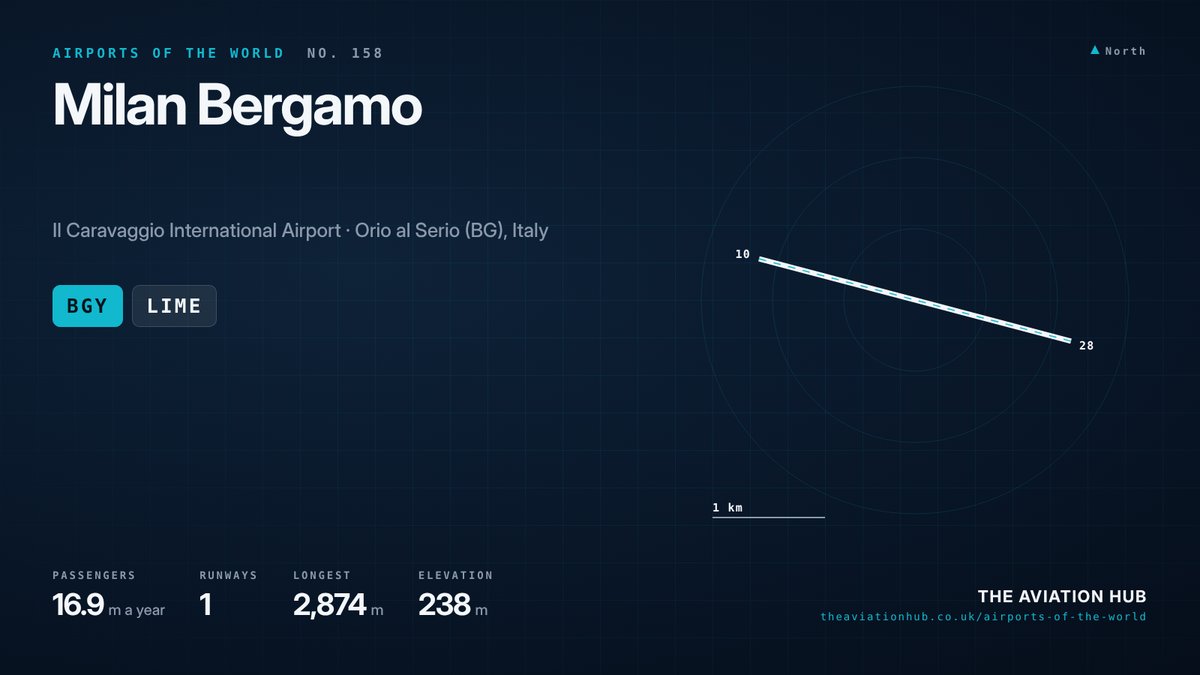
Milan Bergamo Airport, officially Il Caravaggio International Airport and known to generations of pilots as Orio al Serio, sits just 2.3 miles (3.7 km) south east of Bergamo and about 28 miles (45 km) north east of Milan. It is the third busiest airport in Italy and the low cost counterweight to Malpensa and Linate in the Milan system. More than 17 million passengers a year pass through a single runway and one terminal, the great majority of them on Ryanair, which runs one of its four largest bases here.
Milan Bergamo Airport at a Glance
The IATA code is BGY and the ICAO code is LIME. The airport lies in the commune of Orio al Serio in Lombardy, 2.3 miles (3.7 km) from Bergamo’s lower town and roughly 28 miles (45 km) from Milan’s Piazza del Duomo, at an elevation of 238 m (782 ft) at the foot of the Alpine foothills. There is one runway, 10/28, and one terminal split into zones A and B, with the Milan system as a whole handling around 57 million passengers in 2024.
Milan Bergamo Airport handled about 17.4 million passengers in 2024, up 8.6 per cent, with around 110,000 aircraft movements and 23,000 tonnes of cargo. Ryanair is the resident giant, joined by Wizz Air and a growing number of Italian and eastern European operators. SACBO, a company owned by local institutions and the Milan airport operator SEA, which holds 31 per cent, runs the field. Live flight and parking information is on the airport’s official website.
How Orio al Serio Became an Airport
The airfield began as a military base in the late 1930s and remained in Italian Air Force hands through the war and the decades after. SACBO was formed in 1970 to develop civil flying, and scheduled passenger services began in the early 1970s, mostly charters and a handful of domestic routes. For a long time it was a sleepy regional field overshadowed by Linate and the new Malpensa.
Two things changed its fortunes. Cargo operators discovered the uncongested runway and cheap land in the 1990s, with DHL building a hub that pushed freight above 140,000 tonnes a year by the mid 2000s. Then Ryanair arrived in 2002 and found an airport willing to grow with it. Passenger numbers rose from around 4.4 million in 2005 to 13.9 million in 2019, and the Caravaggio name was adopted in 2011 to honour the Baroque painter whose family came from the nearby town.
The pandemic cut traffic to 3.8 million in 2020, and DHL confirmed in early 2022 that it had moved its hub to Malpensa. Passenger growth made up the difference within two years. A Trade Air cargo flight crashed shortly after take off in poor weather in 2005, killing three, and in 2016 an ASL Airlines Hungary Boeing 737 freighter overran runway 28 and came to rest on a car park and a road, destroying cars but injuring nobody.
Runways at Milan Bergamo Airport
Milan Bergamo Airport has one asphalt runway, 10/28, which is 2,874 m (9,429 ft) long and 45 m wide. The length is comfortable for the Boeing 737-800, 737 MAX 8-200 and Airbus A321neo aircraft that dominate the schedule, and it handles the occasional Boeing 777 or Airbus A330 freighter and charter without trouble. The runway runs east to west along the edge of the Po plain, with the Bergamo hills rising immediately to the north.
Runway 28 is the usual landing direction, bringing arrivals in over the A4 motorway and the eastern suburbs, while departures off 10 climb out over farmland. The proximity of the hills restricts circling and missed approach procedures to the north. The lack of a second runway and a parallel taxiway for its full length means the airfield runs close to its practical limit at peak hours. In 2024 a Ryanair 737 MAX 8 burst four tyres on landing and damaged around 450 m of runway surface, closing the airport for several hours.
Terminals and Airlines
The single terminal has been extended repeatedly and is organised in two zones. Zone A has gates A1 to A15 and Zone B has gates B1 to B5, and only a few of them have boarding bridges. Everything else is a walk across the apron or a short bus ride, which suits the low cost model and the quick turnarounds it depends on. The non Schengen area was enlarged between 2019 and 2021, and work began in 2024 on an extension adding 22 check in desks.
Ryanair is overwhelming at Milan Bergamo Airport, carrying the large majority of passengers with a base of around 20 Boeing 737s. Wizz Air is the next biggest, with Airbus A321neo aircraft serving eastern Europe. Pegasus, AJet, Air Arabia, flydubai, Norwegian and a long list of smaller carriers fill the remainder, Aeroitalia and Neos add Italian capacity, and Volotea flies to Nantes and Asturias. None of the global alliances has a meaningful presence, which makes this one of the purest low cost airports in Europe. A VIP lounge provides the premium option.
Routes and Destinations
Ryanair’s network from Bergamo touches almost every corner of Europe, with London Stansted, Bucharest, Barcelona, Tirana and Istanbul the heaviest international routes in 2023. Domestic flights to Naples, Brindisi, Palermo, Bari, Catania, Cagliari and Lamezia Terme serve southern Italians living and working in Lombardy, and they are among the busiest in the schedule year round. Tirana, Bucharest, Chisinau, Warsaw and Krakow mark the eastern European market.
Long haul is modest. Air Arabia serves Sharjah, flydubai links Dubai and Pegasus connects Istanbul to Asia, and there are seasonal charters to Egypt and the Red Sea. The Sharjah and Dubai services, at around 2,900 miles (4,600 km), are the longest. Summer brings the island and beach rush, winter adds ski traffic through the Bergamo valleys. Cargo continues on a much smaller scale since DHL’s departure, with around 23,000 tonnes a year passing through the freight terminal.
Getting to and from Milan Bergamo Airport
There is no railway station yet. The nearest is Bergamo station, about 3.5 miles (5.6 km) away, connected by ATB bus line 1 in around 10 minutes, from where Trenord trains reach Milan Centrale in 50 to 60 minutes. A station at Milan Bergamo Airport is under construction, though RFI admitted in 2026 that the works had fallen behind schedule. It will end the airport’s long dependence on coaches.
Coaches are the standard way to Milan. Orioshuttle, Terravision, Autostradale and Flibco run every 20 to 30 minutes to Milan Centrale, taking about 50 minutes to an hour for 10 to 12 euros (£8.50 to £10), which remains the cheapest sensible option. Other coaches serve Brescia, Verona, Turin and Bologna. Drivers arrive from the A4 motorway, and a taxi to central Milan costs around 110 euros, so it rarely makes sense. Parking is plentiful, with cheaper long stay car parks a short shuttle ride away.
Spotting and Photography
The top floor of the multi storey car park west of the terminal, signposted for the car rental centre, covers runway 10 and most apron movements, with the Oriocenter shopping mall close by. Near the runway 28 threshold, free parking between factories off Via Tonale gives views of landings, take offs and taxiing traffic. A small park opposite a crash gate nearby is good for 28 arrivals, and passengers can shoot through the terminal windows between gates A2 and A9.
Light at the runway 28 spots is good from mid morning until late afternoon, though summer mornings and evenings bring backlight. The traffic is monotonous in type, with Ryanair 737s every few minutes, but the occasional freighter and the light aircraft of the Aero Club Bergamo add variety, and the Alps make a dramatic backdrop on clear days. Stay off the perimeter road and well away from the fence, respect the warnings about the runway ends and never block the crash gates.
What Comes Next
SACBO’s master plan concentrates on the terminal and ground access rather than the runway. The new railway station will connect the airport to Bergamo and Milan directly, and further terminal expansion is planned to keep pace with growth. Noise is the political constraint, with residents of Orio al Serio and the Bergamo suburbs pressing for curbs on night flights, and the single runway caps how far the schedule can grow at peak times.
Milan Bergamo Airport is heading for 20 million passengers with a railway at last and Ryanair still calling the shots. Compare it with Malpensa, Linate and the other Italian gateways on our Airports of the World map.
Continue to follow The Aviation Hub for more analysis and insight.
Advertise with us Your brand, in front of an aviation audience Home page and in-article placements, sold directly, one advertiser per slot. From £250 a year. See the rates

